
Domain-Driven Design in the Age of Microservices: Where Bounded Contexts End and Services Begin

Why DDD’s bounded context and a microservice are not the same thing, and how conflating the two leads to over-fragmented systems nobody can reason about.
“One bounded context, one microservice” is one of the most quoted heuristics in modern system design, and it’s quietly responsible for a fair share of the distributed monoliths teams now regret building. The heuristic isn’t wrong exactly — it’s just doing a lot more work than the sentence implies, collapsing two ideas from two different eras of software design into one rule of thumb that doesn’t always hold. Bounded contexts are a modeling concept. Microservices are a deployment concept. Treating them as interchangeable is where the fragmentation starts.
What a Bounded Context Actually Is
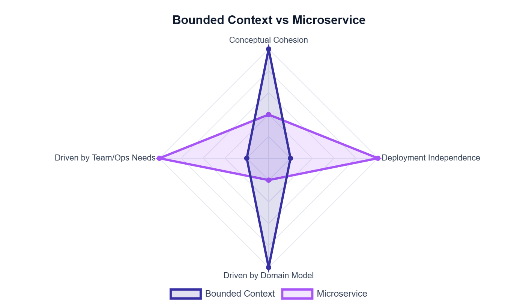
Eric Evans introduced the bounded context as a linguistic and conceptual boundary in Domain-Driven Design, years before microservices existed as a named architectural style. A bounded context is the boundary within which a specific domain model — its terms, its rules, its meaning — stays consistent. The word “Customer” can mean something different in the billing context than it does in the support context, and that’s not a naming collision to fix; it’s the entire point. A bounded context exists to protect a model’s internal consistency, not to describe how that model gets deployed, scaled, or run.
What a Microservice Actually Is
A microservice, by contrast, is a runtime and deployment boundary: an independently deployable unit that can be built, released, scaled, and operated on its own schedule, separate from every other service around it. Its defining properties are almost entirely operational — independent deployability, independent scaling, its own data store, its own failure domain. Nothing in that definition says anything about linguistic consistency or domain modeling; a microservice boundary is drawn for reasons of team autonomy, scaling needs, and technology fit, which are real concerns, but different concerns from the ones a bounded context was invented to solve.
Why the Two Get Conflated
The conflation has a specific origin: early microservices literature, including Sam Newman’s widely read guidance on using bounded contexts to size services, correctly pointed out that a bounded context is a good starting point for drawing service boundaries, since it already represents a coherent, low-coupling unit of the domain. That reasonable starting point calcified, in practice, into a rule: every bounded context must become exactly one service, and every service must correspond to exactly one bounded context. The nuance in “a good place to start looking” got lost somewhere on the way to “the rule.”
| Dimension | Bounded Context | Microservice |
|---|---|---|
| What it protects | Consistency of a domain model’s language and rules | Independent deployability and runtime isolation |
| Granularity driver | Where the domain model’s meaning actually changes | Team size, scaling needs, operational autonomy |
| Can span multiple of the other? | Yes — one context can be served by several services | Yes — one service can implement several small contexts |
| Primary cost of getting it wrong | A muddled, inconsistent domain model | Excessive network calls, distributed transactions, ops overhead |
Where Over-Fragmentation Comes From
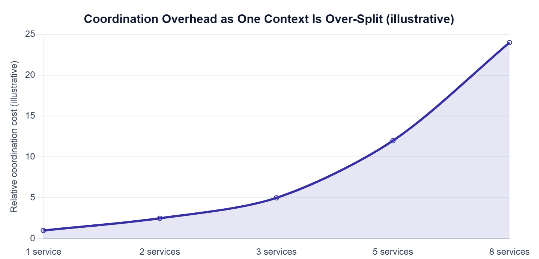
The damage shows up when a single, coherent bounded context — one consistent domain model — gets sliced into several microservices for reasons that have nothing to do with the model itself: a reorg, a trend, an assumption that “more services means more microservices maturity.” What was one consistent set of business rules now lives behind two or three network boundaries, and every operation that used to be a local, transactional method call becomes a distributed call with its own failure modes, its own eventual consistency story, and its own need for coordination that the original model never required.
This is the mechanism behind the “distributed monolith” complaint teams so often raise: the services are technically separate deployables, but they’re still tightly coupled at the model level, because splitting a bounded context doesn’t remove the coupling the model represents — it just moves that coupling from in-process calls to network calls, which are slower, less reliable, and far harder to reason about.
A Bounded Context Can Contain Multiple Services (or Vice Versa)
The healthier mental model treats the two boundaries as independent decisions that sometimes align and sometimes don’t. A single bounded context can legitimately be implemented as several services once scale or team size genuinely demands it — provided the split still respects the consistency boundary, typically by having exactly one of those services own the data that the model’s invariants depend on. Equally, several small, related bounded contexts can reasonably live inside one deployable service when none of them individually justifies the operational overhead of a separate deployment, separate on-call rotation, and separate data store.
Chris Richardson’s decomposition patterns make this same point from the opposite direction: decomposing by subdomain is a starting heuristic for finding service candidates, not a mechanical mapping that guarantees the right number of services on its own.
A Practical Checklist for Drawing the Line
Before splitting a bounded context into multiple services, ask:
- Does this split follow an actual seam in the domain model, or just an organizational or trend-driven preference?
- Which service will own the data whose consistency the model’s business rules actually depend on?
- Will this split replace fast, transactional in-process calls with slower, eventually consistent network calls — and is that trade-off actually justified by scale or team autonomy needs?
- Could a single deployable safely hold several small, related contexts today, with a clear path to splitting later if volume demands it?
- Are we drawing this boundary because the model requires it, or because “more microservices” has become a proxy for architectural maturity?
What We Learned
A bounded context and a microservice solve different problems — one protects the internal consistency of a domain model’s language and rules, the other defines an independently deployable and scalable runtime unit — and the popular shorthand that collapses them into a single rule is where a lot of unnecessary fragmentation actually originates. The two boundaries often do align well, which is exactly why the heuristic became popular in the first place, but treating that alignment as mandatory rather than common ignores the real cases where one context needs several services, or several small contexts comfortably share one. The question worth asking before any service split isn’t “which bounded context does this belong to,” but “does this specific boundary earn its network hop” — and the domain model, not the deployment topology, is what should answer that.