I’ve stumbled upon this very interesting question on Stack Overflow, recently. Its title is:
In this article, we’ll compare the user’s imperative approach to the extremely elegant (Oracle) SQL approach. We’ll be making use of any combination of these awesome SQL features:
- Window functions
- FIRST and LAST functions, using Oracle-specific syntax
LATERAL JOIN(orAPPLY- Recursive SQL
The problem
The user alhashmiya who had asked this question, was looking for a solution to the problem of finding the “closest” sum of elements in a subset of numbers A to a set of “expected” sums B. More concretely, alhasmiya had the following two tables:
ID  ASSIGN_AMT
--------------
1        25150
2        19800
3        27511
And…
ID  WORK_AMT
------------
1       7120
2       8150
3       8255
4       9051
5       1220
6      12515
7      13555
8       5221
9        812
10      6562
The ASSIGN_AMT value is the “expected” sum. What alhashmiya was looking for is the sum of a subset of WORK_AMT values A, such that this sum is as close as possible to any of the “expected” sums. There are two ways to understand this problem:
- The possible “closest” sums are restricted to be the sums obtained in a strictly defined order, e.g. ordered by
ID. An application of this understanding is to find out the exact moment when a well-defined, ordered running total (e.g. bank account balance) has exceeded a certain threshold - The possible “closest” sums are unrestricted. Any unordered subset qualifies to calculate such a sum. An application of this understanding is to find a combination of discrete values to reach a target value as closely as possible, e.g. to optimise a trade.
The second understanding is called the “subset sum problem”, for which there are only exponential algorithms if you’re looking for an exact solution. It is important to notice that this algorithm will NOT scale well at all, regardless of the solution technique!
But let’s look at the simpler understanding first:
1. Calculating a sum of an ordered subset of values
By strictly ordered we mean (in the sense of the question) that we want to order all WORK_AMT values, e.g. by ID, and allow only for sums that can appear in this particular order. I.e.
ID  WORK_AMT  SUBSET_SUM
------------------------
1       7120        7120 (= WORK_AMT)
2       8150       15270 (= previous SUBSET_SUM + WORK_AMT)
3       8255       23525 (= previous SUBSET_SUM + WORK_AMT)
4       9051       32576 (= ...)
5       1220       33796
6      12515       46311
7      13555       59866
8       5221       65087
9        812       65899
10      6562       72461
The above SUBSET_SUM value is the sum of all WORK_AMT values with ID <= "current" ID. We’ve seen this before on this blog, this is called a running total, and it is best calculated using window functions as follows:
WITH
    VALS (ID, WORK_AMT) AS (
                  SELECT 1 , 7120  FROM DUAL
        UNION ALL SELECT 2 , 8150  FROM DUAL
        UNION ALL SELECT 3 , 8255  FROM DUAL
        UNION ALL SELECT 4 , 9051  FROM DUAL
        UNION ALL SELECT 5 , 1220  FROM DUAL
        UNION ALL SELECT 6 , 12515 FROM DUAL
        UNION ALL SELECT 7 , 13555 FROM DUAL
        UNION ALL SELECT 8 , 5221  FROM DUAL
        UNION ALL SELECT 9 , 812   FROM DUAL
        UNION ALL SELECT 10, 6562  FROM DUAL
    )
SELECT
    ID,
    WORK_AMT,
    SUM (WORK_AMT) OVER (ORDER BY ID) AS SUBSET_SUM
FROM
    VALS
ORDER BY
    ID
The above window function calculates the sum of all WORK_AMT values that are in the “window” of values where the ID is smaller or equal to the current ID.
Finding the “closest” of these sums with quantified comparison predicates
Now, the task at hand is to find for each value ASSIGN_AMT in 25150, 19800, and 27511 the closest value of SUBSET_SUM. In a way, what we are trying to do is we want to minimise the expression ABS(SUBSET_SUM - ASSIGN_AMT).
However, the MIN() aggregate function won’t help us here, because that will simply return the minimum value of this difference. We want the value of SUBSET_SUM that produces this difference in the first place.
One solution would be to use a quantified comparison predicate, a rarely used and not well-known comparison operator that works in all SQL databases:
-- The common table expressions are the same as
-- in the previous examples
WITH
    ASSIGN(ID, ASSIGN_AMT) AS (
                  SELECT 1, 25150 FROM DUAL
        UNION ALL SELECT 2, 19800 FROM DUAL
        UNION ALL SELECT 3, 27511 FROM DUAL
    ),
    VALS (ID, WORK_AMT) AS (
                  SELECT 1 , 7120  FROM DUAL
        UNION ALL SELECT 2 , 8150  FROM DUAL
        UNION ALL SELECT 3 , 8255  FROM DUAL
        UNION ALL SELECT 4 , 9051  FROM DUAL
        UNION ALL SELECT 5 , 1220  FROM DUAL
        UNION ALL SELECT 6 , 12515 FROM DUAL
        UNION ALL SELECT 7 , 13555 FROM DUAL
        UNION ALL SELECT 8 , 5221  FROM DUAL
        UNION ALL SELECT 9 , 812   FROM DUAL
        UNION ALL SELECT 10, 6562  FROM DUAL
    ),
    SUMS (ID, WORK_AMT, SUBSET_SUM) AS (
        SELECT
            VALS.*,
            SUM (WORK_AMT) OVER (ORDER BY ID)
        FROM
            VALS
    )

-- This is now the interesting part, where we
-- calculate the closest sum
SELECT
    ASSIGN.ID,
    ASSIGN.ASSIGN_AMT,
    SUBSET_SUM
FROM
    ASSIGN
JOIN
    SUMS
ON
    ABS (ASSIGN_AMT - SUBSET_SUM) <= ALL (
        SELECT
            ABS (ASSIGN_AMT - SUBSET_SUM)
        FROM
            SUMS
)
The quantified comparison predicate reads intuitively. We’re looking for that specific SUBSET_SUM whose difference to the “expected” ASSIGN_AMT is smaller or equal to all the other possible differences.
The above query yields:
ID  ASSIGN_AMT  SUBSET_SUM
--------------------------
1        25150       23525
2        19800       23525
3        27511       23525
In this case, it’s always the same.
You may have noticed that the solution is not entirely correct in the event where ASSIGN_AMT is allowed to be zero (let’s ignore the possibility of negative values) – in case of which we’ll produce duplicate values in the JOIN. This can be achieved when replacing:
UNION ALL SELECT 4 , 0 FROM DUAL
Now, the result is:
ID  ASSIGN_AMT  SUBSET_SUM
--------------------------
1        25150       23525
2        19800       23525
2        19800       23525
3        27511       23525
One solution is to remove those duplicates using DISTINCT (which is an anti-pattern. See #6 in this list). A better solution is to make the JOIN predicate unambiguous by comparing ID values as well, i.e.:
SELECT
    ASSIGN.ID,
    ASSIGN.ASSIGN_AMT,
    SUBSET_SUM
FROM
    ASSIGN
JOIN
    SUMS
ON
    (ABS (ASSIGN_AMT - SUBSET_SUM), SUMS.ID) <= ALL (
        SELECT
            ABS (ASSIGN_AMT - SUBSET_SUM),
            ID
        FROM
            SUMS
)
The above unfortunately doesn’t work in Oracle (yet), which will report an error:
ORA-01796: this operator cannot be used with lists
Oracle supports comparing tuples / row value expressions only with equal comparators, not with less than / greater than comparators – which is a shame. The same query runs smoothlessly in PostgreSQL.
Finding the “closest” of these sums with Oracle’s FIRST function
Oracle has a very interesting function to keep the first (or last) values in a set of aggregate values of a group given any particular ordering, and calculating an aggregate function only on those values within the group. The following SQL statement will illustrate this:
SELECT
    ASSIGN.ID,
    ASSIGN.ASSIGN_AMT,
    MIN (SUBSET_SUM) KEEP (
        DENSE_RANK FIRST
        ORDER BY ABS (ASSIGN_AMT - SUBSET_SUM)
    ) AS CLOSEST_SUM
FROM
    ASSIGN
CROSS JOIN
    SUMS
GROUP BY
    ASSIGN.ID, ASSIGN.ASSIGN_AMT
Essentially, we’re grouping all values from the SUMS table for each ASSIGN_AMT. For each of those groups, we’ll look for the "FIRST" row that appears when ordering rows within the group by our criteria ABS(ASSIGN_AMT - SUBSET_SUM). We "KEEP" only those rows in the group, and retain from those rows the minimum SUBSET_SUM.
This query will again yield:
ID  ASSIGN_AMT  SUBSET_SUM
--------------------------
1        25150       23525
2        19800       23525
3        27511       23525
This is an extremely nice functionality that can come in handy every once in a while.
Remember that we’ve seen a similar feature recently on this blog, when we were looking for FIRST_VALUE (or LAST_VALUE) within the PARTITION of a window. In standard SQL, a similar thing can be achieved using window functions as such:
SELECT DISTINCT
    ASSIGN.ID,
    ASSIGN.ASSIGN_AMT,
    FIRST_VALUE (SUBSET_SUM) OVER (
        PARTITION BY ASSIGN.ID
        ORDER BY ABS (ASSIGN_AMT - SUBSET_SUM)
    ) AS CLOSEST_SUM
FROM
    ASSIGN
CROSS JOIN
    SUMS
Unfortunately, these solutions all produce duplicates, which we have to remove either via GROUP BY (KEEP solution), or via DISTINCT (FIRST_VALUE solution).
Finding the “closest” of these sums with LATERAL JOIN
A cleaner solution that doesn’t rely on the removal of duplicates is using Oracle 12c’s new FETCH FIRST clause along with CROSS JOIN LATERAL (or CROSS APPLY, which is the same)
SELECT
    ASSIGN.ID,
    ASSIGN.ASSIGN_AMT,
    CLOSEST_SUM
FROM
    ASSIGN
CROSS JOIN LATERAL (
    SELECT
        SUBSET_SUM AS CLOSEST_SUM
    FROM
        SUMS
    ORDER BY
        ABS (ASSIGN.ASSIGN_AMT - SUBSET_SUM)
    FETCH FIRST 1 ROW ONLY
) SUMS
What does this mean? We’re essentially joining for each value in ASSIGN only the FIRST 1 ROW in SUMS, ordered by the usual criteria. We need LATERAL (or APPLY), because this allows us to reference columns from the left side of the JOIN expression also in the right side, which wouldn’t be possible otherwise.
The same functionality is supported in SQL Server (only using CROSS APPLY), or in PostgreSQL (only using CROSS JOIN LATERAL).
Lateral can be very useful whenever the right hand side of a JOIN depends on the left hand side. Unlike ordinary joins, this means that the JOIN order will be set in stone from left to right, and the optimiser has a reduced set of join algorithm options. This is useful in examples like these (with ORDER BY and FETCH FIRST), or when joining unnested table-valued functions, which we’ll cover in a future blog post.
2. Calculating a sum of any subset of values
So far, we’ve worked on a simplified version of the problem. This is probably not what alhashmiya meant on their Stack Overflow question. They probably wanted to solve the Subset sum problem, finding the “closest” sum of any subset of WORK_AMT values.
We’ll use recursive SQL to calculate all the possible sums. First off, let’s remember how recursive SQL works:
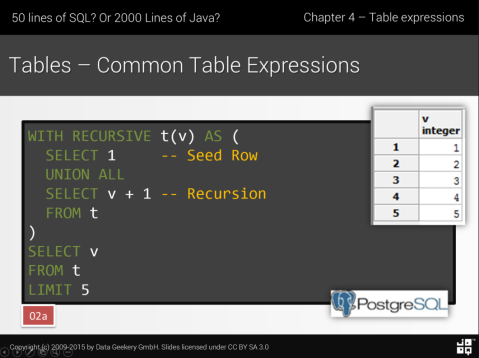
In recursive SQL, we need a UNION ALL query in a common table expression (WITH clause in Oracle, or WITH RECURSIVE clause in PostgreSQL). The first subquery of UNION ALL generates the “seed row(s)” of the recursion, and the second subqeury of UNION ALL generates the recursion based on a SELECT that selects from the table being declared, recursively.
So, a naive solution to this subset sum problem can be seen here:
-- Repetition of the previous data
WITH
    ASSIGN (ID, ASSIGN_AMT) AS (
                  SELECT 1, 25150 FROM DUAL
        UNION ALL SELECT 2, 19800 FROM DUAL
        UNION ALL SELECT 3, 27511 FROM DUAL
    ),
    WORK (ID, WORK_AMT) AS (
                  SELECT 1 , 7120  FROM DUAL
        UNION ALL SELECT 2 , 8150  FROM DUAL
        UNION ALL SELECT 3 , 8255  FROM DUAL
        UNION ALL SELECT 4 , 9051  FROM DUAL
        UNION ALL SELECT 5 , 1220  FROM DUAL
        UNION ALL SELECT 6 , 12515 FROM DUAL
        UNION ALL SELECT 7 , 13555 FROM DUAL
        UNION ALL SELECT 8 , 5221  FROM DUAL
        UNION ALL SELECT 9 , 812   FROM DUAL
        UNION ALL SELECT 10, 6562  FROM DUAL
    ),

-- A new way of calculating all possible sums by
-- Recursively adding up all the sums
    SUMS (SUBSET_SUM, MAX_ID) AS (
        SELECT
            WORK_AMT,
            ID
        FROM
            WORK

        UNION ALL

        SELECT
            WORK_AMT + SUBSET_SUM,
            GREATEST (MAX_ID, WORK.ID)
        FROM
            SUMS
        JOIN
            WORK
        ON
            SUMS.MAX_ID < WORK.ID
    )

-- The same technique to match the "closest" sum
-- As before
SELECT
    ASSIGN.ID,
    ASSIGN.ASSIGN_AMT,
    MIN (SUBSET_SUM) KEEP (
        DENSE_RANK FIRST
        ORDER BY ABS (ASSIGN_AMT - SUBSET_SUM)
    ) AS CLOSEST_SUM
FROM
    SUMS
CROSS JOIN
    ASSIGN
GROUP BY
    ASSIGN.ID, ASSIGN.ASSIGN_AMT
The recursion is simple. In the first subquery of the recursion (the “seed row”), we select each individual row in WORK:
SELECT
            WORK_AMT,
            ID
        FROM
            WORK
In the second subquery of the recursion (the “recusion rows”), we join the value of the previous recursion step (SUMS) with all the remaining values (WORK), i.e. all the values that have a higher ID:
SELECT
            WORK_AMT + SUBSET_SUM,
            GREATEST (MAX_ID, WORK.ID)
        FROM
            SUMS
        JOIN
            WORK
        ON
            SUMS.MAX_ID < WORK.ID
In this combination, we calculate the intermediate sum (which is also a running total, by the way) and we calculate the highest summed-up ID thus far, to reduce the number of combinations. The latter, we can do because summing is commutative.
The main difference in this solution compared to previous approaches is the fact that we’re now generating a lot (a huge lot) more different values in the SUMS table.
After a still acceptable 0.112s for 10 different WORK_AMT values, the database calculated:
ID  ASSIGN_AMT  CLOSEST_SUM
---------------------------
1        25150        25133
2        19800        19768
3        27511        27488
But beware, as soon as you start adding values to the VALS table, this algorithm starts exploding in time and space complexity. Running the same query with the following, only slightyl bigger WORK table already requires 16.3 seconds to yield a result:
WORK(ID, WORK_AMT) AS (
                  SELECT 1 , 7120  FROM DUAL
        UNION ALL SELECT 2 , 8150  FROM DUAL
        UNION ALL SELECT 3 , 8255  FROM DUAL
        UNION ALL SELECT 4 , 9051  FROM DUAL
        UNION ALL SELECT 5 , 1220  FROM DUAL
        UNION ALL SELECT 6 , 12515 FROM DUAL
        UNION ALL SELECT 7 , 13555 FROM DUAL
        UNION ALL SELECT 8 , 5221  FROM DUAL
        UNION ALL SELECT 9 , 812   FROM DUAL
        UNION ALL SELECT 10, 6562  FROM DUAL
        UNION ALL SELECT 11, 1234  FROM DUAL
        UNION ALL SELECT 12, 61    FROM DUAL
        UNION ALL SELECT 13, 616   FROM DUAL
        UNION ALL SELECT 14, 2456  FROM DUAL
        UNION ALL SELECT 15, 5161  FROM DUAL
        UNION ALL SELECT 16, 414   FROM DUAL
        UNION ALL SELECT 17, 516   FROM DUAL
        UNION ALL SELECT 18, 617   FROM DUAL
        UNION ALL SELECT 19, 146   FROM DUAL
    ),
And the result would be:
ID  ASSIGN_AMT  CLOSEST_SUM
---------------------------
1        25150        25150
2        19800        19800
3        27511        27511
Want proof about the actual sum? That’s easy as well with recursive SQL:
-- Repetition of the previous data
WITH
    ASSIGN (ID, ASSIGN_AMT) AS (
                  SELECT 1, 25150 FROM DUAL
        UNION ALL SELECT 2, 19800 FROM DUAL
        UNION ALL SELECT 3, 27511 FROM DUAL
    ),
    WORK (ID, WORK_AMT) AS (
                  SELECT 1 , 7120  FROM DUAL
        UNION ALL SELECT 2 , 8150  FROM DUAL
        UNION ALL SELECT 3 , 8255  FROM DUAL
        UNION ALL SELECT 4 , 9051  FROM DUAL
        UNION ALL SELECT 5 , 1220  FROM DUAL
        UNION ALL SELECT 6 , 12515 FROM DUAL
        UNION ALL SELECT 7 , 13555 FROM DUAL
        UNION ALL SELECT 8 , 5221  FROM DUAL
        UNION ALL SELECT 9 , 812   FROM DUAL
        UNION ALL SELECT 10, 6562  FROM DUAL
    ),

-- A new way of calculating all possible sums by
-- Recursively adding up all the sums
    SUMS (SUBSET_SUM, MAX_ID, CALC) AS (
        SELECT
            WORK_AMT,
            ID,
            TO_CHAR(WORK_AMT)
        FROM WORK

        UNION ALL

        SELECT
            WORK_AMT + SUBSET_SUM,
            GREATEST (MAX_ID, WORK.ID),
            CALC || '+' || WORK_AMT
        FROM
            SUMS
        JOIN
            WORK
        ON
            SUMS.MAX_ID < WORK.ID
    )

-- The same technique to match the "closest" sum
-- As before
SELECT
    ASSIGN.ID,
    ASSIGN.ASSIGN_AMT,
    MIN (SUBSET_SUM) KEEP (
        DENSE_RANK FIRST
        ORDER BY ABS (ASSIGN_AMT - SUBSET_SUM)
    ) AS CLOSEST_SUM,
    MIN (CALC) KEEP (
        DENSE_RANK FIRST
        ORDER BY ABS (ASSIGN_AMT - SUBSET_SUM)
    ) AS CALCULATION
FROM
    SUMS
CROSS JOIN
    ASSIGN
GROUP BY
    ASSIGN.ID, ASSIGN.ASSIGN_AMT
The above now yields:
ID  ASSIGN_AMT  CLOSEST_SUM  CALCULATION
------------------------------------------------------------
1        25150        25150  7120 + 8150 + 9051 + 812
2        19800        19800  1220 + 12515 + 5221 + 812
3        27511        27511  8150 + 8255 + 9051 + 1220 + 812
Conclusion
SQL is powerful. Extremely powerful. In this article, we’ve used various techniques to calculate the subset sum problem, or a simplification thereof. We’ve shown how to solve this problem in Oracle or PostgreSQL using a combination of these awesome SQL features:
- Window functions
KEEP FIRST(in Oracle only)LATERAL JOIN(orAPPLY- Recursive SQL
| Reference: | How to Find the Closest Subset Sum with SQL from our JCG partner Lukas Eder at the JAVA, SQL, AND JOOQ blog. |