In the world of distributed systems, the concept of “time” is notoriously fragile. You might assume that a server in London and one in New York can simply look at their internal quartz-based clocks to determine which event happened first. However, due to clock drift and unpredictable network latency, relying on wall clocks is a recipe for disaster.
When we cannot rely on a shared global clock, how do we determine the true order of events? The answer lies in causality—the “happened-before” relationship. By shifting our focus from when something happened to what caused it, we can achieve causal consistency, a standard that keeps distributed applications intuitive and reliable.
The “Happened-Before” Relationship
Before diving into the tools, we must understand the fundamental logic. Leslie Lamport, a pioneer in the field, argued that what truly matters is the causal order. An event $a$ is said to have “happened-before” event $b$ if:
- Program Order: Both events happen on the same node, and $a$ occurs sequentially before $b$.
- Message Order: $a$ is the sending of a message, and $b$ is the receipt of that same message.
- Transitivity: If $a \to b$ and $b \to c$, then $a \to c$.
If none of these conditions are met, the events are considered concurrent—meaning they happened independently, and their order does not strictly matter to the system’s logic.
Vector Clocks: The Logical Timekeeper
A Vector Clock is a data structure used to track these causal relationships by assigning a specific counter to every node in a distributed cluster.
Instead of a single, fragile timestamp, each node maintains an array (or vector) where the index corresponds to a specific node.
How They Work
- Initialization: Every node starts with a vector of zeros:
[0, 0, 0]. - Local Action: When a node performs a write or local action, it increments its own position in the vector.
- Sending Messages: The node attaches its current version of the vector to the outbound message.
- Receiving Messages: The recipient merges the incoming vector with its own by taking the maximum of each element, then increments its own index.
Logical Clock Progression
This Python snippet illustrates the core merge logic used when two nodes synchronize:
Visualizing Distributed Progress
We can observe how “logical time” evolves as nodes interact. The first graph shows how a single node’s internal state increments, while the second compares two nodes diverging and then merging state.
Figure 1: Single Node Logical Progress
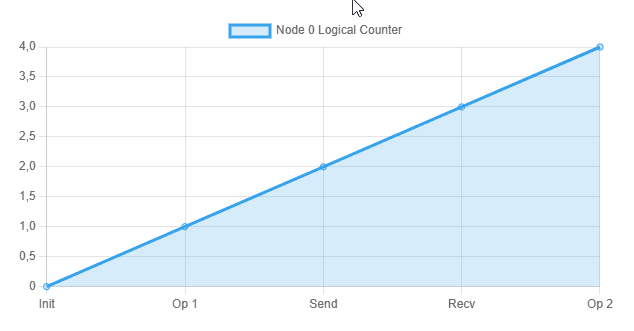
As seen in Figure 1, the counter increases steadily with every local action. However, in a distributed environment, nodes often work on different tasks simultaneously, leading to divergence. When nodes communicate, they must reconcile these differences.
Figure 2: State Merge (Max-Value Logic)
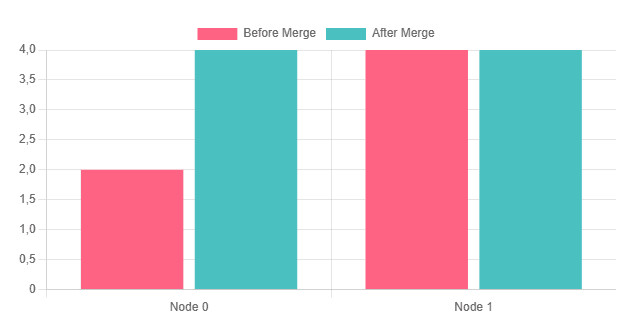
As illustrated in Figure 2, the “max-value” logic ensures that the system always adopts the most recent version of the data, effectively resolving the divergence and maintaining a consistent causal history across the network.
Why Causal Consistency Matters
| Benefit | Why it matters |
| Intuitive User Experience | Replies are never shown before comments; order remains logical. |
| High Availability | Unlike strong consistency, nodes don’t need to block for a global consensus. |
| Conflict Detection | Clearly identifies concurrent writes, facilitating easier conflict resolution. |
Causal consistency acts as the “sweet spot” for many modern distributed databases, such as Cassandra or Riak, ensuring that while the system remains fast and resilient to network partitions, the user never sees an “impossible” history of events.
What We Have Learned
We have explored how distributed systems bypass the inherent flaws of physical time by using Vector Clocks to track causality. By maintaining a simple array of counters, nodes can determine the sequence of events without a central coordinator. This architectural pattern allows systems to remain highly available while presenting a logically coherent view of the world to the user. From resolving conflicts to maintaining causal integrity in high-traffic apps, mastering “happened-before” is essential for building resilient, modern software.