
The Economics of Technical Debt: How to Reason About It Strategically Rather Than Emotionally

Framing technical debt as a financial instrument — interest rate, principal, and amortization — and how that lens changes prioritization conversations with non-engineering stakeholders.
“We really need to fix this” is one of the least persuasive sentences in software engineering, at least to anyone outside engineering. It signals urgency without explaining cost, and it competes poorly against a stakeholder’s roadmap that’s measured entirely in dollars and dates. Ward Cunningham’s original technical debt metaphor was actually trying to solve exactly this translation problem back in 1992, and it’s worth taking the metaphor more literally than most teams do. Debt isn’t just a mood. It’s principal, interest, and a choice about amortization, and reasoning about it that way turns a values-based argument into a numbers-based one.
The Financial Metaphor, Taken Seriously
A financial loan has three components that map cleanly onto a shortcut taken in code. The principal is the size of the shortcut itself — the corners actually cut to ship faster. The interest rate is how much extra effort that shortcut costs every single time someone has to work near it afterward. And amortization is the deliberate schedule by which the debt gets paid down, as opposed to letting it compound silently until a crisis forces an expensive, unplanned repayment all at once.
Martin Fowler’s technical debt quadrant adds a useful refinement here: not all debt is taken on the same way. Some is deliberate and reasonable — a known shortcut taken consciously to hit a real deadline. Some is reckless and avoidable. The financial lens works for both, but the conversation with stakeholders changes depending on which kind you’re describing.
Principal: What You Actually Borrowed
Principal is the easiest part of the metaphor to explain, because it maps directly onto a familiar idea: the size of the corner cut. Skipping a proper caching layer in favor of a quick in-memory workaround, hardcoding a configuration value instead of building a settings system, or duplicating logic across three services instead of extracting a shared library are all principal — a concrete, describable shortcut with a real scope. Stakeholders generally don’t struggle with this part. What they struggle with is the next part.
Interest Rate: Why Some Debt Is Cheap and Some Is Ruinous
The interest rate is the part of the metaphor that actually does the persuasive work, because it’s what determines whether a piece of debt is safe to ignore or urgent to address. A shortcut taken in a module nobody touches again carries a near-zero interest rate — the principal sits there, technically imperfect, costing almost nothing in practice. A shortcut taken in a module every new feature has to pass through carries a punishing interest rate, since every future change pays an extra tax in the form of slower development, more careful testing, and higher regression risk.
| Debt characteristic | Effective interest rate | Example |
|---|---|---|
| Isolated, rarely modified code | Low | A quick script used once for a one-time data migration |
| Shared library used by many teams | High | A core authentication module with an outdated, brittle interface |
| Code on the critical path of every deploy | Very high | A fragile build script every release depends on |
| Deprecated code scheduled for removal | Effectively zero | A feature flag path being phased out next quarter |
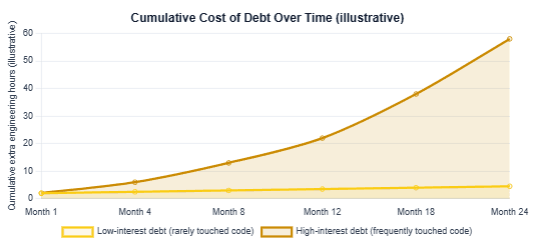
This is precisely why “just fix all the technical debt” is bad prioritization advice: it treats every dollar of principal as if it carried the same interest rate, when in reality a small amount of high-interest debt in a frequently touched module can cost more over a year than a much larger amount of low-interest debt sitting untouched in a legacy corner of the codebase.
Amortization: Paying It Down Deliberately vs. Emergency Refinancing
Amortization is the schedule by which debt gets repaid, and teams generally have two real options. Planned amortization means allocating a consistent, modest amount of engineering time every sprint to pay down principal on the highest-interest debt first — the software equivalent of a fixed monthly loan payment. The alternative is what amounts to emergency refinancing: ignoring the debt until it causes an outage, a missed deadline, or a security incident, at which point the team pays it down anyway, but under duress, at a much higher effective cost due to the incident response, the context-switching, and the reputational damage layered on top.
Framed this way, the question stops being “should we ever pay down technical debt” and becomes “are we paying a fixed, predictable installment, or are we one bad month away from a forced balloon payment.”
Talking to Non-Engineering Stakeholders Using This Lens
The real value of this framing shows up in the room where prioritization decisions actually get made. “This code is messy” competes poorly against a revenue-generating feature request. “This module has a high interest rate — every feature that touches it takes 30% longer to ship safely, and we’re touching it in four of our next six roadmap items” competes on the same terms stakeholders already use to evaluate everything else on their plate: cost, frequency, and risk.
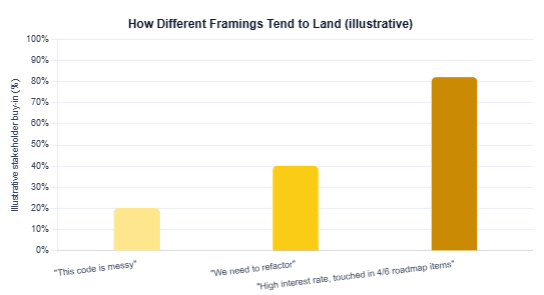
This reframing also naturally surfaces the right question for any debt conversation: not “is this debt bad,” but “what’s the interest rate, and is it high enough on code we touch often enough to justify a deliberate repayment plan this quarter.”
A Practical Checklist for Framing Debt Financially
Before raising a technical debt item with stakeholders, work out:
- What’s the actual principal — the specific shortcut, described concretely, not just “this is old”?
- What’s the effective interest rate — how often is this code touched, and how much slower or riskier does each change become because of the debt?
- What did the last three changes near this code actually cost in extra time, if you can find that data in tickets or PR history?
- Is planned, incremental repayment realistic, or is this already trending toward a forced, expensive rewrite?
- Can this be expressed as a rate — “X% slower,” “Y extra hours per change” — rather than a feeling?
What We Learned
Technical debt stops being a source of friction with stakeholders the moment it’s described the way a loan actually works: a principal that was borrowed on purpose or by accident, an interest rate that depends entirely on how often the affected code gets touched, and a choice between steady, planned amortization or an eventual forced repayment under much worse terms. The debt itself isn’t the problem stakeholders resist — it’s the vague, emotional framing that gives them nothing to compare against the rest of their roadmap. Once technical debt is quantified as a rate rather than a feeling, it competes on the same terms as every other item already fighting for a place on that roadmap.