Zero-Trust Architecture for Backend Engineers: What It Actually Means Beyond the Marketing

A few years ago, securing a backend system was relatively straightforward. Applications lived inside a corporate network, databases sat behind a firewall, and VPN access was often considered sufficient protection.
Today, that assumption feels almost outdated.
Modern Java applications run across cloud platforms, Kubernetes clusters, managed databases, CI/CD pipelines, SaaS integrations, and distributed teams. Consequently, the idea of a trusted internal network has slowly disappeared. This reality is exactly why the concept of Zero-Trust Architecture (ZTA) has become so important.
The problem is that Zero Trust is often presented as a product category rather than what it actually is: a security philosophy.
According to the official NIST SP 800-207 Zero Trust Architecture guidance, trust should never be granted merely because a request originates from a particular network location. Instead, every user, device, service, and workload must continuously prove its identity and authorization before being allowed access to a resource.
For backend engineers, this creates a significant shift in thinking. Security is no longer about protecting a network perimeter. It is about protecting resources through identity, policy, and verification.
The Day the Network Boundary Stopped Mattering
Imagine a Java microservices environment.
A customer places an order through a web application. The request flows through an API gateway, reaches an Order Service, calls a Payment Service, updates Inventory, and finally triggers a notification.
Ten years ago, many organizations would have considered those services trustworthy simply because they operated on the same internal network.
However, what happens when:
- A Kubernetes pod is compromised?
- A service account is leaked?
- A developer’s credentials are stolen?
- A third-party integration is abused?
Once an attacker gets inside, the phrase “it’s internal traffic” suddenly loses its meaning.
This is precisely why NIST’s Zero Trust guidance moves security away from network-centric thinking and toward resource-centric protection. The question is no longer:
Is this request inside my network?
The question becomes:
Can this identity prove it should access this resource right now?
Security Priorities Have Fundamentally Changed
The easiest way to understand Zero Trust is to visualize the shift.
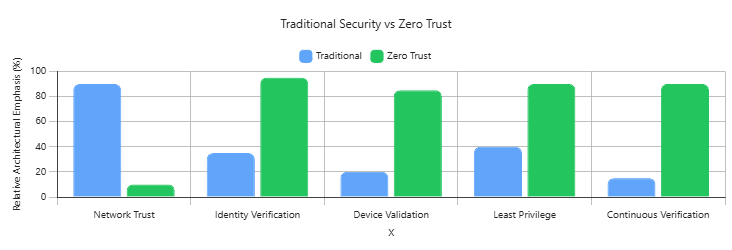
What’s interesting is not the exact numbers. Instead, the graph highlights a broader trend: Traditional security assumes trust and verifies selectively. Zero Trust assumes no trust and verifies continuously. That difference sounds small on paper, yet it completely changes how modern backend systems should be designed.
Identity Becomes the New Perimeter
One of the most important lessons for backend engineers is that identity has effectively become the new perimeter.
Think about all the entities operating inside a modern platform:
- Users
- APIs
- Containers
- Backend services
- CI/CD pipelines
- Databases
- Scheduled jobs
Each of these should possess its own verifiable identity.
For example, when a Java Spring Boot service requests customer information from another microservice, that request should not be trusted simply because it originates from the cluster network.
Instead, the receiving service should know exactly:
- Who is calling
- What permissions exist
- Which policies apply
- Whether access should be granted
This identity-first model aligns closely with both the NIST Zero Trust Architecture framework and the CISA Zero Trust Maturity Model.
If your organization already uses technologies such as:
- OAuth 2.0
- OpenID Connect (OIDC)
- Keycloak
- Okta
- Microsoft Entra ID
then you are already moving in the right direction.
You can learn more from the official NIST Zero Trust Architecture guidance and the CISA Zero Trust Maturity Model.
Mutual TLS: Trusting Services, Not Networks
One of the most practical Zero Trust technologies for backend teams is Mutual TLS (mTLS).
Most engineers understand TLS. When users visit a website, the browser validates the server certificate. mTLS goes one step further. Instead of only the client verifying the server, both sides verify each other.
Consider a Java-based architecture containing:
- Payment Service
- Orders Service
- Inventory Service
Without mTLS, an attacker who gains internal network access may attempt to impersonate a service.
With mTLS in place, every service must present a valid certificate before communication is allowed. The result is simple: The network itself no longer grants trust. Identity does.
This is one of the clearest real-world examples of Zero Trust principles being applied to modern backend systems.
Least Privilege Is Where Real Security Happens
Many security discussions focus heavily on authentication. Authentication matters. However, authentication alone is not enough. A perfectly authenticated service with excessive permissions is still dangerous. Imagine a Customer Service application that only needs to read profile information.
Should it also have:
- Access to payment data?
- Administrative database rights?
- Permission to modify user roles?
Of course not. Yet this exact situation exists in many production environments. Zero Trust promotes a principle known as least privilege, where identities receive only the permissions required to perform their job and nothing more. NIST explicitly emphasizes limiting access and enforcing authorization decisions at the resource level.
A useful example is a banking application. A transaction reporting service might need:
- Read access to transaction records.
- Read access to customer IDs.
It probably does not need:
- Account management permissions.
- User administration rights.
- Database modification privileges.
Restricting access in this way dramatically reduces the impact of a breach.
The Hidden Benefit: Smaller Blast Radius
When discussing least privilege, I often hear developers ask:
“What’s the actual benefit?”
The answer is simple: containment. If an attacker compromises a low-privilege identity, the damage remains limited.
The graph below illustrates the concept.
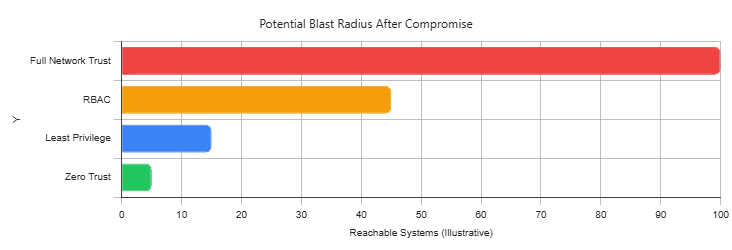
The important takeaway is not the exact values. Rather, it is the direction. As permissions become more targeted, the attacker’s potential reach shrinks significantly.
Zero Trust Is Continuous, Not One-Time
Another misconception is that Zero Trust simply means adding Multi-Factor Authentication.
MFA helps, but Zero Trust goes much further.
Traditional security often treated authentication as a one-time event:
- User logs in.
- User is trusted.
- Session continues.
Zero Trust assumes trust can change at any moment.
For example:
- Credentials may be stolen.
- Devices may become unhealthy.
- Certificates may expire.
- Access behavior may become suspicious.
As a result, security decisions should be continuously evaluated using context and policy. This concept appears throughout both NIST and CISA guidance.
For backend engineers, this often translates into short-lived tokens, automated certificate rotation, centralized auditing, and policy-based authorization rather than static permissions.
Where Organizations Usually Invest First
Organizations rarely implement Zero Trust all at once.
Instead, they focus on specific areas first.

The underlying pillars come directly from CISA’s guidance:
| Pillar | Purpose |
|---|---|
| Identity | Verify who is requesting access |
| Devices | Validate endpoint trustworthiness |
| Networks | Secure communications |
| Applications | Enforce application policies |
| Data | Protect sensitive information |
For Java engineers, identity and applications are often the most visible pillars because they directly influence authentication, authorization, APIs, and service communication.
Final Thoughts
The biggest mistake people make is thinking Zero Trust is a product they can purchase.
It isn’t. Zero Trust is a shift in mindset.
The most successful implementations don’t begin with expensive tools. They begin by questioning long-held assumptions:
- Why do we trust this service?
- Why does this account have so much access?
- Why are we granting permissions based on network location?
Once those questions become part of everyday engineering decisions, Zero Trust stops being a security buzzword and starts becoming architecture.
For backend engineers, that may be the most important lesson of all: in modern distributed systems, trusted networks are temporary, but verified identities can be continuously validated.
What We Have Learned
We explored why traditional network boundaries no longer provide meaningful security in cloud-native environments and how Zero Trust replaces location-based trust with identity-based verification. We examined the role of mutual TLS in service-to-service authentication, saw why least-privilege access dramatically reduces attack impact, and discussed the importance of continuous verification. Finally, we looked at the major investment areas within Zero Trust programs and what they mean for modern Java backend teams building distributed applications.
Sources
- NIST SP 800-207: Zero Trust Architecture https://csrc.nist.gov/pubs/sp/800/207/final
- CISA Zero Trust Maturity Model https://www.cisa.gov/zero-trust-maturity-model [paloaltonetworks.com], [csrc.nist.rip]
- Microsoft Learn – Zero Trust Guidance https://learn.microsoft.com/security/zero-trust