
Event-Driven vs. Request-Driven Architecture: How to Choose and When the Boundary Blurs

A decision-making framework for teams standing at the architectural fork between REST APIs and event streams.
Almost every architecture discussion eventually arrives at the same fork: should this service call that service directly, or should it publish an event and let something else react later? The two answers feel philosophically opposed — one is a conversation, the other is a broadcast — and teams often treat the choice as permanent and binary. In practice, the most resilient systems rarely commit fully to either side. They pick deliberately, service by service, and the boundary between the two models turns out to be far blurrier than the diagrams suggest.
Two Fundamentally Different Communication Models
Request-Driven (Synchronous)
A request-driven call is a direct question that expects a direct answer: a client sends a request, blocks or waits, and gets a response before moving on. REST, gRPC, and GraphQL all live here. The appeal is straightforward reasoning — the caller knows immediately whether the operation succeeded, and the flow of control is easy to trace by simply reading the code from top to bottom.
Event-Driven (Asynchronous)
An event-driven interaction inverts that relationship. A service publishes a fact — “order placed,” “payment captured” — without knowing or caring who, if anyone, is listening. Consumers react whenever they’re ready, on their own schedule. Platforms like Apache Kafka and cloud-native equivalents like AWS EventBridge exist specifically to make that decoupling durable and scalable.
The Real Trade-offs Behind the Buzzwords
Both models solve the same underlying problem — getting information from one part of a system to another — but they optimize for different failure modes and different mental models of time.
| Dimension | Request-Driven | Event-Driven |
|---|---|---|
| Coupling | Tight; caller must know the callee’s address and contract | Loose; producer doesn’t know who consumes the event |
| Failure isolation | A downstream outage blocks the caller immediately | Downstream outage delays processing but doesn’t block the producer |
| Latency expectation | Immediate response, typically milliseconds | Eventual; consumers process on their own timeline |
| Debugging a single flow | Straightforward call stack to trace | Requires distributed tracing across producers and consumers |
| Consistency model | Naturally supports strong consistency | Naturally eventual, unless deliberately compensated for |
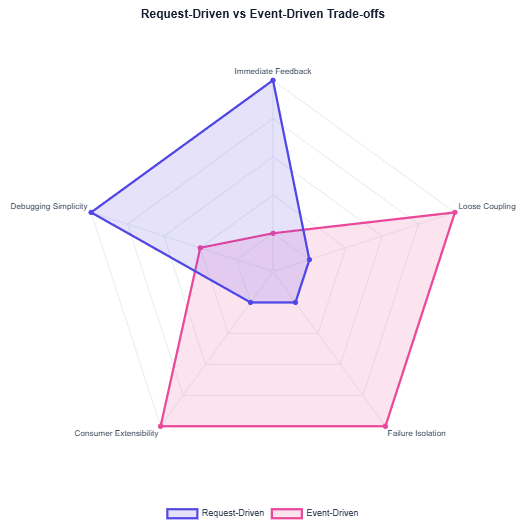
Neither column is objectively better, and that’s exactly the point most “microservices best practices” listicles gloss over. A payment authorization almost certainly wants the immediate certainty of a request-response call. A shipping notification, a recommendation-engine update, or an analytics pipeline almost certainly doesn’t need to block anything while it happens.
Where the Boundary Blurs: Hybrid Patterns in Practice
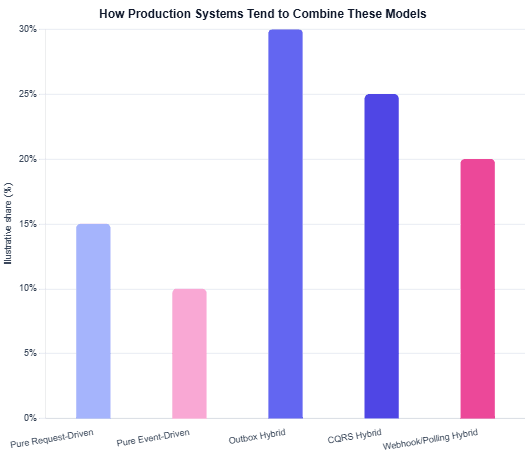
The cleanest architecture diagrams show a clear line between “the REST layer” and “the event layer.” Production systems rarely stay that tidy, and three patterns explain why.
The Outbox Pattern: A Request That Quietly Becomes an Event
A service might expose a perfectly ordinary synchronous REST endpoint for placing an order, while internally writing that order and a corresponding event to the same database transaction — the transactional outbox pattern. A separate process then reliably publishes the event afterward. From the caller’s perspective, it’s a request-driven interaction. Underneath, it’s already feeding an event-driven pipeline.
CQRS: An Event-Sourced Core with a Synchronous Front Door
Command Query Responsibility Segregation often pairs an event-driven write path with a request-driven read path. Writes are appended as events and processed asynchronously, while reads are served from a synchronously queried, denormalized projection. The two models coexist inside a single bounded context, each doing the job it’s actually good at.
Webhooks and Polling: Async Dressed Up as Sync
Public APIs frequently fake synchronicity over an inherently asynchronous process. A payment provider might return an immediate “pending” response, then deliver the real outcome later via a webhook — which is, underneath the HTTP framing, an event. Long-polling and Server-Sent Events blur the same line from the other direction, keeping a request open while waiting for something event-driven to happen.
A Practical Decision Framework
Instead of asking “should we be event-driven or request-driven,” a more useful question is which model fits each specific interaction. A short set of signals tends to point clearly in one direction.
| Signal | Leans toward |
|---|---|
| Caller needs an immediate success/failure answer | Request-driven |
| Multiple unrelated services need to react to the same fact | Event-driven |
| Strong consistency is a hard business requirement | Request-driven |
| Producer and consumer scale independently or fail independently | Event-driven |
| The interaction is a simple, well-known two-party contract | Request-driven |
| New consumers should be addable without changing the producer | Event-driven |
Before defaulting to one model system-wide, ask:
- Does this specific interaction need an answer right now, or just needs to eventually happen?
- How many consumers exist today, and how many are likely to exist in a year?
- What’s the actual cost of eventual consistency here — seconds of staleness, or a real business risk?
- Can we debug this flow in production with the tracing tools we already have?
- Are we choosing event-driven because it fits, or because it’s currently fashionable?
What We Learned
Request-driven and event-driven architectures aren’t really competing philosophies — they’re two tools that trade immediate certainty for loose coupling, or vice versa, depending on what a specific interaction actually needs. The trade-offs are real and worth respecting: tight coupling and blocking failure on one side, eventual consistency and harder debugging on the other. But the sharp line between them tends to dissolve once you look closely at production systems, where patterns like the transactional outbox, CQRS, and webhook-based APIs deliberately blend both models within a single service. The healthiest architecture decision usually isn’t picking a side once — it’s asking the question separately for every interaction that crosses a service boundary.