After nearly three decades, Python’s most notorious bottleneck is finally optional. Here is what really changes — and what does not.
For most developers, the words “Python threads” bring back a memory of frustration: you spun up four threads, watched the CPU spike on exactly one core, and quietly swapped to multiprocessing. The culprit was always the same — the Global Interpreter Lock. Well, as of Python 3.13, that lock is officially optional.
This is not a minor tweak hidden somewhere in the changelog. It is, in the words of the PEP 703 authors, “a fundamental reimagining of how Python handles concurrency.” At the same time, it comes with real trade-offs that are worth understanding before you rush to flip the switch in production. So let us walk through what actually changed, what the benchmarks say, and — perhaps most importantly — who should actually care right now.
First, a Quick Refresher on the GIL
The Global Interpreter Lock (GIL) is a mutex — a mutual exclusion lock — that lives deep inside CPython, the standard Python interpreter. Its job is straightforward: it ensures that only one thread can execute Python bytecode at any given moment. Even if you create ten threads on a ten-core machine, the GIL serialises them into a single lane of execution.
This design was intentional. It dramatically simplified CPython’s memory management and made writing C extensions far easier, since authors could assume thread safety for free. For I/O-bound work — waiting on network responses, reading files, hitting a database — the GIL is actually released during the wait, so threads cooperate reasonably well. The problem surfaces the moment your code does real computation: image processing, JSON parsing at scale, numerical transforms, machine learning pipelines. That is where the GIL becomes a hard ceiling.
For years, the standard answer to CPU-bound parallelism in Python was
multiprocessing— spinning up separate processes, each with their own GIL. It works, but at the cost of high memory usage, complex inter-process communication, and the overhead of serialising data across process boundaries. Free-threading removes that tax entirely.
What Python 3.13 Actually Shipped
Released on October 7, 2024, Python 3.13 did not remove the GIL from the regular build. Instead, it introduced a separate build of CPython — internally called the “free-threaded build” or python3.13t — where the GIL is disabled. To enable it, you either install the special build or toggle it at runtime with a flag.
# Install the free-threaded build via pyenv
pyenv install 3.13t

# Or, on Ubuntu, via the deadsnakes PPA
sudo apt-get install python3.13-nogil

# Verify GIL is actually off at runtime
python3.13t -c "import sys; print(sys._is_gil_enabled())"
False

# Or force-disable at launch with an environment variable
PYTHON_GIL=0 python3.13t your_script.py
Under the hood, the change replaces CPython’s single coarse-grained lock with per-object locking and atomic reference counting. Instead of one global gatekeeper, each Python object manages its own thread safety. This allows multiple threads to truly run in parallel across CPU cores — but it also means every object access now carries a small synchronisation cost, even in single-threaded code.
The Performance Story: Where It Shines and Where It Hurts
Here is the part most articles skip over. Free-threading is not universally faster — it is a trade-off, and understanding that trade-off is the whole point. Let us look at the numbers.
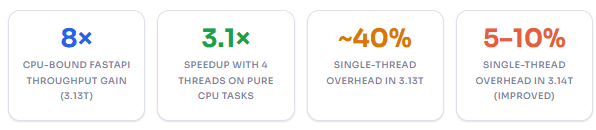
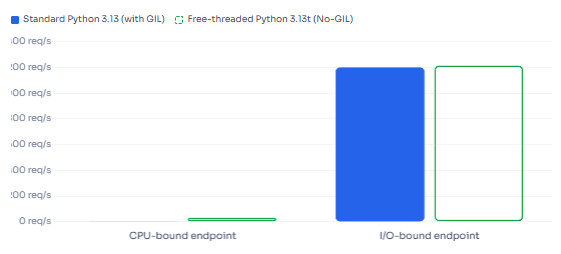
The headline result from real FastAPI benchmarks is striking: CPU-bound endpoints jump from roughly 4 requests per second to around 32 req/s — an 8× increase — with zero code changes. However, I/O-bound endpoints show essentially no difference, because the GIL was already released during network and database waits.
CPU-bound vs I/O-bound: GIL vs No-GIL throughput
The Single-Thread Tax
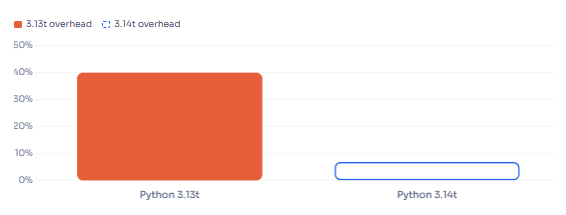
This is where things get more nuanced. In Python 3.13t, enabling free-threading caused single-threaded code to run approximately 40% slower than the standard build. The reason is straightforward: per-object locking and atomic reference counting add overhead on every operation, even when only one thread is running. For workloads that are not parallelised — or that already use asyncio for I/O concurrency — this is a meaningful regression.
Fortunately, Python 3.14 addressed this head-on. By re-enabling the specialising adaptive interpreter (which had been disabled in 3.13t for safety reasons), Python 3.14’s free-threaded build brings that penalty down to just 5–10%. That is a much more acceptable baseline for general-purpose adoption.
Single-thread performance overhead: free-threaded vs standard build
Multi-thread Scaling in Practice
On purely CPU-focused tasks with no shared mutable state, benchmarks show about a 2.2× speedup with 4 threads on Python 3.13t, rising to 3.09× on Python 3.14t. That is a real gain, though still below the theoretical 4× maximum — which makes sense, given that some parts of any workload are inherently sequential, and per-object locking still introduces contention when threads share data.
Who Benefits — and Who Does Not
Not every Python application will see improvement from switching to a free-threaded build. In fact, for some workloads, the switch could make things worse. The table below gives an honest breakdown.
| Workload type | Example | Expected impact | Worth switching? |
|---|---|---|---|
| CPU-bound multi-threaded | Image processing, data transforms, numeric loops | 2–8× faster with threads | Yes — high value |
| AI/ML pipeline orchestration | Preprocessing, postprocessing, env logic | Significant gains for Python-land work | Yes — high value |
| High-throughput web APIs | FastAPI + CPU-heavy endpoints | Up to 8× on CPU-bound routes | Yes — with profiling |
| I/O-bound async | asyncio web scraping, DB queries | Negligible — GIL was already released | Neutral |
| Single-threaded scripts | CLI tools, build scripts, notebooks | ~5–40% slower (version-dependent) | No — avoid on 3.13t |
| Heavy C extension use | NumPy, Pandas, OpenCV | May silently re-enable the GIL | Verify first |
Watch out for silent GIL re-enabling
Any C extension that has not been updated to support free-threading will automatically re-enable the GIL for the entire process when it is imported — and it will do so silently. You won’t get an error or a warning. Your code will simply run single-threaded. Always verify with
sys._is_gil_enabled()after your imports to confirm you are actually running without it.
The AI and Data Science Angle
One of the most compelling use cases that often gets overlooked is modern AI pipeline orchestration. While the heavy numerical work in neural networks typically happens in C++, CUDA, or JAX — well outside the GIL’s reach — a huge portion of the surrounding Python code is still bottlenecked by it. Think about what a typical training loop actually does:
It reads batches from disk, applies Python-level augmentations, runs environment logic for reinforcement learning, coordinates multiple models, handles logging, and executes feature transformations on incoming data. All of that happens in Python. All of it was GIL-bound. Free-threading does not speed up the matrix multiplication, but it absolutely speeds up everything else. As one RL researcher noted, their training loop spent 40% of its time in Python-land doing environment logic — exactly the kind of work that benefits directly from genuine thread parallelism.
Is the Ecosystem Ready?
This is the most practical question for anyone evaluating free-threading for production use today. The honest answer is: it depends on your dependencies.
Major libraries including NumPy, SciPy, and FastAPI now offer pre-compiled wheels for the free-threaded build. The community tracker at py-free-threading.github.io is the best place to check compatibility for specific packages. Notably, FastAPI 0.136.0 officially supports free-threaded Python, meaning the 8× benchmark result described earlier is achievable without any workarounds.
Escape hatch during the transition
If one dependency is not yet free-threading-ready, you do not have to abandon the build entirely. Run the free-threaded interpreter with the GIL temporarily re-enabled for that dependency:
python3.13t -X gil=1 your_script.py. This lets you stay on the free-threaded build while waiting for libraries to catch up.
The Three-Phase Roadmap
The Python Steering Council laid out a deliberate, staged rollout via PEP 703 and, more recently, PEP 779. Understanding where we are on that roadmap helps set expectations correctly.
Phase 1 — Experimental Python 3.13
Free-threading available as a separate opt-in build. Experimental status. ~40% single-thread overhead. PEP 703 implementation begins.
Phase 2 — Officially Supported Python 3.14
No longer experimental. PEP 779 accepted. Single-thread overhead down to 5–10%. Still optional — not the default build. This is where we are now.
Phase 3 — Default Build ~2028–2030
Free-threading becomes the default. GIL can still be re-enabled via a flag. Timeline depends on library ecosystem adoption.
Should You Try It Today?
Given everything above, here is a practical take on where free-threading fits right now. The short answer: yes, but with intention.
If you are building a new service with CPU-intensive processing — a data pipeline, an ML inference server, a web API with meaningful compute in its handlers — then benchmarking against the free-threaded build (ideally Python 3.14t, given its improved single-thread overhead) is absolutely worth your time. The potential gains are real, and the setup cost is low.
On the other hand, if your application is almost entirely I/O-bound and already leverages asyncio, free-threading is unlikely to move the needle. The GIL was never your bottleneck. Furthermore, if your project depends heavily on third-party C extensions, spend 20 minutes on the compatibility tracker before committing to anything.
1. Profile first — confirm a CPU-bound bottleneck exists. 2. Check all C-extension dependencies on the compatibility tracker. 3. Use Python 3.14t, not 3.13t, to avoid the 40% single-thread overhead. 4. After importing dependencies, call
sys._is_gil_enabled()to verify the GIL is actually off. 5. Run your existing test suite — free-threading can surface latent race conditions.
What We Learned
Python 3.13 introduced an optional free-threaded build that removes the Global Interpreter Lock, enabling genuine parallel execution across CPU cores for the first time in CPython’s history. Benchmarks confirm dramatic gains for CPU-bound workloads — up to 8× in multi-threaded API scenarios — but there is a real trade-off: single-threaded code runs roughly 40% slower on 3.13t, a penalty that drops to 5–10% with Python 3.14t as the specialising interpreter is re-enabled. I/O-bound workloads see no meaningful change, since the GIL was already released during I/O waits.
The ecosystem is catching up quickly, with NumPy, SciPy, and FastAPI all supporting the free-threaded build, though any non-updated C extension will silently re-enable the GIL. Governed by a clear three-phase roadmap, free-threading is now officially supported in Python 3.14 and is on track to become the default build later this decade. For CPU-heavy applications — especially AI pipelines, data processing, and high-throughput APIs — it is now worth evaluating seriously.