Hibernate 6 vs. Spring Data JDBC vs. jOOQ. Picking Your Persistence Strategy for the Virtual-Thread Era

JDBC is still blocking. Hibernate 6 added reactive support through Vert.x. jOOQ is reviewing its ThreadLocal usage for Loom compatibility. Spring Data JDBC gained first-class IntelliJ tooling in 2025.3. This comparison cuts through framework loyalty and asks a practical question: which persistence approach has the fewest hidden surprises at 50k req/s?
1. The Virtual Thread Context: What Actually Changed
Virtual threads (Project Loom, finalised in Java 21) promised to change the economics of blocking I/O. Instead of one platform thread per request — each costing 1–2 MB of stack and OS context switches — you get millions of lightweight user-mode threads that park cheaply whenever they block. Blocking JDBC calls, which do block, would now block a virtual thread rather than a platform thread. In theory: the same throughput, a fraction of the resource cost.
In practice, the devil is in the details. The critical insight that almost every migration guide glosses over is this: virtual threads solve the platform thread scarcity problem, but they do not solve the database connection scarcity problem. Your PostgreSQL cluster still has 100 connections. Virtual threads mean you can now queue 50,000 virtual threads against those 100 connections without exhausting OS threads — but you’ve introduced a new failure mode: a connection stampede. Applications that had 200 platform threads as a natural request limiter now have theoretically unlimited virtual threads hammering the same connection pool.
The stampede risk
With platform threads, the thread pool size was your implicit back-pressure mechanism against the database. With virtual threads and a naïve configuration, you remove that cap entirely. The symptom is not CPU exhaustion — it’s connection pool timeouts, with CPU sitting at 20% while requests queue.Always set a connection pool ceiling explicitly when moving to virtual threads.With Hibernate or Spring Data JDBC on HikariCP, a pool size of 10–40 is often optimal; the right value depends on your database’s own connection limit and query duration.
2. The Pinning Timeline: Java 21 → Java 24
Before going framework-specific, it’s important to establish what “virtual thread friendly” actually meant between Java 21 and Java 24 — because the answer changed significantly in March 2025.
In Java 21, a virtual thread that entered a synchronized block and then blocked (on I/O, a lock, etc.) would pin its carrier platform thread. Pinning means the carrier thread can’t be reused for other virtual threads for the duration of the block. If pinning happened on hot paths — connection acquisition, logging, caching — you could saturate your carrier pool (typically one per CPU core) and see throughput collapse. HikariCP’s synchronization in its hot path was a documented issue; the team debated replacing synchronized with ReentrantLock but ultimately waited for the JVM fix.
That fix is JEP 491, shipped in Java 24. It changes the HotSpot object monitor implementation so virtual threads can unmount even inside synchronized blocks, releasing their carriers. As of Java 24, the vast majority of pinning scenarios are resolved — including the ConcurrentHashMap cache issue that caught many teams. The JEP authors explicitly say to stop replacing synchronized with ReentrantLock as a workaround; the JVM now handles it.
Virtual Thread Pinning Risk by Framework — Java 21 vs Java 24
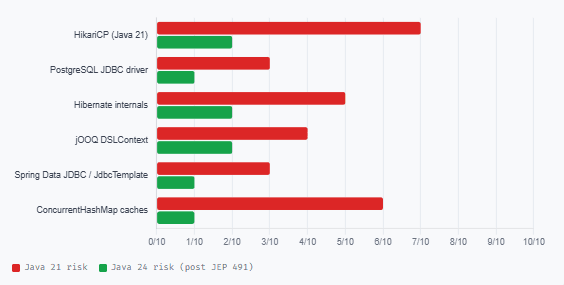
The important caveat from production data: a real-world benchmark found that even with JEP 491 applied, database-heavy workloads saw no meaningful throughput improvement compared to Java 21. The conclusion was unambiguous — the bottleneck for database applications is connection pool behaviour and database I/O characteristics, not JVM-level pinning. JEP 491 removes a real failure mode; it doesn’t magically increase database throughput.
3. Hibernate 6: Power with Hidden Costs at Scale
3.1 What Hibernate 6 actually changed
Hibernate 6 is a substantial rewrite of the internals, not just a major version bump. The SQL generation engine was rebuilt, @NaturalId queries improved, and the reactive story was clarified: Hibernate Reactive (currently 2.4.x, tracking Hibernate ORM 6.6.x) uses the Vert.x SQL client, not R2DBC directly. This is a deliberate design choice — Vert.x’s async database drivers are more mature and performant than most R2DBC implementations — but it means Hibernate Reactive and Spring Data R2DBC are separate stacks and do not share drivers or connection management.
For teams on plain Hibernate 6 with JDBC and virtual threads, the picture is more complicated. Production retrospectives from 2025 are consistent on this point: lazy loading is the biggest Hibernate problem at high virtual-thread concurrency. A request running on a virtual thread that accesses a lazily-loaded association fires an additional database query on that same thread. At low concurrency, this is annoying. At 50k req/s with virtual threads, it means each of your thousands of concurrent logical requests can independently and silently fire additional queries, flooding your connection pool. The effect is what production engineers call a “thundering herd on the database.”
@Transactional
public List<OrderSummaryDto> getOrderSummaries() {
    // One query: SELECT * FROM orders
    List<Order> orders = orderRepo.findAll();

    // For each order — a separate SELECT to load customer (lazy!)
    // At 50k req/s with VTs: potentially 50k × N extra queries fired concurrently
    return orders.stream()
        .map(o -> new OrderSummaryDto(o.getId(), o.getCustomer().getName()))
        .toList();
}

// Fix: explicit JOIN FETCH eliminates the N+1
@Query("SELECT o FROM Order o JOIN FETCH o.customer")
List<Order> findAllWithCustomers();
4. Spring Data JDBC: Predictable but Opinionated
4.1 What changed in the tooling (IntelliJ 2025.3)
Spring Data JDBC’s core philosophy has always been DDD-aligned: aggregates own their data, repositories map directly to SQL, and there is no session state, no dirty checking, no lazy loading. What you query is what you load. What you save is what gets written. IntelliJ IDEA 2025.3 delivered the tooling gap that had held JDBC adoption back relative to JPA: first-class entity generation from an existing database schema, with Flyway and Liquibase migration generation from entity changes, and schema synchronisation in both directions.
This matters for the database-first teams that were previously forced to either write entities by hand or use JPA-with-Hibernate just to get the IDE generation tooling. As of 2025.3, that argument is gone. You can reverse-engineer a Spring Data JDBC entity model from an existing schema as easily as you could with JPA, and the Persistence tool window understands JDBC entities as a first-class concept alongside JPA entities.
4.2 Virtual threads and Spring Data JDBC
Spring Data JDBC is, architecturally, the friendliest of the three for virtual threads — because it makes no claims about lazy loading, session lifecycle, or connection reuse. Every repository call is explicit, stateless from the framework’s perspective, and maps predictably to one or a small number of SQL queries. There are no surprises hiding in proxy objects or interceptors waiting to fire additional queries when you access a field.
The predictability does come at a cost. Spring Data JDBC performs eager loading by default, which means complex aggregate hierarchies with many associations load everything upfront. For write-heavy endpoints this is fine; for read-heavy endpoints returning large graphs, you need custom queries. There’s also no built-in second-level cache, which Hibernate teams sometimes use to reduce database round-trips. With Spring Data JDBC, caching is your explicit responsibility.
@Table("orders")
public record Order(
    @Id Long id,
    String status,
    Set<OrderLine> lines  // loaded eagerly — always, no surprises
) {}

@Repository
public interface OrderRepository extends CrudRepository<Order, Long> {

    // This fires exactly two queries: one for orders, one for lines
    // No matter the thread type. No lazy-load surprises.
    List<Order> findByStatus(String status);
}
5. jOOQ: SQL-First with Loom Awareness
5.1 The virtual thread compatibility picture
jOOQ’s concurrency story is simpler than either ORM’s, because jOOQ makes fewer concurrency promises. The DSLContext is safe to share across threads as long as the underlying ConnectionProvider is thread-safe, which it is when backed by HikariCP or any pooled DataSource. The team has explicitly opened an issue to review internal ThreadLocal usage in the context of virtual threads, with some of those usages being JDBC shortcomings rather than jOOQ design choices.
The key virtual-thread advantage for jOOQ is its transparency. Every jOOQ statement maps to exactly one SQL string. There is no ORM magic that might fire additional queries, no proxy interception, no session state that might become a bottleneck under concurrent load. jOOQ’s own documentation states that overhead compared to plain JDBC is typically less than 1ms per query — for most applications, that’s in the noise compared to actual database latency.
import static com.example.jooq.Tables.*;

List<OrderSummaryDto> summaries = dsl
    .select(
        ORDERS.ID,
        ORDERS.STATUS,
        CUSTOMERS.NAME.as("customerName")
    )
    .from(ORDERS)
    .join(CUSTOMERS).on(ORDERS.CUSTOMER_ID.eq(CUSTOMERS.ID))
    .where(ORDERS.STATUS.eq("PENDING"))
    .fetchInto(OrderSummaryDto.class);
5.2 The licensing caveat
jOOQ is open source for open-source databases (PostgreSQL, MySQL, MariaDB, SQLite, H2). For commercial databases — Oracle, SQL Server, DB2 — it requires a commercial licence. This is the most common reason teams choose Spring Data JDBC or Hibernate instead despite jOOQ’s technical merits. If you’re on PostgreSQL, this is a non-issue. If you’re on Oracle, factor the licence cost into your comparison.
6. Head-to-Head: The Surprise Matrix at 50k req/s
The critical question isn’t which framework performs best in synthetic microbenchmarks. It’s which one has the fewest unexpected failure modes when concurrency climbs. Here’s an honest assessment of each framework’s hidden surprises, drawn from production data and framework internals.
| Surprise / Risk | Hibernate 6 | Spring Data JDBC | jOOQ |
|---|---|---|---|
| N+1 queries under high concurrency | High risk — lazy loading fires on every VT | Low risk — eager by default, explicit queries | Low risk — SQL is explicit |
| Session / unit-of-work locking | Medium — shared L2 cache, dirty tracking | None — no session state | None — stateless DSL |
| Connection pool stampede | All three — VTs remove natural limiter | All three | All three |
| ThreadLocal issues (Java 21) | Medium — via HikariCP + third-party drivers | Medium — via HikariCP + JdbcTemplate | Medium — internal TLs under review |
| ThreadLocal issues (Java 24+) | Largely resolved via JEP 491 | Largely resolved | Largely resolved |
| Query predictability | Low — SQL varies by loading strategy / fetch hints | High — fixed per repository method | Very high — SQL is explicit in code |
| Schema evolution friction | Low — Hibernate Tools, JPA Buddy | Low — IDEA 2025.3 entity generation | Medium — codegen must re-run on schema change |
| Reactive / non-blocking support | Hibernate Reactive — Vert.x only, separate stack | Spring Data R2DBC — separate module | Limited — R2DBC support exists but less mature |
Framework Characteristics at High Concurrency — Qualitative Radar
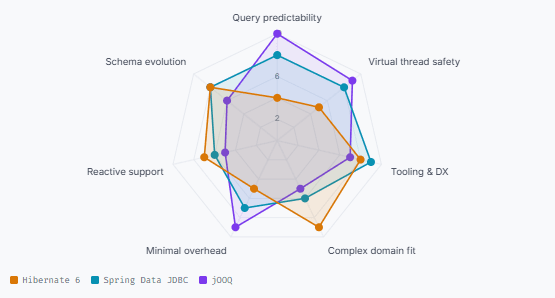
The pool sizing rule for all three
Regardless of framework, moving to virtual threads requires you to explicitly set a connection pool ceiling. The rule of thumb from the Loom team and HikariCP users: set maximumPoolSize equal to your database’s effective connection limit divided by your number of application instances. On PostgreSQL with 100 connections and 4 app instances, that’s maximumPoolSize=25. Do not set it to thousands “because virtual threads are cheap.” The database is not cheap.
7. How to Actually Choose
The honest answer is that all three are production-ready and all three have teams running them successfully at high concurrency. The choice is more about which failure modes your team is equipped to detect and mitigate, and less about raw performance differences that are usually smaller than network latency.
| Your situation | Recommended starting point | Why |
|---|---|---|
| Complex domain, rich object graph, teams with Hibernate experience | Hibernate 6 | Unit of work pattern and dirty checking are genuine productivity wins when used correctly. Mitigate N+1 aggressively with JOIN FETCH and DTO projections on hot read paths. |
| DDD-oriented team, database-first or code-first with IntelliJ 2025.3+ | Spring Data JDBC | No session state, predictable queries, excellent new tooling. The best choice when you want the Spring ecosystem without the ORM cognitive overhead. Eager loading is a feature, not a bug. |
| SQL-heavy workload, complex reporting queries, team comfortable writing SQL, PostgreSQL/MySQL | jOOQ | Highest SQL control, compile-time query checking via codegen, minimal overhead. The right choice when your bottleneck is query shape, not entity mapping. |
| Oracle/SQL Server, cost-sensitive, need full ORM | Hibernate 6 | jOOQ commercial licence may not be justified. Spring Data JDBC can work but complex queries need custom repository implementations. |
| Still on Java 21, experiencing HikariCP issues with virtual threads | Upgrade to Java 24 | JEP 491 resolves most pinning. Alternatively, consider Agroal (Red Hat’s VT-friendly pool) as a HikariCP replacement on Java 21. |
| Greenfield on Java 24+, high throughput read-heavy service | jOOQ + HikariCP + VTs | Stateless, transparent, near-JDBC overhead, JEP 491 removes the last pinning concerns. Pair with a small pool size and let virtual threads handle queuing. |
“Virtual threads don’t magically fix bad JPA models; they just expose all the inefficiencies much faster.”— Production retrospective, Govind, 2025 · Java Virtual Threads In Production
One more consideration worth naming explicitly: the hybrid approach. Many high-throughput production systems use Hibernate or Spring Data JDBC for write paths — where the unit-of-work and entity mapping genuinely help — and plain jOOQ or even JdbcTemplate for read paths where query shape and performance matter most. Mixing persistence strategies within a single service is not architectural sin; it’s pragmatism. Spring Boot 4’s modularised autoconfiguration makes this easier than it used to be — you can include exactly the persistence modules you need without pulling in the full Hibernate stack for a service that only needs JdbcTemplate.
8. What We Have Learned
The virtual-thread era does not change which persistence framework is architecturally best. It changes which failure modes become visible first. Hibernate 6’s N+1 problem was always there; at 50k req/s with virtual threads, it surfaces within seconds of load test start rather than gradual degradation. Spring Data JDBC’s eager loading was always an explicit choice; under high concurrency it’s a predictability advantage. jOOQ’s near-JDBC overhead was always its selling point; virtual threads make that advantage more pronounced by eliminating the thread cost of blocking I/O.
The most important configuration change for all three is the same: set an explicit connection pool ceiling. Virtual threads remove the natural back-pressure that platform thread pools provided. Without a ceiling, you turn a 100-connection PostgreSQL instance into a thundering herd target.
On the tooling front, Spring Data JDBC became meaningfully more competitive with IntelliJ IDEA 2025.3’s entity generation from existing schemas. That had been a real gap — teams chose JPA with Hibernate partly for the IDE tooling, not purely on technical merits. That argument is now substantially weaker. Meanwhile, JEP 491 in Java 24 resolved the worst virtual thread pinning scenarios, making Java 24 the recommended baseline for any new project prioritising high concurrency. On Java 21, audit your JDBC driver and connection pool for synchronization hotspots using -Djdk.tracePinnedThreads=full before you discover them in production.
Finally: the choice between these three frameworks is not a lifetime commitment. They can coexist. The teams that navigate the virtual-thread era most successfully will be the ones who stop treating persistence as an all-or-nothing religion and start treating it as a layered toolset — using whichever of Hibernate, Spring Data JDBC, and jOOQ is the right instrument for each query shape.