
Cloud development environments have become one of the hottest trends in modern software engineering. Open a browser, spin up a preconfigured workspace, connect to a repository, and start coding within minutes. Platforms such as GitHub Codespaces, Gitpod, and cloud-hosted IDEs promise consistency, onboarding simplicity, and environments that closely resemble production. For distributed teams, those benefits are undeniably attractive.
And yet, after spending a considerable amount of time working with cloud-based development environments, I’ve been moving back toward a local-first setup.
This isn’t an argument against the cloud. Quite the opposite. Cloud platforms remain essential for CI/CD pipelines, testing, deployments, and production workloads. However, I’ve started questioning whether every stage of development actually benefits from living remotely.
What surprised me most is that the answer increasingly seems to be “no.”
Introduction: The Current Trend of “Everything in the Cloud”
Over the past few years, software teams have pushed aggressively toward cloud-hosted developer environments. The reasoning is easy to understand. A new engineer joins the team. Instead of spending a day installing dependencies, configuring SDKs, setting up databases, and resolving version conflicts, the engineer clicks a button and receives a ready-to-use environment. Organizations gain consistency, security controls, and easier onboarding. Meanwhile, developers gain flexibility because they can access their workspace from almost anywhere.
The promise sounds compelling.
However, after the initial excitement wears off, a different question emerges:
Is the developer actually more productive?
That question ultimately led me to rethink my own setup.
The Developer Experience (DX) Gap: Dealing with Latency and Connectivity Issues
One aspect of cloud development is rarely discussed in marketing material: latency.
Not production latency.
Developer latency.
Every action during development is part of a feedback loop. You change code, run tests, wait for results, make another change, and repeat. The shorter that loop becomes, the easier it is to stay focused.
When everything runs locally, interactions feel almost instantaneous.
- A build starts immediately.
- A terminal responds immediately.
- A search indexes immediately.
- A database query executes immediately.
Once a remote development environment enters the picture, even small delays begin to accumulate. Most individual delays are measured in milliseconds or seconds, but development is made of thousands of tiny interactions. Eventually, those interruptions become difficult to ignore.
Figure 1: Developer Flow and Responsiveness
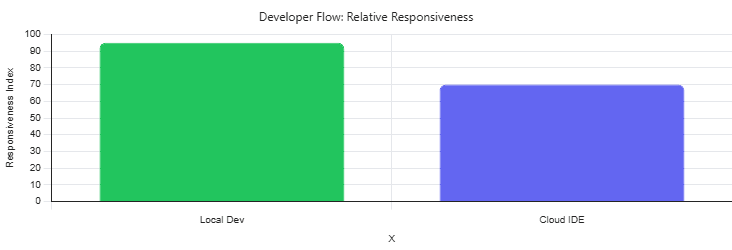
The issue isn’t necessarily raw performance. Modern cloud environments can be incredibly powerful. The issue is that the developer is no longer working directly against the machine that executes the workload. Every edit, save, search, terminal command, and debugging session now depends on network quality.
A temporary connection issue might not affect production operations. However, it can absolutely affect concentration. And in software engineering, concentration is often the most valuable resource.
The Financial Cost: Is Your Docker-in-the-Cloud Setup Secretly Expensive?
The second realization came after reviewing costs. Many developers assume cloud development environments are inexpensive because the individual hourly rates appear small. However, usage-based pricing accumulates surprisingly quickly.
According to GitHub’s pricing documentation, Codespaces charges based on compute usage and storage consumption. Larger machine types increase costs proportionally, and long-running environments can generate significant monthly expenses.
Let’s consider a simple example.
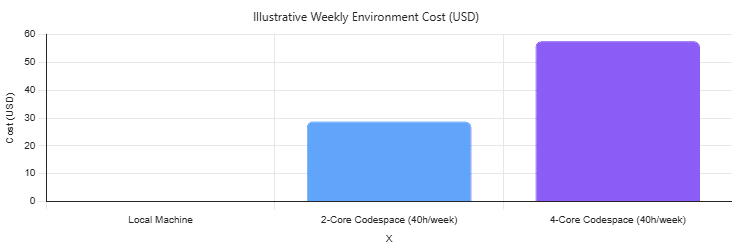
GitHub currently lists a 2-core Codespace at approximately $0.18 per hour and a 4-core environment at approximately $0.36 per hour. A full-time developer working 40 hours per week could potentially reach the following compute costs before considering storage.
Figure 2: Illustrative Weekly Development Environment Cost
Now compare those recurring expenses with a modern developer workstation.
A powerful local machine may require a larger upfront investment, but that cost is fixed. After the hardware is purchased, local builds, databases, containers, and IDE workloads generally do not incur additional hourly charges.
For individual developers and smaller teams, that difference becomes increasingly difficult to ignore.
Returning to Local-First: Tools That Make Local Development as Powerful as the Cloud
The argument for cloud development used to be straightforward:
Local environments are messy.
Fortunately, that is becoming less true every year. Modern tooling has dramatically improved the local development experience.
For example, Docker allows applications to run inside reproducible containers. The same Docker image can be used locally, in CI pipelines, and in production. Meanwhile, Dev Containers enable developers to standardize development environments without requiring everyone to manually install identical dependencies.
This means the historical choice between:
- consistency
- local performance
is no longer as binary as it once was.
Today, a developer can combine:
- Docker
- Dev Containers
- Local Kubernetes clusters
- Testcontainers
- Local databases
- Modern IDEs
and create an environment that feels remarkably close to production while still retaining local responsiveness. In my experience, this combination delivers the best of both worlds.
The workflow remains highly reproducible. However, builds, debugging sessions, log inspection, and experimentation happen at local-machine speed. And speed matters.
Not because developers are impatient, but because software development is fundamentally about maintaining momentum.
When Cloud Still Makes Sense: Balancing Local Efficiency with Production Parity
Despite my preference for local-first development, abandoning the cloud entirely would be a mistake. There are situations where cloud environments remain the better option.
For example, large organizations often onboard dozens or hundreds of developers. Standardized cloud environments eliminate many support issues and ensure everyone starts from the same baseline. Similarly, highly regulated industries may prefer development environments that never leave managed infrastructure.
Cloud development also shines when projects require resources that most laptops cannot provide. Running large-scale data processing jobs, distributed test environments, GPU workloads, or multi-service integration tests often makes more sense remotely.
The ideal approach is usually not local versus cloud. Instead, it is local and cloud.
A practical workflow might look like this:
- Develop locally.
- Run unit tests locally.
- Debug locally.
- Push code.
- Execute integration testing in the cloud.
- Validate production parity through CI/CD pipelines.
- Deploy through managed infrastructure.
This model keeps everyday development fast while still benefiting from cloud scalability.
Conclusion: Optimize for Speed of Thought, Not Just Parity with Production
For years, the industry has focused heavily on production parity. That focus is understandable because software should behave consistently across environments. However, production parity is only one side of the equation. The other side is developer productivity.
If cloud-hosted environments introduce friction, delay feedback loops, or quietly generate costs that exceed expectations, then they deserve scrutiny just like any other engineering decision.
The longer I work with modern development tools, the more I find myself returning to a simple principle:
Optimize for speed of thought.
When an idea appears, the shortest path from idea to implementation is often the most valuable workflow you can build. For many developers in 2026, that path is leading back to a surprisingly familiar place: the local machine.
What We Have Learned
Cloud-based development environments solve many real problems, particularly around onboarding, standardization, and production parity. However, they can also introduce latency, increase operational costs, and slow down the day-to-day feedback loop that developers rely on. Modern tools such as Docker, Dev Containers, and local Kubernetes distributions have significantly reduced the traditional disadvantages of local development.
As a result, many developers are rediscovering a local-first approach that combines fast iteration locally with cloud infrastructure for testing, validation, and deployment.
Sources
- GitHub Codespaces Billing Documentation:
- GitHub Pricing Calculator: https://github.com/pricing/calculator
- GitHub Codespaces Product Documentation: