How the internal developer platform changes the relationship between infrastructure and product teams, and what it means for autonomy, cognitive load, and delivery speed.
Platform engineering is often introduced as simply “DevOps with a dedicated team,” as if the only real change was adding a new box to the org chart. That framing misses what’s actually different. DevOps asked product teams to absorb operational responsibility directly. Platform engineering asks a different question entirely: what if most of that responsibility could be absorbed by a well-designed system instead of by a person? That’s not a staffing change. It’s a conceptual one, and it reshapes autonomy, cognitive load, and delivery speed all at once.
What DevOps Actually Asked Teams To Do
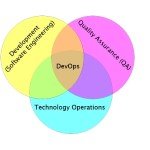
The original DevOps promise was to tear down the wall between development and operations by making product teams own their software end to end — “you build it, you run it.” In principle this eliminated the classic handoff delay where a team threw code over a fence and waited for someone else to deploy and operate it. In practice, it also meant every product team suddenly needed real expertise in Kubernetes manifests, cloud IAM policies, observability pipelines, and incident response, on top of the product problem they were actually hired to solve.
Why “You Build It, You Run It” Quietly Overloaded Teams
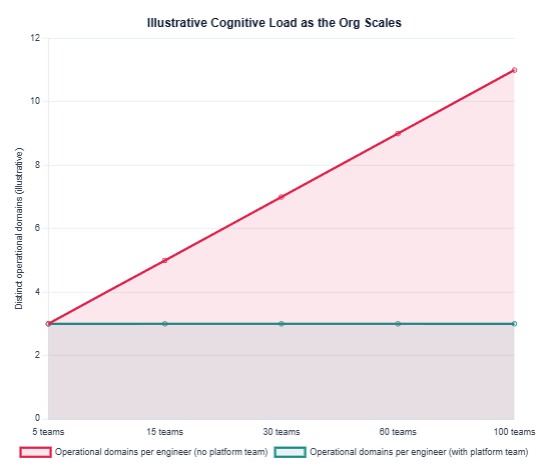
The book Team Topologies, by Matthew Skelton and Manuel Pais, gives useful language for what actually went wrong: cognitive load. A team has a finite capacity to hold context in their heads, and every additional domain of expertise required to ship safely — infrastructure provisioning, security policy, deployment pipelines — competes with the cognitive space needed to understand the actual product domain. DevOps didn’t remove operational complexity from the system. It just redistributed that complexity onto every product team simultaneously, whether or not they had the bandwidth to absorb it well.
What an Internal Developer Platform Actually Changes
Platform engineering, as described by organizations like the Platform Engineering community and the broader Internal Developer Platform movement, reframes infrastructure as a product with its own users: the product teams themselves. Instead of every team learning Kubernetes deeply, a platform team builds a self-service layer — often called a golden path — that lets a developer deploy a new service, provision a database, or wire up observability through a small, well-defined interface, without needing to understand everything happening underneath it.
The infrastructure expertise doesn’t disappear from the organization. It gets concentrated in a team whose entire job is maintaining that abstraction well, instead of being duplicated imperfectly across every product team that has to reinvent it under deadline pressure.
| Dimension | DevOps (“you build it, you run it”) | Platform Engineering (self-service IDP) |
|---|---|---|
| Where infra expertise lives | Distributed across every product team | Concentrated in a dedicated platform team |
| Cognitive load on product teams | High; must learn infra alongside product domain | Lower; interacts through a defined self-service interface |
| Consistency across teams | Varies team to team | Standardized via golden paths |
| Team autonomy | High in theory, often reduced by infra learning curve | High in practice, bounded by the platform’s paved road |
| Delivery speed for new services | Slower; each team solves infra from scratch | Faster; infra is templated and pre-approved |
The Autonomy Paradox
The most counterintuitive part of this shift is that constraining a team’s choices can increase their effective autonomy. Under pure DevOps, a team is technically free to choose any deployment method, any observability stack, any database — but that freedom comes with the burden of making and maintaining every one of those decisions correctly, indefinitely. A golden path narrows the menu of options while removing the burden of evaluating and operating each one, and most teams find they move faster inside those guardrails than they did with the unrestricted, unsupported freedom that came before.
The paradox resolves once autonomy is redefined as “freedom to ship the product,” rather than “freedom to configure infrastructure any way we like.” Platform engineering deliberately trades the second kind of freedom for more of the first.
Signals That an Organization Needs a Platform Team
Not every organization needs a dedicated platform team on day one, and building one too early can itself become overhead without enough product teams to justify it. A few recurring signals tend to appear once the need becomes real: every team has quietly built its own slightly different CI/CD pipeline, incident response quality varies wildly depending on which team is on call, onboarding a new engineer takes weeks just to understand the deployment process, and senior engineers spend a disproportionate amount of time on infrastructure questions instead of product work.
Before investing in an internal developer platform, ask:
- Are multiple product teams solving the same infrastructure problem independently, with inconsistent results?
- Would a golden path genuinely reduce cognitive load, or just add a new abstraction layer teams have to learn on top of everything else?
- Do we have the staffing to treat the platform itself as a real product, with its own roadmap and user feedback loop?
- Is there an escape hatch for teams with genuinely unusual requirements the golden path doesn’t cover?
- Are we building this because product teams are asking for it, or because it’s the current industry trend?
What We Learned
DevOps and platform engineering aren’t really two versions of the same idea — DevOps distributed operational responsibility to every product team, while platform engineering concentrates the underlying expertise into a self-service system maintained by a dedicated team. The conceptual shift is treating infrastructure as a product with real users, not just a shared set of scripts and runbooks. Done well, this doesn’t reduce autonomy, it redefines it: teams give up unrestricted control over infrastructure choices in exchange for genuinely faster, lower-friction delivery of the product work they were actually hired to do.