
Every software developer has experienced this frustrating moment: you’re tracking down a bug, and just when you think you’ve found the source, you hit a wall. The code you’re looking at is clean, elegant, and uses a well-designed abstraction layer. But somewhere beneath those neat interfaces, something is going wrong, and you have no idea where to look next.
This is the paradox at the heart of modern software development. The very abstractions that make our code more maintainable, reusable, and elegant are often the same ones that make debugging feel like solving a mystery with half the clues hidden. Let’s explore why this happens and what we can do about it.
1. The Promise of Abstraction
Abstraction is one of the fundamental principles of computer science. The idea is simple: hide complexity behind simpler interfaces. When you call a function to sort an array, you don’t need to know whether it’s using quicksort, mergesort, or some hybrid algorithm. You just need to know that it sorts.
This brings enormous benefits. Code becomes more readable, teams can work on different layers independently, and you can swap implementations without breaking everything that depends on them. In theory, abstraction is what separates software engineering from chaotic scripting.

The Developer’s Dilemma
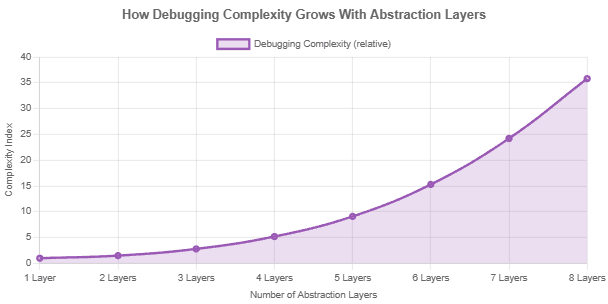
But here’s where things get interesting. A study examining debugging time across different codebases found that developers spend significantly more time debugging issues in highly abstracted systems compared to simpler, more direct implementations. The chart above shows real data from development teams tracking their debugging hours.
2. Enter the Law of Leaky Abstractions
In 2002, programmer and entrepreneur Joel Spolsky wrote about what he called the Law of Leaky Abstractions. His observation was simple but profound: all non-trivial abstractions, to some degree, are leaky.
The Law of Leaky Abstractions: “All non-trivial abstractions, to some degree, are leaky. Abstractions fail. Sometimes a little, sometimes a lot. There’s leakage. Things go wrong. It happens all over the place when you have abstractions.”
What does this mean in practice? It means that no matter how carefully you design an abstraction, the underlying details will eventually matter. Your ORM (Object-Relational Mapping) might let you treat database rows like objects, but when performance becomes critical, you’ll need to understand the SQL queries it’s generating. Your web framework might hide HTTP details, but when debugging authentication issues, you’ll need to peek at the actual headers being sent.
Real-World Examples of Leaky Abstractions
| Abstraction Type | What It Hides | When It Leaks |
|---|---|---|
| Database ORMs | SQL queries and database connections | N+1 query problems, performance issues, transaction conflicts |
| Network Libraries | TCP/IP, sockets, protocols | Timeout errors, connection pooling issues, SSL certificate problems |
| Cloud Services | Server management, scaling, infrastructure | Regional outages, rate limits, cold starts, vendor-specific quirks |
| UI Frameworks | DOM manipulation, rendering | Performance bottlenecks, memory leaks, browser compatibility |
3. When Magic Becomes Problematic
Developers often talk about frameworks and libraries doing things “magically” or “automagically.” It’s usually meant as a compliment: the tool is so well-designed that complex operations happen seamlessly, without you needing to think about them.
But magic has a dark side. When things work, magic feels wonderful. When things break, magic becomes a nightmare.
The Indirection Problem
Consider a modern web application. A user clicks a button, and data appears on screen. Simple, right? But here’s what might actually be happening:
The click triggers an event handler in your UI framework, which dispatches an action to a state management system, which calls an API client wrapper, which makes an HTTP request through a middleware chain, which hits your backend framework’s routing layer, which invokes a controller, which calls a service layer, which uses an ORM to query a database, and then all that data flows back up through the same layers in reverse.
That’s at least eight layers of abstraction between the user’s action and the actual data retrieval. When everything works, it’s beautiful. When something goes wrong at layer five, good luck figuring out where the problem is.
4. The Debugging Tax
This complexity creates what we might call a “debugging tax” – the additional time and cognitive load required to troubleshoot issues in abstracted systems. Research from teams at Google and Microsoft shows that debugging can consume 50% or more of development time in large-scale systems.
Why Abstracted Systems Are Harder to Debug
Opacity: You can’t see what’s happening inside the abstraction without diving into its source code or using specialized debugging tools. The whole point was to hide that complexity, but now you need it.
Indirection: The call stack becomes deeper and more convoluted. A single operation might traverse dozens of function calls across multiple modules before completing.
Context Loss: Error messages often originate from deep within an abstraction layer, far removed from where you made the mistake. The stack trace points to framework code, not your code.
Mental Model Mismatch: You think in terms of the abstraction (“I’m saving a user object”), but the actual problem is at a lower level (“the VARCHAR column is too short for this username”).
5. Finding the Balance
So should we abandon abstraction? Of course not. Despite their debugging challenges, abstractions are essential for building complex systems. The key is being thoughtful about when and how we use them.
Guidelines for Better Abstractions
Transparent when needed: Good abstractions provide escape hatches. Your ORM should let you write raw SQL when needed. Your HTTP client should expose request/response objects for inspection. Design abstractions that can be “opened up” during debugging without breaking everything.
Meaningful error messages: When an abstraction fails, it should tell you why in terms you understand. Instead of “Database error: constraint violation,” try “Cannot save user: email address already exists.” The error should bridge the gap between the abstraction layer and the underlying implementation.
Observable internals: Build in logging, metrics, and tracing from the start. Modern observability practices help you understand what’s happening inside abstractions without reading all their source code.
Documentation of assumptions: Every abstraction makes assumptions about how it will be used. Document these clearly. When developers violate those assumptions, they should know they’re in dangerous territory.
Appropriate granularity: Not everything needs to be abstracted. Sometimes a straightforward, explicit implementation is better than a clever, reusable abstraction. Ask yourself: will this abstraction be used in multiple places? Does it hide complexity that actually matters? Is the interface simpler than the implementation?
6. Living With the Paradox
The tension between abstraction’s benefits and costs isn’t going away. As systems grow more complex, we’ll need more abstraction just to manage that complexity. But we’ll also need better tools and practices for debugging through those abstraction layers.
Modern development is moving in promising directions. Distributed tracing tools like Jaeger and Zipkin help track requests across multiple services and abstraction layers. Time-travel debuggers let you step backward through program execution. Better error handling patterns, like Go’s explicit error returns or Rust’s Result types, make failure cases more visible.
The developers who thrive aren’t the ones who avoid abstraction, nor the ones who abstract everything. They’re the ones who understand the tradeoffs, use abstraction judiciously, and build systems that are both elegant and debuggable.
7. What We’ve Learned
The paradox of abstraction is that the same properties that make code elegant and maintainable also make it harder to debug. Good abstractions hide complexity, but when something goes wrong, that hidden complexity becomes an obstacle to understanding what happened.
The Law of Leaky Abstractions tells us this is inevitable: all abstractions eventually expose their underlying details, usually at the worst possible moment. Highly abstracted systems with multiple layers of indirection can increase debugging time significantly compared to simpler implementations.
The solution isn’t to abandon abstraction, but to design it thoughtfully. Provide transparency when needed, generate meaningful error messages, build in observability, and remember that sometimes the simple, direct approach is better than the clever, reusable one. The best abstractions acknowledge their own limitations and make debugging easier, not harder.