
In traditional software engineering, developers often strive for the “perfect” system—one that never crashes and always delivers a response. However, experienced architects know a different truth: failure is inevitable.
Resilient systems are not built by hoping for the best; they are designed from the assumption of failure outward. Instead of bolting on recovery tools as an afterthought, we must bake resilience into the very foundations of our architecture.
1. Defining the Blast Radius
The “blast radius” is the measure of how many users or services are affected when a specific component fails. If a single microservice crashing brings down your entire e-commerce platform, your blast radius is 100%.
To minimize this:
- Decoupling: Use asynchronous communication (like message queues) to prevent a failing dependency from cascading across your entire stack.
- Isolation: Deploy critical features in separate execution environments so that a bug in one module cannot consume the resources (CPU/Memory) of another.
2. Bulkheads: The Shipbuilder’s Secret
Inspired by nautical engineering, bulkheads are watertight partitions in a ship’s hull. If one compartment is punctured, the water is contained, and the ship stays afloat.
In software, we implement bulkheads by:
- Resource Partitioning: Assigning dedicated thread pools or connection limits to specific services. If the “User Profile” service is struggling, it shouldn’t exhaust all available connections to your database, leaving the “Checkout” service functional.
- Service Segmentation: Keeping administrative dashboards and public-facing APIs on separate infrastructure.
3. Graceful Degradation: The Art of Doing Less
A resilient system knows when to sacrifice non-essential features to save the core experience. This is graceful degradation.
| Failure Scenario | Normal Operation | Degraded Mode |
| Search Service Down | Full search with filters | Display cached “featured items” only |
| Recommendation Engine Error | Personalized UI | Generic “popular items” list |
| Slow Database Response | Full dynamic content | Serve static content/cached pages |
By prioritizing essential functions, you ensure that even when things go wrong, the user can still perform the primary action they came to your site for.
Visualizing Resilient Architecture
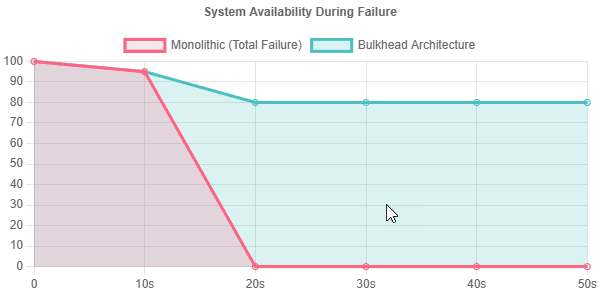
The graph below represents a system using bulkhead patterns compared to a monolithic approach during a service failure.
Figure 1: Throughput During Partial System Failure
The Resilient Mindset
Building for failure requires a shift in perspective. You are not designing a system that works until it breaks; you are designing a system that continues to work while it is breaking. By proactively managing the blast radius, implementing bulkheads, and planning for graceful degradation, you move from reactive patching to intentional, robust engineering.
What We Have Learned
We have explored how resilient architecture assumes failure as the baseline. By isolating components to control the blast radius, using bulkhead patterns to contain damage, and planning for graceful degradation, we ensure that individual component failures do not result in total system collapse. Building these safeguards early is not just good practice but it is the only way to guarantee reliability in a complex distributed environment.