By 2026, AI coding assistants have become as routine in a Java developer’s workflow as Stack Overflow once was. Stack Overflow’s Developer Survey shows that well over 70% of professional developers now use some form of AI code generation in their day-to-day work — and that number keeps climbing. Tools like GitHub Copilot, JetBrains AI Assistant, and various Claude-powered integrations can scaffold a Spring Boot endpoint, generate a JPA entity, or wire up a Kafka consumer in seconds.
That speed is genuinely impressive. However, speed without judgment is how bugs get shipped to production. The uncomfortable truth is that AI assistants do not understand your system — they pattern-match against millions of code samples to produce something that looks plausible, compiles cleanly, and passes a cursory glance. Most of the time that is exactly what you need. But sometimes it is subtly, dangerously wrong.
In this article we are going to walk through three categories of real pitfalls I have observed in AI-generated Java code throughout 2026: subtle logic errors, security vulnerabilities, and the over-engineering trap. We will then round off with a practical pairing checklist you can apply immediately. Let us get into it.
AI tool adoption among Java developers

When AI Gets the Logic Wrong — The Subtle Bugs
The most dangerous category of AI-generated mistakes is not the kind that causes a compile error. It is the kind that causes a wrong answer at runtime, silently. These bugs survive code review precisely because they look correct on the surface.
Off-by-one errors in streams and collectors
One pattern I keep encountering is misuse of Java Stream terminal operations. AI assistants often mix up findFirst() and findAny() semantics, or generate a Collectors.groupingBy() where a Collectors.partitioningBy() would be semantically correct — and the resulting map still compiles and runs, it just silently partitions data incorrectly.
Similarly, when dealing with paginated queries in Spring Data, generated code sometimes calculates page offsets incorrectly — swapping zero-based and one-based page indices. That means your first page of results might actually skip the very first record, which is exactly the kind of bug that survives unit tests if those tests were also generated by the same AI.
Incorrect use of Optional
Java’s Optional is a frequent source of AI-generated logic mistakes. The following pattern is something AI tools generate surprisingly often:
// AI-generated — looks fine, but defeats the purpose of Optional entirely
Optional<User> user = userRepository.findById(id);
if (user.isPresent()) {
    return user.get();
} else {
    throw new UserNotFoundException(id);
}
This compiles, runs, and does the right thing. But it is functionally identical to ignoring Optional and simply calling .get(). The idiomatic version is:
// Idiomatic — one line, same semantics, no boilerplate
return userRepository.findById(id)
    .orElseThrow(() -> new UserNotFoundException(id));
The real risk is that when AI generates the verbose version inside a larger method, a reviewer assumes the logic was intentional and moves on. In a codebase with several hundred such patterns, maintainability suffers badly.
Thread-safety assumptions that do not hold
With JEP 444 Virtual Threads now stable, AI assistants frequently suggest refactoring blocking code to run in virtual threads — which is often the right call. However, AI tools regularly miss the consequence: objects that were previously confined to a single platform thread can now be shared unexpectedly across concurrent virtual threads. A SimpleDateFormat instance stashed in a field, a Connection borrowed from a pool and re-used, or a static HashMap used as a cache — all of these become race conditions that manifest only under load.
Watch outAI-generated virtual thread migrations rarely audit for shared mutable state. Always grep for static fields, thread-local variables, and connection reuse patterns before enabling virtual thread executors.
| Pattern | Why AI gets it wrong | Severity | Catch rate in review |
|---|---|---|---|
| Optional.get() without check | Training data contains both safe and unsafe usages | Medium | Often missed |
| Wrong Stream collector | Collectors have similar signatures | Medium | Rarely caught |
| Shared state in virtual threads | Misses non-local scope analysis | High | Almost never caught |
| Off-by-one in pagination | Zero-based vs one-based confusion | Medium | Caught only with data checks |
| Incorrect equals/hashCode | Generated based on visible fields only | High | Caught only with Set/Map tests |
Security Vulnerabilities: Identifying Unsafe Patterns Generated by AI
Logic bugs are frustrating. Security vulnerabilities are career-defining in the wrong way. Unfortunately, AI assistants are remarkably good at generating code that works correctly in the happy path while leaving the door wide open on the security front. Here are the patterns to watch for specifically in Java in 2026.
SQL injection through JPQL concatenation
Despite JPQL being far safer than raw SQL, AI tools regularly generate string-concatenated JPQL queries, especially in “quick” repository implementations. Spring Data’s @Query annotation supports parameterized queries properly — yet the generated code sometimes reaches for string concatenation out of laziness or because the training example was older:
// UNSAFE — AI-generated JPQL with string concatenation
@Query("SELECT u FROM User u WHERE u.email = '" + "' + :email + '" + "'")
List<User> findByEmailUnsafe(@Param("email") String email);

// SAFE — parameterized binding
@Query("SELECT u FROM User u WHERE u.email = :email")
List<User> findByEmail(@Param("email") String email);
The OWASP Top 10 for 2025 still lists injection as a top-three risk. AI-generated JPQL and Criteria API snippets are a common source. Never concatenate user input into any query string, regardless of the abstraction layer.
Overly permissive CORS configuration
When you ask an AI assistant to “enable CORS for the REST API,” it very often generates allowedOrigins("*") with allowCredentials(true) — a combination that is both invalid in modern browsers and a security anti-pattern. More subtly, it sometimes generates a configuration that works in development because the browser tolerates it there, but would represent a real vulnerability in production.
Always review generated Spring Security CORS configurations against your actual allowed origin list. For reference, the Spring Security CORS documentation is explicit that wildcard origins must not be combined with credential-bearing requests.
Insecure deserialization of untrusted input
AI assistants often suggest Jackson’s ObjectMapper with enableDefaultTyping() — a deprecated and dangerous method that enables polymorphic deserialization. When applied to untrusted JSON input, this opens a well-documented path to remote code execution. The safer modern alternative is to use activateDefaultTyping() with a strict allowlist via BasicPolymorphicTypeValidator. Always check whether generated serialization code enables polymorphism, and if so, whether it restricts the accepted types.
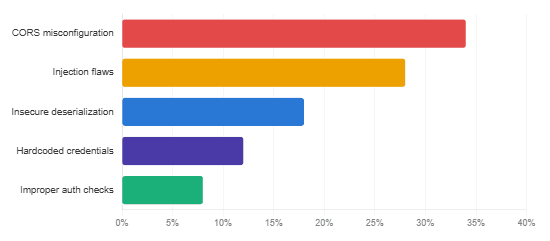
Top security issues in AI-generated Java code (2025–2026)
Run SpotBugs with the Find Security Bugs plugin on any module where AI generated a significant portion of the code. It catches several of these patterns automatically and is a quick addition to any Maven or Gradle build.
The “Over-Engineering” Trap: Why AI Loves Complex Patterns Where Simple Ones Work Best
There is a subtler, non-security-related class of AI mistake that is arguably the most widespread: reaching for a sophisticated pattern when a plain solution would be simpler, faster to build, and far easier to maintain. AI assistants are trained on a huge corpus of architecture articles and design pattern tutorials — so they default to those patterns even when the problem does not need them.
Strategy pattern for a two-branch condition
Ask an AI to “handle multiple payment types” and it will often generate a full Strategy pattern with a PaymentStrategy interface, a PaymentStrategyFactory, a PaymentContext, and concrete implementations. When your use case has exactly two payment types and the logic is genuinely simple, a straightforward switch expression (which in Java 21+ is expressive and concise) is the right tool. The Strategy pattern adds five files, two layers of indirection, and nothing except the illusion of extensibility.
CQRS for a single-table CRUD endpoint
Command Query Responsibility Segregation is a genuinely valuable pattern for systems with high read/write asymmetry, complex domain logic, or independent scaling requirements. AI assistants suggest it for CRUD endpoints on a single table with fifty rows. The cost is a separate command model, a separate query model, a synchronization mechanism between them, and additional infrastructure overhead — all to serve a GET /customers/{id} endpoint that would have been three lines with Spring Data JPA.
Martin Fowler’s original CQRS guidance is very explicit on this: the pattern “comes at a significant cost” and “should only be applied to specific portions of a system.” AI assistants have read that article — but they apply the pattern regardless.
Before accepting a generated architecture, ask: “Would a senior developer with ten years of production experience reach for this pattern here?” If the answer is probably not, push back. The simplest code that satisfies the requirement is almost always the best code.
| AI-generated pattern | When it is appropriate | When it is overkill | Simpler alternative |
|---|---|---|---|
| Strategy + Factory | 5+ interchangeable algorithms, runtime selection | 2–3 known cases | switch expression / sealed interface |
| CQRS | High read/write asymmetry, event sourcing | Standard CRUD, single schema | Spring Data repository |
| Event-driven async | Decoupled microservices, high throughput | Single-service internal calls | Direct method call or Spring @Async |
| Builder for a 2-field POJO | Objects with many optional fields (>5) | Simple value containers | Java record or constructor |
| Abstract factory hierarchy | Multiple product families, parallel hierarchies | Single product variant | Static factory method |
My Personal Rules for AI Pairing: A Checklist for Reviewing AI-Generated Code
After running into the issues above repeatedly over the past year, I developed a review checklist that I now apply to any significant block of AI-generated Java code before accepting it. It takes roughly five minutes and has caught something meaningful almost every time I use it.
- Read the business logic, not just the syntax. AI produces syntactically correct code almost always. What it misses is semantic correctness relative to your domain. Read what the code does, not just whether it compiles.
- Check every place user input touches the database or filesystem. Look for query string concatenation, file path construction, and XML/JSON parsing of untrusted data. These are the highest-risk injection surfaces.
- Count the number of new abstractions. If the change introduces more than two new types or interfaces for a problem that sounds simple, question each one. Ask whether it could be replaced by a language feature (sealed interfaces, records, switch expressions).
- Verify thread-safety assumptions explicitly. When generated code introduces new threads, virtual threads, or async operations, map every shared object and ask whether it is either immutable or properly synchronized.
- Check equals() and hashCode() whenever a generated class is used in a Set or as a Map key. AI frequently generates these based only on visually prominent fields, missing natural-key semantics entirely.
- Test the unhappy path manually. AI-generated code tends to handle the happy path well and generate stub error-handling that compiles but swallows exceptions silently. Exercise at least one failure mode.
- Run a static analysis pass. Add PMD, SpotBugs, or SonarQube to your pipeline and check the AI-generated diff specifically. Most teams already have these tools — the habit of actually looking at the output on AI-heavy diffs is what matters.
- Ask the AI to explain its own output. Paste the generated code back and ask “What assumptions did you make, and what could go wrong?” It surfaces its own uncertainty and often reveals the edge cases it silently ignored.
The OWASP Top 10 (2025 edition), the OpenJDK JEP index, and Martin Fowler’s Refactoring Guru pattern catalog are three tabs worth keeping open during AI-assisted development sessions.
Conclusion: AI Is a Tool, Not a Senior Developer
None of what we have covered here is an argument for using AI tools less. Quite the opposite. The developers who get the most value from AI assistants are the ones who treat the output as a confident first draft from a brilliant junior engineer — one who has read everything but has never been paged at 2 AM because of a race condition in production.
The senior developer’s role has not been replaced; it has shifted. You are no longer the one who types out the boilerplate — you are the one who knows which boilerplate to accept, which to rewrite, and which to reject entirely. That requires a sharper understanding of the language and platform, not a lesser one. Interestingly, AI adoption is therefore raising the bar for what it means to be a strong Java engineer rather than lowering it.
Keep the checklist close, build the habit of reading AI output with the same critical eye you would apply to a pull request from someone you do not yet know well, and you will extract the productivity benefit without inheriting the debt.
What We Learned
We started by acknowledging how deeply AI coding assistants have embedded themselves in the Java ecosystem by 2026 and then walked through three distinct risk categories. First, we saw how AI generates subtle logic errors — particularly around Java Streams, Optional usage, and thread-safety assumptions with virtual threads — that survive compilation and cursory review. Next, we examined common security vulnerabilities in generated code: SQL/JPQL injection through string concatenation, overly permissive CORS configurations, and dangerous Jackson deserialization settings. We then looked at the over-engineering trap, where AI defaults to heavyweight design patterns (CQRS, Strategy, Abstract Factory) for problems that modern Java language features handle more cleanly. Finally, we built a practical eight-point checklist for reviewing AI-generated Java code before merging it — focusing on semantic correctness, security surfaces, abstraction count, thread-safety, and the static analysis pass that should accompany every AI-heavy diff.