Cloud architecture is no longer a niche specialisation — it is the backbone of how modern enterprises build, scale, and secure everything from mobile apps to AI pipelines. Yet the certification landscape can feel overwhelming. Which badge actually opens doors? Which one pays for itself fastest? This guide cuts through the noise and focuses specifically on role-based credentials that solution architects will find most valuable in 2026.
Before diving in, it helps to understand why role-based certifications matter more than vendor-neutral fundamentals at this stage of the market. General cloud literacy is increasingly assumed at the hiring level. What employers are looking for now is proof that you can design systems — not just use them. With that lens in place, let’s walk through the nine certifications worth your attention this year.
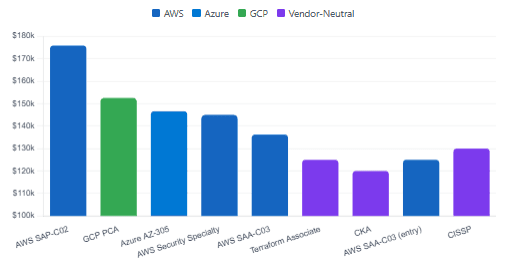
Average US Salary by Certification (2026, USD)
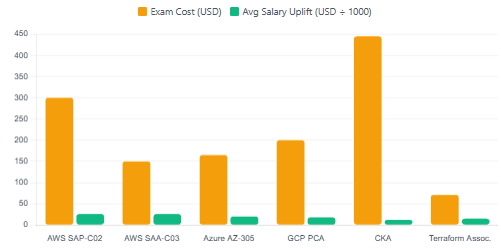
Exam Cost vs Average Salary Uplift (2026)
Now let’s break down each certification in detail — starting with the certifications most architects reach for first, and working toward the specialisations that separate senior practitioners from the crowd.
1. AWS Certified Solutions Architect – Associate (SAA-C03)
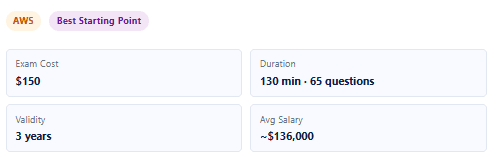
If there is one place most architects begin, it is here. The AWS Certified Solutions Architect – Associate (SAA-C03) is widely recognised as the entry credential for cloud architecture roles. It proves you can design and deploy secure, scalable solutions across core AWS services — compute, storage, databases, networking, and more.
What makes it particularly valuable is market reach. AWS holds the largest share of the global cloud market, and LinkedIn job data shows over 45,000 AWS cloud engineer openings at any given time — far ahead of GCP. For most professionals, this is the right first step, even if the goal eventually includes Azure or GCP credentials too.
The exam itself covers 1–3 years of recommended hands-on experience and is offered at a very accessible price point. From a pure ROI standpoint, it delivers an average salary uplift of around $26,000 — one of the strongest returns on a $150 investment in the certification world.
2. AWS Certified Solutions Architect – Professional (SAP-C02)
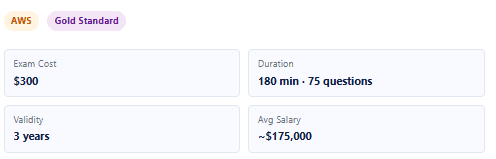
Once you have the Associate under your belt and two or more years of real-world AWS design experience, the AWS Certified Solutions Architect – Professional (SAP-C02) is the natural and most rewarding next step. This is the certification that truly separates architects from administrators.
The exam expects you to work across complex, multi-account environments and evaluate architectural trade-offs under real business constraints. It is demanding — but the payoff is clear. The national median base salary for professionals holding SAP-C02 sits at approximately $175,847, with senior-level practitioners regularly clearing $220,000+.
Moreover, as iCert Global notes, the Professional tier is what transforms someone from a technician into a strategic partner — the person who oversees the entire technical lifecycle of an organisation’s cloud infrastructure.
3. Microsoft Certified: Azure Solutions Architect Expert (AZ-305)
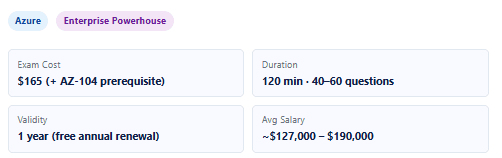
Azure holds the second-largest slice of the cloud market — around 21% — and is trusted by over 95% of Fortune 500 companies. For architects targeting large enterprise environments, banking, healthcare, or government, the Azure Solutions Architect Expert (AZ-305) is effectively a mandatory credential.
The exam covers four domains: identity and governance (25–30%), data storage solutions (25–30%), business continuity (10–15%), and infrastructure design (30–35%). Importantly, you must hold the Azure Administrator Associate (AZ-104) first, which means the full path costs $330 in exam fees. That said, the ROI is exceptional — a $330 investment against a potential $40,000+ salary increase is hard to argue with.
One feature worth highlighting is the renewal model. Unlike AWS’s three-year re-exam requirement, Microsoft offers free annual renewal via a 30-minute online assessment on Microsoft Learn — a practical advantage for professionals who want to stay current without interrupting project work.
4. Google Professional Cloud Architect (PCA)
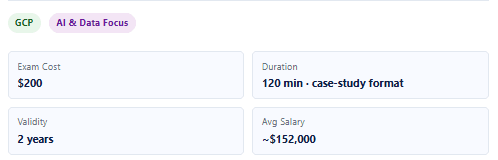
GCP may have a smaller job market than AWS, but what it lacks in volume it makes up for in salary. Google’s Professional Cloud Architect commands average salaries of around $152,550, with top earners crossing $192,000 — the highest average of the big three cloud providers.
What makes GCP particularly interesting in 2026 is its positioning around AI, ML, and data analytics. Google’s Kubernetes-native environment and BigQuery ecosystem make it the platform of choice for data-driven startups, research institutions, and organisations with heavy ML workloads. The PCA exam itself uses a unique case-study format — candidates work through four pre-published scenarios including EHR Healthcare, Mountkirk Games, and TerramEarth — which tests real architectural judgment rather than rote recall.
If your work or target employer leans heavily on data pipelines, Kubernetes, or generative AI infrastructure, GCP PCA deserves a serious look, either as a primary credential or as a complement to an existing AWS certification.
Quick Comparison: The Big Three Architect Certs
Before moving to specialisations, it is worth placing the three flagship credentials side by side so you can quickly gauge which best matches your situation:
| Credential | Provider | Exam Cost | Avg Salary | Best For |
|---|---|---|---|---|
| SAA-C03 | AWS | $150 | ~$136k | Entry-level architects, startups |
| SAP-C02 | AWS | $300 | ~$175k | Senior architects, enterprise AWS |
| AZ-305 | Azure | $165 (+prereq) | ~$147k | Enterprise, Microsoft-shop environments |
| GCP PCA | Google Cloud | $200 | ~$152k | Data/AI/ML-heavy workloads |
5. AWS Certified Security – Specialty (SCS-C02)
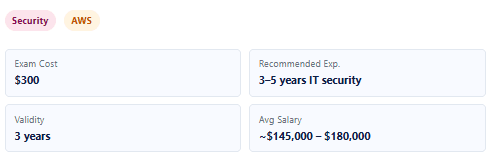
Security is no longer a separate concern architects hand off to a different team — it is baked into every design decision. The AWS Certified Security – Specialty (SCS-C02) validates deep expertise in identity and access management, encryption at scale, logging, and compliance frameworks like HIPAA, PCI-DSS 4.0, and FedRAMP.
In 2026, demand for this credential is being pushed upward by continued AWS migrations and increasingly tight regulatory environments. Senior cloud security architects in major US metros are clustering around $180,000. Many professionals also combine SCS-C02 with Azure AZ-500 to position themselves as multi-cloud security architects — a combination that typically commands a 15–20% salary premium over single-cloud specialists.
There are no mandatory prerequisites for SCS-C02, but AWS recommends at least two years of hands-on experience specifically securing AWS workloads. The scenario-based exam format is unforgiving if you lack real operational exposure.
6. HashiCorp Certified: Terraform Associate (004)
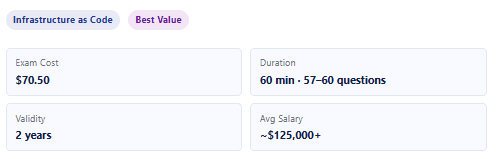
At $70.50, the HashiCorp Certified: Terraform Associate is one of the most affordable serious credentials in the industry — and the combination of AWS Solutions Architect + Terraform Associate is widely considered one of the strongest resume stacks for cloud engineering roles in 2026.
The numbers back this up: Terraform appears in 42% of infrastructure engineering job postings on LinkedIn as of Q1 2026 — far ahead of CloudFormation (18%) and Pulumi (7%). The exam covers HCL syntax, state management, modules, workspaces, and Terraform Cloud workflows. Version 004 launched in January 2026 and covers Terraform 1.12.
Even for architects who are not primarily infrastructure engineers, holding this certification signals that you can own the full IaC story — designing not just the architecture, but the automation that deploys it repeatably and reliably.
7. Certified Kubernetes Administrator (CKA)
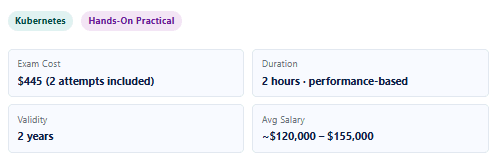
Modern cloud architectures are containerised architectures. As a result, the Certified Kubernetes Administrator (CKA) from the Linux Foundation has become a valuable complement to any cloud architect’s credentials — particularly for those designing microservices platforms or overseeing platform engineering teams.
The CKA is notably different from multiple-choice exams. It is a two-hour, fully hands-on, performance-based exam where you solve real cluster problems at the command line. This means you either know how Kubernetes works or you don’t — there is no guessing your way through it. Topics include cluster architecture, networking, storage, workloads, security, and troubleshooting.
The exam includes two attempts, which helps offset the higher cost. Furthermore, Kubernetes expertise pairs exceptionally well with GCP PCA given Google’s Kubernetes-native environment, as well as with Azure AKS and AWS EKS architecture work.
8. AWS Certified Machine Learning – Specialty (MLS-C01)
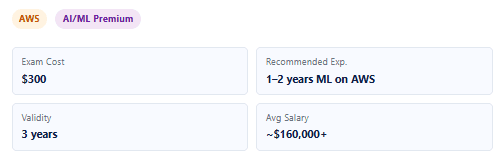
The AI/ML hiring premium is real and it is growing. The AWS Certified Machine Learning – Specialty (MLS-C01) delivers an average salary uplift of around $33,000 — among the highest of any AWS certification — and ML-related certifications are growing at 14% year-over-year in 2026.
As enterprises accelerate deployments of generative AI, computer vision, and NLP systems on AWS, architects who understand how to design ML infrastructure — from data ingestion pipelines through SageMaker training and inference endpoints — are commanding significant premiums. This certification validates exactly that knowledge base.
It is worth noting that MLS-C01 demands genuine machine learning knowledge, not just cloud mechanics. The study commitment is substantial (180–250 hours assuming foundational ML knowledge), but for architects targeting AI-focused organisations or leadership roles in data-heavy verticals, the investment is clearly justified.
9. CISSP – Certified Information Systems Security Professional
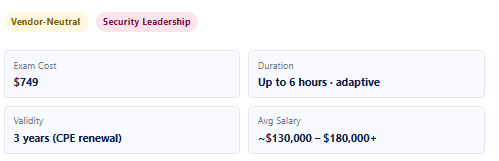
While every other certification on this list is cloud-provider-specific or tool-focused, the CISSP is the globally recognised standard for senior security leadership — and it belongs here because solution architects increasingly operate at the intersection of system design and enterprise security governance.
CISSP validates expertise across eight domains of security knowledge, including security and risk management, asset security, software development security, and identity and access management. Unlike the AWS Security Specialty (which is tightly scoped to AWS controls), CISSP speaks to boards, regulators, and auditors — making it valuable for architects who are also influencing security strategy at the organisational level.
The exam is genuinely demanding: the CAT (Computerised Adaptive Testing) format runs between 100 and 150 questions over up to six hours. Moreover, candidates need five years of paid work experience in at least two of the eight domains. This is not an entry-level certification — but for architects targeting CISO adjacency, Principal Architect, or Distinguished Engineer tracks, it is a powerful differentiator.
Choosing the Right Path for Your Stage
With nine certifications on the table, the question naturally becomes: where do you start and in what order? The answer depends largely on your current role, your target employer, and your timeline. As a general framework, however, the following progression works well for most architects:
| Career Stage | Recommended Certs | Why |
|---|---|---|
| Early (0–2 yrs) | AWS SAA-C03 → Terraform Associate | Best ROI and job market entry point; IaC shows immediate practical value |
| Mid (2–5 yrs) | AWS SAP-C02 or AZ-305 → CKA | Architect-level credentials that open senior roles; Kubernetes for platform work |
| Senior (5+ yrs) | GCP PCA + AWS Security Specialty or MLS-C01 | Multi-cloud positioning; AI/security specialisation for premium roles |
| Leadership track | CISSP | Security governance credibility for Principal/Distinguished/CISO-adjacent roles |
Multi-cloud note: In 2026, architects are increasingly expected to understand AI infrastructure orchestration alongside traditional cloud design. The emerging sweet spot is holding at least two major cloud credentials — typically AWS plus either Azure or GCP — combined with either an IaC or security specialisation. This combination is becoming a baseline expectation at Fortune 500 firms.
What We Learned
Cloud certifications in 2026 are far more than exam badges — they are role-specific signals of architectural maturity. We walked through nine credentials that matter most for solution architects this year, starting with the high-ROI AWS SAA-C03 and SAP-C02 pair, moving through Azure AZ-305 and GCP PCA for multi-cloud positioning, and extending into the specialisations — Terraform for IaC fluency, CKA for container platforms, AWS Security Specialty and CISSP for security leadership, and AWS MLS-C01 for the AI/ML premium.
The clearest takeaway is that the most valuable architects in 2026 are not single-cloud generalists — they are multi-cloud designers with a meaningful specialisation in security, IaC, or AI. Choosing your path deliberately, starting with the credential that best matches your current environment and target role, is far more effective than chasing every badge at once.