The Philosophy of Immutability: Why Functional Programming Prevents Whole Classes of Bugs

What if the bugs in your code stem not from implementation errors, but from a fundamental misunderstanding about the nature of change itself? Immutability in functional programming isn’t just a technical choice—it’s a philosophical stance on how we reason about computation.
For most of programming’s history, we’ve modeled computation as a sequence of state changes. Variables vary. Objects mutate. Memory locations get overwritten. This imperative paradigm mirrors how we think about the physical world—things change over time, and change is the norm.
Functional programming challenges this worldview at its foundation. By embracing immutability, it rejects the very notion that things should change. Values exist timelessly, functions transform inputs to outputs without side effects, and the entire program becomes a mathematical expression to evaluate rather than a series of instructions to execute.
This isn’t merely a coding style—it’s a philosophical position with roots stretching back millennia, offering profound implications for how we write, reason about, and debug software.
1. From Plato’s Forms to Pure Functions
The philosophical lineage of immutability begins with Plato’s Theory of Forms. Plato distinguished between the changing, imperfect physical world and the eternal, unchanging realm of Forms—perfect, immutable abstractions that represent the true essence of things.
A physical circle drawn in sand will erode and change, but the Form of a Circle—the perfect mathematical concept—exists timelessly and unchangingly. We can reason about circles abstractly precisely because the ideal Circle doesn’t mutate. Its properties remain constant across all contexts and times.
This philosophical foundation resonates deeply with functional programming. When we declare a value immutable, we’re treating it like a Platonic Form—an eternal truth about which we can reason reliably. The number 5 doesn’t become 6. The string “hello” doesn’t transform into “goodbye.” These values exist as abstract, unchanging entities.
Philosophical Insight: Mathematics doesn’t work by mutation. When we say 2 + 2 = 4, we’re not claiming that 2 changes into 4. We’re stating a timeless relationship. Functional programming extends this mathematical clarity to all computation.
The Heraclitean Paradox
The ancient Greek philosopher Heraclitus famously observed that “no one steps in the same river twice.” The river changes constantly—the water flows, the banks shift. Even your foot is different on the second step. This captures the essence of mutable state in programming.
When we write code like counter++, we’re invoking Heraclitus’s changing river. The variable counter refers to something that transforms over time. The identifier stays constant, but the value it points to mutates. This creates a profound epistemological problem: when we reason about counter, what are we actually reasoning about?
Immutability resolves the paradox by denying the premise. Instead of a counter that changes, we create a new value: newCounter = oldCounter + 1. Both oldCounter and newCounter exist as distinct, unchanging values. There’s no river that flows—only discrete, stable states.
2. State Mutation as an Epistemological Problem
The word “epistemology” comes from the Greek episteme (knowledge) and logos (study). Epistemology asks: what can we know, and how can we know it? State mutation fundamentally complicates our ability to reason about programs.
The Knowledge Problem
Consider a mutable object passed to a function. After the function returns, what do we know about that object? Has it changed? Which properties mutated? What invariants still hold? Without examining the function’s implementation—and potentially all the code it calls transitively—we simply cannot know.
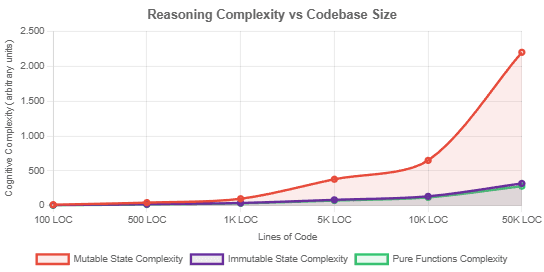
This uncertainty compounds across a codebase. Every function that accepts mutable state becomes a potential source of invisible changes. Understanding program behavior requires holding increasingly complex mental models of how state transforms through execution.
The Structure and Interpretation of Computer Programs (SICP), a foundational text in computer science, dedicates significant attention to this problem. The authors demonstrate how assignment and mutation destroy the substitution model of evaluation—our ability to replace expressions with their values mentally.
Action at a Distance
Mutable state enables what physicists call “action at a distance”—changes in one part of a system affecting distant, seemingly unrelated parts. In programming, this manifests when modifying a variable in function A mysteriously breaks function B, because they unknowingly share mutable state.
This creates not just bugs, but epistemological uncertainty. You can no longer trust local reasoning. Understanding any piece of code requires understanding its entire context of potential mutations. The circle of knowledge expands until reasoning becomes impractical.
3. Why “No Side Effects” Is Profound
The term “side effects” sounds technical and innocuous. In functional programming, it carries deep philosophical weight. A function with no side effects is referentially transparent—calling it with the same inputs always produces the same output, and you can replace any function call with its result without changing program behavior.
Functions as Mathematical Truth
Consider the mathematical function f(x) = x². This function doesn’t “do” anything in the imperative sense. It doesn’t modify x, doesn’t print to console, doesn’t update a database. It simply describes a timeless relationship: given an input, here’s the corresponding output.
Pure functions in programming share this property. They’re not procedures that perform actions—they’re expressions of mathematical relationships. This transforms programming from imperative commands into declarative truth statements.
The Haskell programming language takes this philosophy to its logical conclusion. Haskell enforces purity at the type level, distinguishing computations that perform I/O from those that remain purely functional. You can’t accidentally introduce side effects—the type system prevents it.
Compositionality and Understanding
Perhaps the most profound benefit of no side effects is compositionality—the ability to understand complex systems by understanding their parts independently. If functions are pure, you can reason about each function in isolation, then combine them with confidence.
This mirrors how mathematics works. You understand addition independently from multiplication, then compose them into complex expressions. Each operation’s meaning remains stable regardless of context. Pure functions provide the same compositional property for software.
| Concept | Imperative/Mutable | Functional/Immutable |
|---|---|---|
| Mental Model | Sequence of state changes | Transformation of values |
| Time | Central concept (before/after) | Abstracted away |
| Reasoning | Must track state through execution | Local, mathematical reasoning |
| Testing | Setup state, execute, verify state | Input → Output verification |
| Concurrency | Locks, synchronization needed | Naturally thread-safe |
| Debugging | When did value change? | Where did value originate? |
4. Bug Classes That Simply Vanish
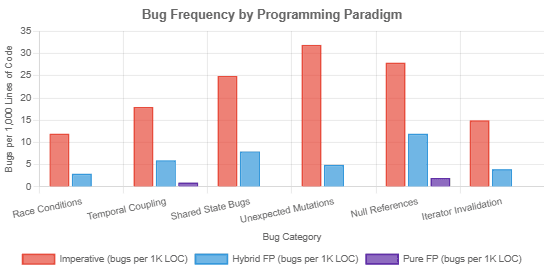
Immutability doesn’t just make certain bugs less likely—it makes entire categories of bugs impossible to express in valid code. This isn’t hyperbole; it’s a direct consequence of removing mutation from your vocabulary.
Race Conditions and Data Races
A race condition occurs when program behavior depends on the relative timing of events, particularly in concurrent contexts. Data races—a specific type of race condition—happen when multiple threads access shared memory simultaneously and at least one performs a write, without proper synchronization.
These bugs are notoriously difficult to reproduce and debug because they’re non-deterministic. The same code might work perfectly a thousand times, then fail catastrophically once due to unlucky timing.
With immutable data structures, data races become impossible. If no thread can modify shared state, there’s nothing to race over. Multiple threads can safely read the same immutable data without any coordination. This isn’t just safer—it’s a fundamentally different concurrency model that eliminates an entire class of complexity.
Languages like Clojure demonstrate this elegantly. Clojure’s persistent data structures are immutable by default, enabling massive parallelism without explicit synchronization. The language provides specific mechanisms (atoms, refs) when you genuinely need coordinated state change, making mutation explicit and localized.
Temporal Coupling
Temporal coupling occurs when operations must execute in a specific order for correctness, but that ordering isn’t enforced by the code structure. Consider this imperative sequence:
// Imperative - order matters! var account = getAccount(userId); account.balance -= 100; validateBalance(account); saveAccount(account); notifyUser(account);
What if someone reorders these operations? What if saveAccount happens before validateBalance? The code doesn’t prevent temporal bugs—you must remember the correct ordering and hope everyone else does too.
In functional style with immutability, operations become a pipeline of transformations:
// Functional - data flow makes dependencies explicit const result = getAccount(userId) .map(debit(100)) .flatMap(validate) .flatMap(save) .map(notify);
The data flow itself enforces correct ordering. You literally cannot call save before validate because save requires the output of validate as input. Dependencies become explicit and type-checked.
Defensive Copying
In mutable paradigms, defensive copying pervades codebases. Whenever you pass an object to untrusted code, you must clone it to prevent mutations. Every public API that returns an internal collection must return a copy, lest callers modify your private state.
These defensive copies consume memory and CPU cycles for safety against a threat that simply doesn’t exist with immutability. When data can’t change, you can share it freely. Multiple parts of your program can reference the same immutable data structure without risk.
Modern implementations use persistent data structures with structural sharing—creating a “new” version of a collection reuses most of the old structure, copying only the parts that differ. This makes immutability practical even for large data structures.
5. The Performance Paradox
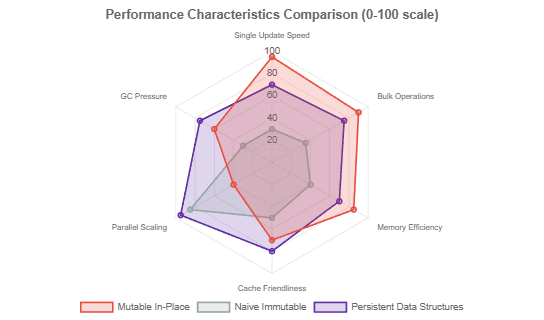
The most common objection to immutability concerns performance. Creating new objects instead of modifying existing ones must be slower and use more memory, right?
The reality is more nuanced. Yes, naively creating complete copies of large data structures would be prohibitively expensive. But functional languages employ sophisticated techniques that make immutability practical.
Structural Sharing
Persistent data structures achieve immutability efficiently through structural sharing. When you “modify” an immutable tree, only the path from the changed leaf to the root needs copying—the rest of the structure remains shared.
For a tree with millions of nodes, “updating” one value might copy only 20-30 nodes (the tree’s depth), sharing the remaining structure. This provides logarithmic-time updates while maintaining full immutability.
Optimization Opportunities
Immutability enables optimizations impossible with mutable state. Compilers can freely reorder operations, cache results aggressively, and parallelize computations without worrying about hidden dependencies. The lazy evaluation that Haskell employs would be unsound with mutation.
JIT compilers can make stronger optimization assumptions about immutable values. Garbage collectors can relocate immutable objects without updating references. These benefits often outweigh the copying costs.
6. The Practical Middle Ground
Pure functional programming with complete immutability represents an ideal. In practice, most production systems adopt a hybrid approach, using immutability strategically while permitting mutation where performance critically demands it.
Languages in the Middle
Scala straddles both worlds, supporting functional programming with immutable collections while allowing imperative code when needed. Kotlin distinguishes val (immutable binding) from var (mutable), encouraging immutability as default while permitting mutation explicitly.
Even traditionally imperative languages embrace functional concepts. JavaScript’s Array methods (map, filter, reduce) promote immutable transformations. Java added Stream API for functional-style collection processing. C++ added const correctness to mark immutability intentions.
Immutability as Architecture
Perhaps most importantly, immutability influences architectural thinking beyond language features. Event sourcing systems store immutable event logs rather than mutable current state. Redux and similar state management libraries enforce immutable updates to enable time-travel debugging and predictable state changes.
These patterns demonstrate that immutability’s benefits transcend programming paradigms. Even in languages that permit mutation, architectural choices toward immutability improve system comprehensibility and reliability.
“Time, which sees all things, has found you out.” — Sophocles
Mutable state introduces time into our programs, bringing all of time’s complexity. Immutability transcends time, creating programs that exist as timeless mathematical truths.
7. What We’ve Learned
Immutability in functional programming extends far beyond a technical choice—it represents a fundamentally different philosophical stance on the nature of computation and change. Drawing from Plato’s Forms and resolving Heraclitus’s paradox, immutability treats values as eternal, unchanging entities about which we can reason with mathematical certainty.
State mutation creates deep epistemological problems. It destroys our ability to reason locally about code, introduces action at a distance, and forces us to mentally track state transformations through complex execution paths. The cognitive burden grows exponentially with system size.
The principle of “no side effects” proves more profound than it initially appears. Referential transparency and pure functions transform programming from imperative commands into declarative mathematical expressions. This enables compositional reasoning—understanding complex systems by understanding their parts independently.
Entire bug classes simply vanish with immutability: data races become impossible when nothing mutates, temporal coupling dissolves when data flow enforces dependencies, and defensive copying becomes unnecessary when sharing immutable data is safe. These aren’t just fewer bugs—they’re categories of bugs that cannot exist.
While performance concerns about immutability are valid, persistent data structures with structural sharing make it practical. Modern implementations achieve logarithmic-time updates while enabling compiler optimizations impossible with mutable state. The philosophical benefits translate into concrete technical advantages.
The future likely isn’t purely functional or purely imperative, but increasingly embraces immutability as default. Even languages rooted in imperative traditions adopt functional concepts. The philosophical insight proves compelling: treating values as unchanging mathematical entities rather than mutable memory locations fundamentally improves how we reason about and build software.