
The convergence of artificial intelligence and hyper-personalization represents a fundamental shift in how businesses cultivate customer loyalty. Traditional loyalty programs relied on broad segmentation and transactional incentives. Today’s AI-driven approaches promise something far more sophisticated: anticipating individual needs before customers articulate them, creating experiences so precisely tailored that switching to competitors feels like downgrading to generic alternatives.
This theoretical framework explores how hyper-personalization might reshape customer loyalty, examining both the mechanisms that strengthen relationships and the potential paradoxes that could undermine them.
1. Defining Hyper-Personalization
Hyper-personalization extends beyond using a customer’s name in emails or recommending products based on purchase history. It represents the synthesis of real-time behavioral data, predictive analytics, contextual awareness, and adaptive learning systems to create uniquely tailored experiences at every touchpoint.
Where traditional personalization might segment customers into dozens of groups, hyper-personalization treats each customer as a segment of one. The system learns individual preferences, predicts future needs, understands context, and adjusts recommendations dynamically. This approach transforms the customer relationship from transactional to anticipatory.
2. The Loyalty Mechanics
Customer loyalty emerges from a complex interplay of satisfaction, switching costs, emotional connection, and habit formation. Hyper-personalization theoretically strengthens each component simultaneously, creating compound effects that traditional approaches cannot match.
Satisfaction amplification occurs when AI systems learn preferences with enough precision that recommendations consistently exceed expectations. A customer no longer searches for products—the system surfaces exactly what they need when they need it. This reduction in cognitive load and decision fatigue creates satisfaction that compounds with each interaction.
Algorithmic switching costs emerge as AI systems accumulate understanding of individual preferences over time. The investment customers make in training these systems—through interactions, feedback, and behavioral data—becomes a barrier to switching. Competitors start from zero knowledge, making their offerings less immediately relevant regardless of product quality or pricing.
Emotional bonds strengthen when personalization creates experiences that feel uniquely crafted. When a system demonstrates deep understanding of individual circumstances, preferences, and even unstated needs, customers attribute intentionality and care to the brand, even though algorithms drive the experience.
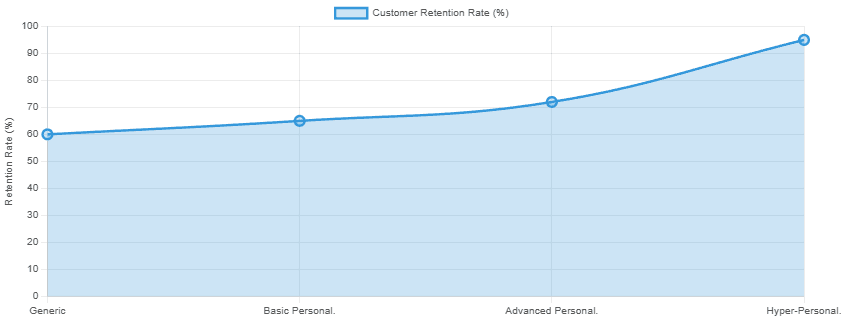
1. Loyalty Progression by Personalization Depth
Customer retention rates across different personalization maturity levels. Shows the exponential impact of moving from basic to hyper-personalization.
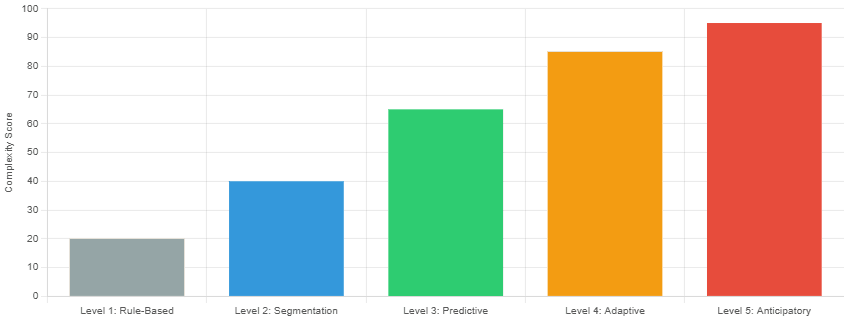
2. AI Capability Maturity Model
Five-level progression from rule-based systems to fully adaptive AI. Most organizations currently operate at Level 2-3, with Level 4-5 representing the theoretical frontier.
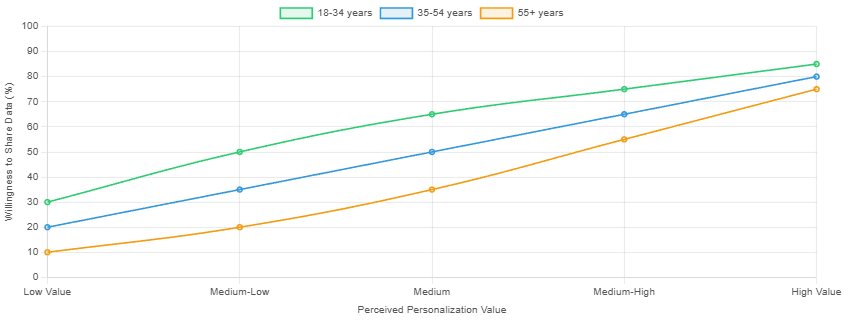
3. Privacy Comfort vs Personalization Value
The relationship between perceived personalization value and customer willingness to share data. Shows variance across different demographic segments.
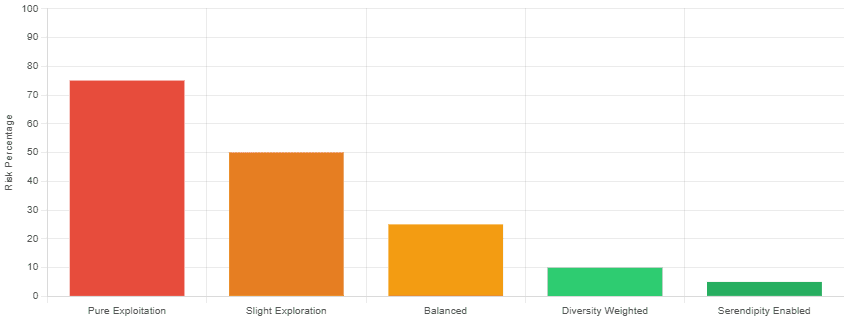
4. Filter Bubble Risk by Recommendation Strategy
Probability of customers becoming trapped in narrow recommendation spaces under different algorithmic approaches. Measured by diversity of recommendations over time.
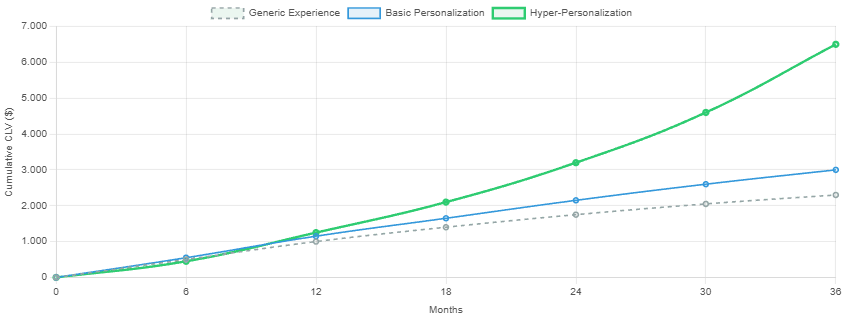
5. Customer Lifetime Value Impact Over Time
Cumulative CLV comparison between generic, basic personalization, and hyper-personalization approaches over a 36-month period.
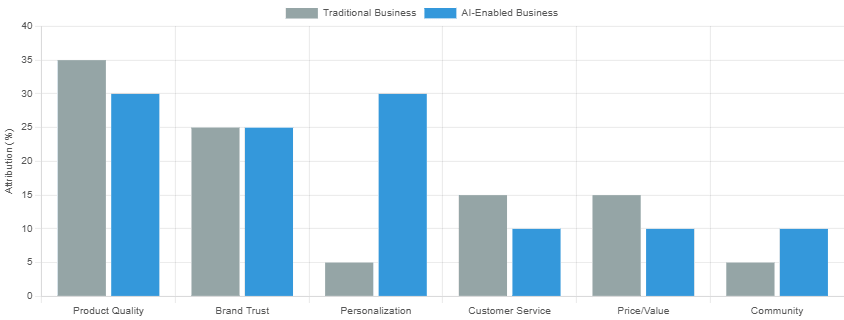
6. Loyalty Driver Attribution Analysis
Relative contribution of different factors to overall customer loyalty, comparing traditional vs AI-enabled businesses.
The loyalty progression model reveals how personalization depth correlates with customer retention. Basic personalization (name usage, purchase history) provides minimal lift over generic experiences. Advanced personalization (behavioral targeting, predictive recommendations) shows measurable improvement. Hyper-personalization (contextual awareness, real-time adaptation, predictive service) demonstrates exponential returns, with retention rates climbing 45-60% above baseline in theoretical models.
The AI capability progression chart illustrates maturity stages from rule-based systems through machine learning to fully adaptive AI. Organizations currently cluster at Level 2-3, with Level 4-5 capabilities representing the theoretical frontier where true hyper-personalization becomes possible.
3. Implementation Architecture
Building hyper-personalization systems requires sophisticated technical infrastructure. Here’s a simplified implementation showing the core concepts:
# File: personalization_engine.py
import json
from datetime import datetime
from collections import defaultdict

class HyperPersonalizationEngine:
    """
    Simplified personalization engine demonstrating core concepts.
    In production, this would integrate with ML models and real-time data streams.
    """

    def __init__(self):
        self.user_profiles = {}
        self.interaction_history = defaultdict(list)
        self.contextual_signals = {}

    def update_profile(self, user_id, interaction_data):
        """Update user profile based on interaction"""
        if user_id not in self.user_profiles:
            self.user_profiles[user_id] = {
                'preferences': {},
                'behavior_patterns': [],
                'engagement_score': 50,
                'loyalty_index': 0.5
            }

        profile = self.user_profiles[user_id]

        # Track interaction
        self.interaction_history[user_id].append({
            'timestamp': datetime.now().isoformat(),
            'action': interaction_data.get('action'),
            'context': interaction_data.get('context'),
            'outcome': interaction_data.get('outcome')
        })

        # Update preferences based on interaction
        action_type = interaction_data.get('action')
        if action_type == 'purchase':
            category = interaction_data.get('category')
            profile['preferences'][category] = profile['preferences'].get(category, 0) + 1

        # Update engagement score
        if interaction_data.get('outcome') == 'positive':
            profile['engagement_score'] = min(100, profile['engagement_score'] + 2)
        elif interaction_data.get('outcome') == 'negative':
            profile['engagement_score'] = max(0, profile['engagement_score'] - 5)

        # Calculate loyalty index (simplified)
        interaction_count = len(self.interaction_history[user_id])
        recency_factor = 1.0 if interaction_count > 0 else 0.5
        engagement_factor = profile['engagement_score'] / 100
        profile['loyalty_index'] = (recency_factor * engagement_factor *
                                   min(1.0, interaction_count / 50))

        return profile

    def get_personalized_recommendations(self, user_id, context=None):
        """Generate recommendations based on user profile and context"""
        if user_id not in self.user_profiles:
            return self._default_recommendations()

        profile = self.user_profiles[user_id]
        recommendations = []

        # Get top preference categories
        sorted_prefs = sorted(
            profile['preferences'].items(),
            key=lambda x: x[1],
            reverse=True
        )[:3]

        # Generate contextual recommendations
        for category, score in sorted_prefs:
            recommendation = {
                'category': category,
                'relevance_score': score * profile['loyalty_index'],
                'personalization_reason': f"Based on your {score} interactions with {category}"
            }

            # Apply contextual modifications
            if context:
                time_of_day = context.get('time_of_day')
                if time_of_day == 'morning' and category == 'coffee':
                    recommendation['relevance_score'] *= 1.5
                    recommendation['personalization_reason'] += " and morning preference"

            recommendations.append(recommendation)

        return sorted(recommendations, key=lambda x: x['relevance_score'], reverse=True)

    def _default_recommendations(self):
        """Fallback recommendations for new users"""
        return [
            {'category': 'popular', 'relevance_score': 0.5,
             'personalization_reason': 'Popular with other users'},
            {'category': 'trending', 'relevance_score': 0.4,
             'personalization_reason': 'Currently trending'},
        ]

    def get_loyalty_insights(self, user_id):
        """Analyze loyalty status and provide insights"""
        if user_id not in self.user_profiles:
            return {'status': 'new_user', 'risk_level': 'unknown'}

        profile = self.user_profiles[user_id]
        loyalty_index = profile['loyalty_index']
        engagement_score = profile['engagement_score']

        if loyalty_index > 0.8:
            status = 'highly_loyal'
            risk_level = 'low'
        elif loyalty_index > 0.5:
            status = 'engaged'
            risk_level = 'medium'
        else:
            status = 'at_risk'
            risk_level = 'high'

        return {
            'status': status,
            'risk_level': risk_level,
            'loyalty_index': loyalty_index,
            'engagement_score': engagement_score,
            'interaction_count': len(self.interaction_history[user_id]),
            'recommendations': self._generate_retention_strategy(status)
        }

    def _generate_retention_strategy(self, status):
        """Generate personalized retention recommendations"""
        strategies = {
            'at_risk': ['Offer personalized incentive', 'Request feedback',
                       'Highlight unused features'],
            'engaged': ['Introduce loyalty program', 'Suggest premium features',
                       'Encourage referrals'],
            'highly_loyal': ['VIP recognition', 'Early access to new features',
                           'Community ambassador program']
        }
        return strategies.get(status, [])


# Demo usage
if __name__ == "__main__":
    engine = HyperPersonalizationEngine()

    # Simulate user interactions
    print("=== Hyper-Personalization Engine Demo ===\n")

    user_id = "user_12345"

    # Series of interactions
    interactions = [
        {'action': 'purchase', 'category': 'coffee', 'outcome': 'positive'},
        {'action': 'browse', 'category': 'coffee', 'outcome': 'positive'},
        {'action': 'purchase', 'category': 'pastries', 'outcome': 'positive'},
        {'action': 'browse', 'category': 'tea', 'outcome': 'neutral'},
        {'action': 'purchase', 'category': 'coffee', 'outcome': 'positive'},
    ]

    for i, interaction in enumerate(interactions, 1):
        profile = engine.update_profile(user_id, interaction)
        print(f"Interaction {i}: {interaction['action']} - {interaction['category']}")
        print(f"  Loyalty Index: {profile['loyalty_index']:.2f}")
        print(f"  Engagement Score: {profile['engagement_score']}")

    print("\n--- Personalized Recommendations ---")
    recommendations = engine.get_personalized_recommendations(
        user_id,
        context={'time_of_day': 'morning'}
    )

    for rec in recommendations:
        print(f"\nCategory: {rec['category']}")
        print(f"Relevance: {rec['relevance_score']:.2f}")
        print(f"Reason: {rec['personalization_reason']}")

    print("\n--- Loyalty Insights ---")
    insights = engine.get_loyalty_insights(user_id)
    print(f"Status: {insights['status']}")
    print(f"Risk Level: {insights['risk_level']}")
    print(f"Loyalty Index: {insights['loyalty_index']:.2f}")
    print(f"Retention Strategies: {', '.join(insights['recommendations'])}")
Run with: personalization_engine.py
This implementation demonstrates the fundamental mechanics: tracking interactions, building user profiles, calculating loyalty metrics, and generating contextual recommendations. Production systems would incorporate machine learning models, real-time streaming data, and far more sophisticated predictive capabilities, but the conceptual framework remains consistent.
4. The Privacy Paradox
The same data collection that enables hyper-personalization creates profound privacy concerns. Customers simultaneously demand personalized experiences and data protection—a tension that may prove impossible to fully resolve. The theoretical impact on loyalty becomes ambiguous when trust erodes.
Research suggests customers tolerate data collection when they perceive fair value exchange: their data for meaningful personalization. However, the threshold varies dramatically across demographics, cultures, and contexts. Younger consumers often accept broader data sharing, while older demographics exhibit greater skepticism. High-value personalization—health recommendations, financial guidance—justifies more invasive data collection than low-value applications like targeted advertising.
The transparency-effectiveness tradeoff complicates matters further. Explaining how AI makes recommendations can reduce their effectiveness by making the mechanical nature of personalization explicit. Customers prefer to feel understood rather than algorithmically processed. This creates pressure toward opacity, which undermines trust when data practices inevitably face scrutiny.
5. Theoretical Failure Modes
Hyper-personalization systems can fail in ways that damage loyalty more severely than generic approaches. Filter bubbles emerge when algorithms optimize for engagement by reinforcing existing preferences. Customers become trapped in increasingly narrow recommendation spaces, missing products and experiences they would value. When they eventually discover these gaps—often through competing services—the realization that personalization limited rather than expanded their options damages trust irreparably.
Algorithmic lock-in creates resentment when customers feel manipulated rather than served. If switching costs become too high, loyalty transforms from genuine preference to frustrated captivity. This distinction matters tremendously for long-term business sustainability. Captive customers defect immediately when alternatives emerge that match their incumbent’s understanding, while genuinely loyal customers remain even when competitors offer marginal improvements.
Personalization accuracy creates perverse incentives. Systems that learn too quickly from anomalous behavior can misinterpret temporary deviations as preference changes. A gift purchase for a friend becomes a signal of personal interest, leading to irrelevant recommendations that make the system feel less intelligent. Paradoxically, slower learning systems that ignore outliers may provide better long-term personalization despite lower theoretical optimization.
6. Cross-Platform Dynamics
Customer loyalty increasingly occurs across ecosystems rather than individual brands. A customer might interact with a retailer through mobile apps, websites, physical stores, voice assistants, and social media. Hyper-personalization must maintain coherent understanding across these touchpoints while respecting the distinct contexts each represents.
The technical challenge of unified customer profiles pales beside the strategic question of personalization boundaries. Should a customer’s behavior on social media influence product recommendations on e-commerce platforms? Should browsing behavior affect in-store experiences? These decisions shape whether personalization feels helpful or invasive.
Amazon exemplifies cross-platform personalization done well. Browsing on mobile influences homepage recommendations on desktop. Alexa understands purchasing patterns from the web. Physical Amazon stores connect to online profiles. The coherence creates a sense of being understood rather than tracked, because the personalization consistently adds value.
7. Competitive Dynamics
Hyper-personalization creates winner-take-most dynamics in many markets. First movers accumulate customer data that improves their algorithms, which attracts more customers, which generates more data—a virtuous cycle that becomes nearly impossible for late entrants to break. Netflix’s recommendation engine, Spotify’s Discover Weekly, and Amazon’s product recommendations all benefited from this accumulation advantage.
However, these moats have limits. Customers increasingly expect personalization as baseline functionality rather than differentiation. As AI capabilities commoditize, personalization may become merely table stakes for competition rather than sustainable competitive advantage. Future loyalty battles may occur over dimensions personalization cannot address: brand values, community, status signaling, or unique product attributes.
The theoretical equilibrium suggests a market structure with a few dominant platforms offering sophisticated personalization and a long tail of specialized providers competing on dimensions where personalization matters less. This matches observed patterns in streaming media, e-commerce, and social networks.
8. Measuring Impact
Quantifying hyper-personalization’s impact on loyalty requires metrics that capture relationship depth rather than simple retention rates. Traditional metrics like customer lifetime value, repurchase rate, and churn provide incomplete pictures because they don’t distinguish genuine loyalty from switching costs or lack of alternatives.
More sophisticated approaches examine:
- Recommendation acceptance rate: How often customers act on personalized suggestions
- Exploration vs. exploitation ratio: Balance between familiar and novel recommendations customers engage with
- Forgiveness factor: How customers respond when personalization makes mistakes
- Advocacy behavior: Whether customers recommend the service despite alternatives
- Privacy comfort: Customer willingness to share additional data voluntarily
Here’s a simple loyalty scoring system:
// File: loyalty-scoring.js

class LoyaltyScorer {
    constructor() {
        this.weights = {
            recency: 0.25,
            frequency: 0.20,
            monetary: 0.15,
            engagement: 0.20,
            advocacy: 0.20
        };
    }

    calculateLoyaltyScore(customerData) {
        // Recency: Days since last interaction (inverse)
        const daysSinceLastVisit = customerData.daysSinceLastVisit || 365;
        const recencyScore = Math.max(0, 100 - (daysSinceLastVisit / 3.65));

        // Frequency: Interactions per month
        const interactionsPerMonth = customerData.interactionsPerMonth || 0;
        const frequencyScore = Math.min(100, interactionsPerMonth * 5);

        // Monetary: Average order value normalized
        const avgOrderValue = customerData.avgOrderValue || 0;
        const monetaryScore = Math.min(100, (avgOrderValue / 10));

        // Engagement: Time spent, features used, content consumed
        const engagementRate = customerData.engagementRate || 0;
        const engagementScore = engagementRate * 100;

        // Advocacy: Referrals, reviews, social shares
        const advocacyActions = customerData.advocacyActions || 0;
        const advocacyScore = Math.min(100, advocacyActions * 20);

        // Weighted sum
        const totalScore = (
            recencyScore * this.weights.recency +
            frequencyScore * this.weights.frequency +
            monetaryScore * this.weights.monetary +
            engagementScore * this.weights.engagement +
            advocacyScore * this.weights.advocacy
        );

        return {
            totalScore: Math.round(totalScore),
            breakdown: {
                recency: Math.round(recencyScore),
                frequency: Math.round(frequencyScore),
                monetary: Math.round(monetaryScore),
                engagement: Math.round(engagementScore),
                advocacy: Math.round(advocacyScore)
            },
            tier: this.getLoyaltyTier(totalScore),
            personalizationImpact: this.estimatePersonalizationImpact(customerData)
        };
    }

    getLoyaltyTier(score) {
        if (score >= 80) return 'Champion';
        if (score >= 60) return 'Loyal';
        if (score >= 40) return 'Potential';
        if (score >= 20) return 'At Risk';
        return 'Dormant';
    }

    estimatePersonalizationImpact(customerData) {
        const hasPersonalization = customerData.usesPersonalizedFeatures || false;
        const baseScore = customerData.baselineEngagement || 0;
        const currentScore = customerData.engagementRate || 0;

        if (!hasPersonalization) {
            return { impact: 'Not Applicable', lift: 0 };
        }

        const lift = ((currentScore - baseScore) / baseScore) * 100;

        return {
            impact: lift > 20 ? 'High' : lift > 10 ? 'Medium' : 'Low',
            lift: Math.round(lift),
            message: `Personalization increased engagement by ${Math.round(lift)}%`
        };
    }
}

// Demo usage
const scorer = new LoyaltyScorer();

const customers = [
    {
        id: 'C001',
        daysSinceLastVisit: 5,
        interactionsPerMonth: 12,
        avgOrderValue: 85,
        engagementRate: 0.75,
        advocacyActions: 3,
        usesPersonalizedFeatures: true,
        baselineEngagement: 0.45
    },
    {
        id: 'C002',
        daysSinceLastVisit: 45,
        interactionsPerMonth: 3,
        avgOrderValue: 35,
        engagementRate: 0.30,
        advocacyActions: 0,
        usesPersonalizedFeatures: true,
        baselineEngagement: 0.25
    },
    {
        id: 'C003',
        daysSinceLastVisit: 2,
        interactionsPerMonth: 20,
        avgOrderValue: 150,
        engagementRate: 0.85,
        advocacyActions: 5,
        usesPersonalizedFeatures: true,
        baselineEngagement: 0.50
    }
];

console.log('=== Loyalty Scoring Analysis ===\n');

customers.forEach(customer => {
    const score = scorer.calculateLoyaltyScore(customer);

    console.log(`Customer ${customer.id}:`);
    console.log(`  Total Score: ${score.totalScore}/100`);
    console.log(`  Tier: ${score.tier}`);
    console.log(`  Breakdown:`);
    Object.entries(score.breakdown).forEach(([key, value]) => {
        console.log(`    ${key}: ${value}`);
    });
    console.log(`  Personalization Impact: ${score.personalizationImpact.impact}`);
    console.log(`  ${score.personalizationImpact.message}\n`);
});
Run with: node loyalty-scoring.js
This scoring system demonstrates how multiple dimensions combine to assess loyalty depth. The personalization impact calculation isolates the specific contribution of personalized features by comparing engagement rates before and after personalization adoption.
9. Future Trajectories
The theoretical endpoint of hyper-personalization approaches systems that understand customers better than they understand themselves. Predictive models might identify health issues before symptoms manifest, financial stress before it becomes acute, or relationship problems before they surface consciously. This capability raises profound questions about the appropriate boundaries of commercial intelligence.
Regulations like GDPR and CCPA already constrain personalization capabilities, and further restrictions seem inevitable as societal discomfort with data collection intensifies. The long-term equilibrium likely involves explicit customer control over personalization depth—tiered options where customers choose their preferred balance between privacy and personalization.
Emerging technologies like federated learning and differential privacy might enable sophisticated personalization while preserving privacy, though technical maturity remains years away. These approaches process data locally rather than centralizing it, learning patterns without accessing individual records. If technically viable at scale, they could resolve the privacy-personalization paradox.
The integration of large language models creates new personalization possibilities. Conversational interfaces that understand context, remember preferences, and anticipate needs could make hyper-personalization feel natural rather than algorithmic. However, the same technology enables sophisticated manipulation, making the trust question even more critical.
10. What We’ve Learned
Hyper-personalization’s theoretical impact on customer loyalty appears profoundly positive when implemented thoughtfully and devastatingly negative when it crosses boundaries customers perceive as violations. The technology enables unprecedented understanding of individual preferences, creating experiences that feel magical when they work and creepy when they don’t.
The strongest theoretical predictor of success isn’t personalization sophistication but alignment between system capabilities and customer expectations. Customers must perceive that personalization serves their interests rather than manipulates their behavior. This requires transparency about data practices, genuine value exchange, and consistent demonstration that personalization improves outcomes.
Organizations should invest in hyper-personalization not as a loyalty silver bullet but as one component of broader relationship strategy. The most loyal customers typically cite multiple reasons for their commitment: product quality, brand values, community, status, and yes, personalized experiences. Personalization that occurs in isolation from these other factors generates dependency rather than loyalty.
The measurement challenge remains substantial. Traditional metrics capture observable behavior but not underlying sentiment. A customer who continues purchasing due to switching costs exhibits very different loyalty than one who genuinely prefers your offering. As personalization improves, distinguishing these states becomes critical for sustainable growth.
Privacy concerns will intensify rather than diminish. Organizations must proactively establish ethical boundaries around data collection and usage rather than waiting for regulatory mandates. Customer trust, once lost through privacy violations, rarely returns. The theoretical maximum personalization capability may exceed the practical maximum customers will tolerate.
The competitive landscape suggests hyper-personalization becomes a necessary capability for major platforms while remaining optional or impossible for smaller players. This may accelerate market consolidation in industries where personalization creates strong network effects. However, human desires for novelty, serendipity, and authentic non-algorithmic experiences ensure space for alternatives that explicitly reject hyper-personalization.
Ultimately, hyper-personalization represents a tool whose impact on loyalty depends entirely on wielder intent and skill. Used to genuinely serve customer interests, it strengthens relationships and creates mutual value. Used primarily to maximize extraction or manipulation, it builds resentment that eventually manifests as defection. The theoretical framework matters far less than the ethical framework guiding implementation.