Continuous Delivery for Django Apps with Kubernetes: Blue/Green & Canary Deployments

As web applications scale and user expectations for uptime grow, traditional deployment methods become insufficient. Continuous Delivery (CD) bridges this gap by enabling faster, safer, and more reliable releases. For Django developers, combining CD pipelines with Kubernetes deployment strategies—like Blue/Green and Canary releases—offers a powerful path to continuous evolution without service interruption.
In this article, we’ll explore how to set up a Kubernetes-based CD pipeline for Django, analyze the differences between Blue/Green and Canary deployment models, and discuss when to use each in production.
1. Why Continuous Delivery Matters for Django
Continuous Delivery automates the process of integrating, testing, and deploying your application. For Django apps, this ensures that every code change can move to production confidently. The goals include:
- Reduced deployment risk: Smaller, more frequent updates are easier to debug.
- Faster feedback: Immediate validation of code changes.
- Improved reliability: Automated tests catch regressions before they reach users.
In essence, CD turns deployments from events into routines.
2. Kubernetes: The Backbone of Scalable Deployments
Kubernetes plays a pivotal role in achieving reliable CD pipelines. It abstracts infrastructure management and allows seamless deployment of Django containers. Key Kubernetes components that enable CD include:
| Component | Purpose |
|---|---|
| Deployments | Define how Django app versions are rolled out and scaled. |
| Services | Expose your application to users via stable endpoints. |
| Ingress Controllers | Manage routing and SSL termination for smooth blue/green transitions. |
| ConfigMaps & Secrets | Manage environment-specific settings securely. |
| Horizontal Pod Autoscaler (HPA) | Automatically scales Django pods based on load. |
By containerizing Django and deploying it on Kubernetes, you gain not just scalability but also predictable rollouts.
3. Blue/Green Deployments for Django
Concept
In a Blue/Green deployment, two identical environments (Blue and Green) exist simultaneously:
- Blue: The current production environment.
- Green: The new version awaiting release.
When Green is validated, traffic seamlessly switches from Blue to Green with zero downtime.
Workflow Example
- The Blue environment runs the current Django version.
- Developers push changes to Git; CI builds a new Docker image.
- The CD pipeline deploys this image to the Green environment.
- QA tests the Green version using internal endpoints.
- Once validated, Kubernetes Ingress switches traffic to Green.
- Blue remains idle and can be rolled back instantly if issues arise.
apiVersion: apps/v1
kind: Deployment
metadata:
  name: django-green
spec:
  replicas: 3
  template:
    metadata:
      labels:
        app: django
        version: green
    spec:
      containers:
        - name: django
          image: myregistry/django:2.0
Pro Tip: Automate traffic switching with a GitOps tool like Argo Rollouts, which integrates with Kubernetes services to perform Blue/Green and Canary transitions declaratively.
4. Canary Deployments for Django
Concept
Canary deployments release new features to a subset of users before a full rollout. This allows teams to monitor stability and metrics before full adoption.
Workflow Example
- A new Django version (v2.0) is deployed alongside v1.9.
- The load balancer routes 5–10% of traffic to v2.0.
- Real-time monitoring (e.g., Prometheus + Grafana) measures key metrics: latency, error rates, database health.
- If metrics are stable, traffic gradually increases until v2.0 fully replaces v1.9.
apiVersion: apps/v1
kind: Deployment
metadata:
  name: django-canary
spec:
  replicas: 2
  template:
    metadata:
      labels:
        app: django
        track: canary
    spec:
      containers:
        - name: django
          image: myregistry/django:2.0
The key advantage is risk isolation. Problems are caught early, reducing user impact and improving confidence in releases.
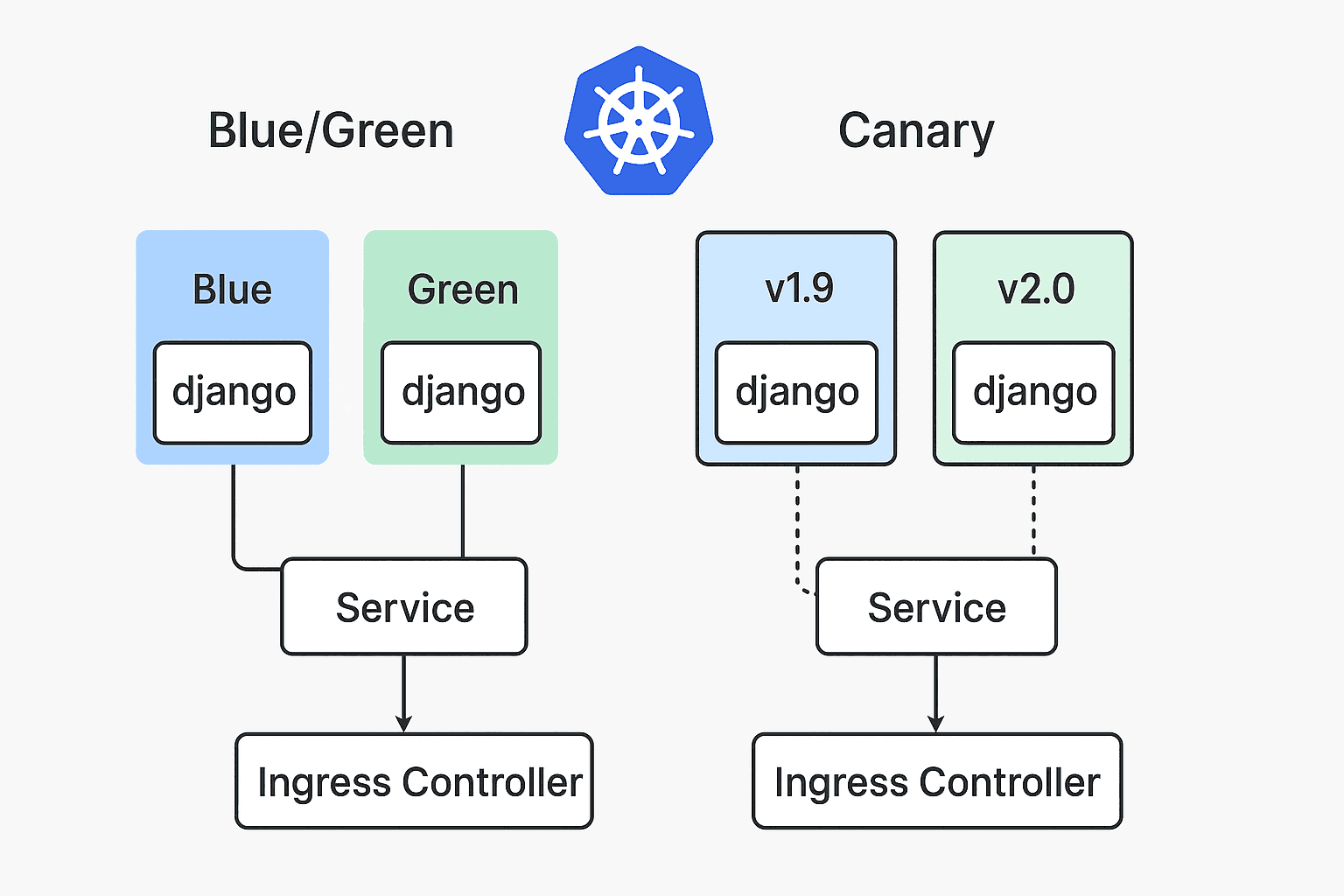
To better understand how traffic flows during Blue/Green and Canary deployments, the diagram below illustrates the process. In Blue/Green deployments, all traffic switches at once from the old (Blue) environment to the new (Green) environment. In Canary deployments, only a small portion of users are routed to the new version initially, with traffic gradually increasing as confidence grows. This visual representation helps clarify the differences in risk management and rollout strategy between the two approaches.
5. Comparing Blue/Green vs. Canary Deployments
| Criteria | Blue/Green | Canary |
|---|---|---|
| Traffic Switching | All-at-once | Gradual |
| Rollback Speed | Instant | Gradual |
| Monitoring Needs | Moderate | High (requires detailed metrics) |
| Best For | Major version upgrades | Incremental feature rollouts |
| Risk Level | Medium | Low |
In practice, many teams use both: Blue/Green for core updates and Canary for experimental features.
6. Automating the Pipeline
To achieve continuous delivery, integrate Kubernetes with CI/CD tools:
| Tool | Purpose |
|---|---|
| GitHub Actions / GitLab CI | Build and push Django Docker images. |
| Argo CD / Flux | Manage declarative deployments on Kubernetes. |
| Helm | Package and version Django deployment templates. |
| Prometheus & Grafana | Monitor application metrics for canary validation. |
A simplified GitHub Actions YAML might look like:
name: Django CD Pipeline
on: [push]
jobs:
  build-and-deploy:
    runs-on: ubuntu-latest
    steps:
      - uses: actions/checkout@v3
      - name: Build Docker image
        run: docker build -t myregistry/django:${{ github.sha }} .
      - name: Push image
        run: docker push myregistry/django:${{ github.sha }}
      - name: Deploy with kubectl
        run: kubectl apply -f k8s/
7. Monitoring and Rollback
Real-time observability is the backbone of safe continuous delivery. Using Prometheus, Grafana, and Kubernetes Events, teams can visualize latency, error rates, and resource consumption. If anomalies arise, Kubernetes enables instant rollback by simply scaling down the faulty deployment and scaling up the previous one.
kubectl rollout undo deployment/django-green
Conclusion
Continuous Delivery transforms Django deployment workflows into seamless, automated processes. By leveraging Kubernetes, Blue/Green, and Canary strategies, development teams can confidently deliver updates without downtime — blending agility with reliability.
As your deployment complexity grows, integrating tools like Argo CD or Spinnaker will take your CD pipeline to the next level.
Useful Links
- Argo Rollouts Documentation
- Kubernetes Deployment Strategies Guide
- Prometheus for Kubernetes Monitoring
- GitHub Actions for Kubernetes
- Django Docker Deployment Best Practices