
Understanding Backpressure in Reactive Systems: Why Producers Must Listen to Consumers

In the modern landscape of distributed systems and high-throughput stream processing, one of the most common causes of catastrophic failure is a simple, yet fatal, mismatch in processing speeds. When a producer generates data at a velocity that outpaces a consumer’s ability to process it, the system enters a state of overload. The essential mechanism designed to mitigate this collapse is known as backpressure.
Defining Backpressure
At its core, backpressure is a flow-control strategy that empowers a consumer to signal its processing capacity back to the producer. Rather than operating in isolation, the producer and consumer engage in an ongoing negotiation. In a reactive system, data producers—often called publishers—generate information at fluctuating rates, while consumers—or subscribers—operate under fixed or variable constraints.
When backpressure is absent, data must reside somewhere while waiting for the consumer. It typically accumulates in an internal buffer or queue. If these buffers are unbounded, memory usage will grow indefinitely until the system exhausts its resources, resulting in a disastrous “out-of-memory” (OOM) crash.
Backpressure vs. Rate Limiting
Engineers often conflate backpressure with rate limiting, yet they serve distinct architectural goals:
- Rate Limiting (Proactive): This is a rigid, predetermined cap on throughput. It rejects traffic based on a fixed threshold (e.g., “no more than 500 requests per second”), regardless of the consumer’s current state. It is primarily an instrument for protecting the entry point of a service from overload or malicious abuse.
- Backpressure (Reactive): This is a dynamic, real-time feedback mechanism. It observes the actual state of the consumer. If the consumer signals it is catching up, the “pressure” is eased and the producer may increase its throughput; conversely, if the consumer signals overload, the producer is commanded to throttle back immediately.
Backpressure at the Protocol Level
Backpressure is not merely an abstract concept; it is enforced through concrete signaling protocols that allow components to communicate state:
- Reactive Streams: Standards like the Reactive Streams specification provide a standardized approach where subscribers use a
request(n)method to explicitly inform the producer how many items they are currently prepared to process. - TCP Protocol: At the networking level, TCP utilizes window-based flow control. If the receiver’s buffer becomes full, it communicates a “zero window” size to the sender, effectively pausing the transmission of data packets.
- Message Queues: In distributed messaging systems like RabbitMQ, consumers can manage flow by sending “not acknowledged” (nack) signals or by simply stopping the consumption of new messages from the queue until they have regained processing capacity.
The Consequences of Absent Backpressure
When a system lacks a formal backpressure mechanism, it functions without a safety valve. The lack of backpressure leads to several predictable and devastating failure modes:
- Cascading Failures: If Service A is sluggish and fails to signal Service B to slow down, Service B’s buffers overflow. This leads to the failure of Service B, which then triggers a chain reaction that destabilizes Service C and beyond.
- Memory Exhaustion: Unbounded queues inevitably consume all available system memory, leading to garbage collection thrashing and eventual process termination.
- Indiscriminate Data Loss: Systems that attempt to manage overflow by dropping messages without a coordinated signal will often shed data indiscriminately, rather than making informed decisions about which tasks to prioritize.
Visualizing Throughput and Failure
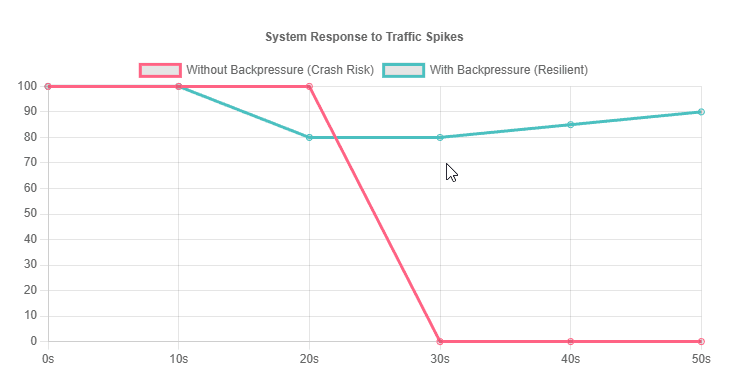
The graph below provides a clear comparison of how a system behaves during a traffic spike, contrasting an unmanaged approach with a backpressure-enabled architecture.
Figure 1: System Response to Traffic Spikes
Conclusion: The Cooperative Protocol
Backpressure is fundamentally a cooperative protocol. It succeeds only if every component in the communication chain respects the signals being sent. By implementing bounded buffers, propagating demand signals upstream, and designing systems that treat overload as a normal operational state rather than an emergency, engineers can ensure their software remains resilient. Moving from simple rate-based constraints to reactive, backpressure-aware communication is the hallmark of modern, stable, and high-performance distributed architecture.