Read/Write Quorums and the Algebra of Consistency: Why N, R, and W Aren’t Just Configuration Knobs

CAP and PACELC tell you what’s possible. Quorum math tells you exactly how to get there, one replica at a time.
Most engineers meet N, R, and W as three numbers in a config file: replication factor, read count, write count. Set them, restart the cluster, move on. But underneath those three letters sits a small, elegant piece of set theory that explains, with actual certainty rather than hand-waving, why some configurations guarantee you’ll always read what you last wrote, and why others quietly let you read something stale.
This is the mechanism behind Dynamo-style databases like Cassandra, Riak, and Voldemort, and it deserves the same rigorous treatment usually reserved for CAP and PACELC, because it’s the part of the theory you actually get to tune.
The Three Letters, Defined Precisely
N is the number of nodes a piece of data is replicated to. W is the number of those replicas that must acknowledge a write before the client is told it succeeded. R is the number of replicas that must respond before a read is considered complete. None of these numbers alone tells you anything about consistency. It’s the relationship between them that matters.
The classic Dynamo paper frames this precisely: setting R and W so that R plus W exceeds N yields a quorum-like system, and in that model, the latency of a read or write operation is dictated by the slowest of the required replicas, not by the full replica set. That second detail is easy to miss and turns out to matter just as much as the first.
Why R + W > N Actually Works
The guarantee isn’t magic, it’s the pigeonhole principle wearing a database costume. If you write to W out of N replicas, and later read from R out of N replicas, and R plus W is greater than N, then no matter which specific nodes happen to answer, the read set and the write set are mathematically forced to share at least one node in common.
R + W > N ⟹ read set ∩ write set ≠ ∅
That shared node is what saves you. It received the most recent write, and since it’s also part of the read set, the latest version is guaranteed to be visible to that read, even if every other replica happens to be lagging behind. The overlap isn’t a probability. Given the arithmetic condition holds, it’s a certainty.
Seeing It In Numbers
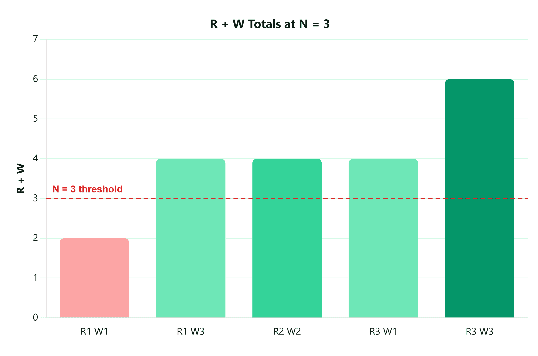
With a replication factor of 3, the chart below shows several common R and W combinations, their combined sum, and how that sum compares against N. Only the configurations that clear the N=3 threshold get the quorum-overlap guarantee.
| N | R | W | R + W | Overlap Guaranteed? | Typical Use |
|---|---|---|---|---|---|
| 3 | 1 | 1 | 2 | No | Maximum speed, eventual consistency accepted |
| 3 | 1 | 3 | 4 | Yes | Fast reads, expensive but safe writes |
| 3 | 2 | 2 | 4 | Yes | Amazon’s original Dynamo production default |
| 3 | 3 | 1 | 4 | Yes | Fast writes, expensive but safe reads |
| 3 | 3 | 3 | 6 | Yes | Strongest guarantee, weakest availability |
The N=3, R=2, W=2 row is worth pausing on, since it was Amazon’s own production configuration for Dynamo. It’s a balanced middle ground: neither read nor write has to wait for every replica, yet the arithmetic still guarantees overlap. It’s also the most commonly copied default across Cassandra and Riak deployments today, for exactly that reason.
The Cost Side of the Equation
Every one of these guarantees comes with a price, and the price is latency. Since an operation only completes once the required number of replicas has responded, raising R or W means waiting on more nodes, and a request is only as fast as its slowest required participant. Push R and W both up toward N, and you trade speed and fault tolerance for a stronger consistency guarantee.
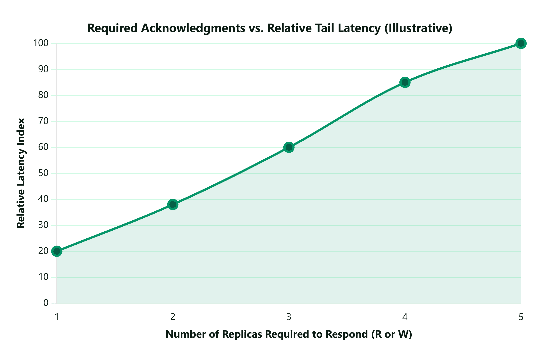
This is the real trade-off hiding behind those three letters. A low R and W gets you a fast, highly available system that will occasionally hand back a slightly outdated value. A high R and W gets you a system that behaves close to strongly consistent, but one that also becomes unavailable the moment too many replicas are unreachable at once, since there’s no longer enough of the cluster left to form a quorum.
Where the Guarantee Quietly Breaks
The R + W > N formula assumes a strict quorum: the actual, specific N replicas are the only ones allowed to count toward R or W. Dynamo itself doesn’t always work that way. Under failure conditions, it falls back to what the original paper calls a sloppy quorum, where writes and reads are served by the first N healthy nodes in a preference list rather than a fixed set, keeping the system available even when some designated replicas are down.
That flexibility is exactly why Dynamo stays highly available during partitions, but it also means the clean mathematical guarantee above isn’t unconditional. A sloppy quorum can accept a write on a temporary substitute node, and if that substitute never actually intersects with the read set before the real replica catches up, the neat overlap argument no longer holds. The math is correct; it just assumes the quorum is strict, and production systems don’t always keep that assumption intact.
Quick Checklist: Choosing N, R, and W
- Confirm R + W > N if you need the read-your-writes guarantee; otherwise expect eventual consistency.
- Remember that raising R or W raises tail latency, since the slowest required replica sets the pace.
- Check whether your system uses strict or sloppy quorums, since sloppy quorums can quietly weaken the overlap guarantee during failures.
- Balance R and W rather than maxing out one, unless your workload is clearly read-heavy or write-heavy.
- Revisit these settings whenever N changes, since the same R and W no longer mean the same thing at a different replication factor.
What We Learned
N, R, and W look like three independent dials, but their real power comes from the arithmetic relationship between them. Once R + W exceeds N, the read set and write set are mathematically guaranteed to overlap, which is what gives Dynamo-style systems their consistency guarantee without needing every replica to agree. That guarantee comes at the direct cost of latency, since every operation waits on its slowest required replica, and it can be quietly loosened by mechanisms like sloppy quorums that trade strict overlap for higher availability. Treating N, R, and W as an algebra rather than a checklist is what turns a configuration decision into an informed one.