
The Principal Engineer Role Nobody Agrees On — And Why the Ambiguity Is a Trap for Senior ICs

The title exists at almost every company. What it means at each one is almost completely different. Here is what nobody tells you before you get there — and why Java engineers are particularly vulnerable to its structural failure modes.
Here is a thought experiment. Take five engineers who hold the title “Principal Engineer.” One is at a 30-person startup where there is no one else above senior. One is at a 300-person scale-up where the role sits between staff and distinguished. One is at a FAANG company where the title maps to L7, corresponds to VP-level scope, and there are fewer than two dozen of them in a division of 800 engineers. One is at a large bank where the role is a job grade, not a career progression, and is assigned to anyone who leads a team of more than four. The fifth is at a consultancy, where it is effectively a billing tier.
These five people have almost nothing structurally in common. Their scope, their authority, their visibility, their career trajectory, and their daily experience of the job are entirely different. And yet the title on their LinkedIn profiles is identical. This is not a minor nuance. It is a fundamental structural ambiguity that has real consequences for anyone navigating the IC track at senior levels — and it is almost never acknowledged in the career content aimed at them.
“It is not easy to find many resources on the staff engineer role, which is still massively misunderstood due to wildly varying definitions and assumptions.”— Nicky Wrightson, Principal Engineer at Skyscanner, reviewing Will Larson’s Staff Engineer
That observation, made about a book specifically written to address the gap, is itself revealing. If the role is still massively misunderstood after dedicated literature has been written about it, the problem is not a lack of information. It is that the role is genuinely, structurally different depending on where you sit — and the industry’s tendency to use one title for multiple distinct things obscures that reality in ways that are harmful to the engineers inside it.
Part 1 — What the Title Actually Means by Company Size
Before discussing failure modes, it is worth being specific about what “principal engineer” actually means structurally across different environments, because the failure modes are different in each case. The role’s scope, its relationship to management, and its fundamental purpose all shift dramatically as you move along the company-size spectrum.
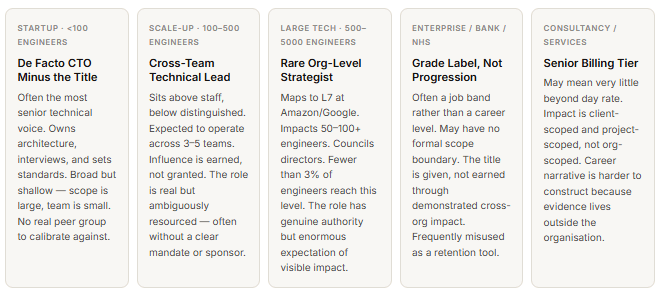
The consequence of this variation is that the title transfers poorly. A principal engineer at a 120-person startup who joins a FAANG company will, in almost every case, be levelled as a staff engineer — or, as one widely circulated discussion on Blind bluntly put it, “Senior at most. If you ask Google, well… L4 covers the universe.” The inverse is also true: a Google L7 principal who joins a mid-size company may be handed the same title they held at Google, but with a fifth of the scope and none of the organisational infrastructure that made the role functional.
Neither of these transitions is a demotion or a promotion in any meaningful sense. They are a category change — moving between environments where the same title means fundamentally different things. The problem is that most engineers in the role do not know this until they are already in it, and by then the sunk cost of the move makes honest reassessment difficult.
Part 2 — The Three Structural Failure Modes
Once an engineer is inside a principal or staff-level IC role, three failure modes recur with enough consistency across organisations that they deserve to be named and examined directly. They are not failures of individual competence. They are structural features of the role that organisations frequently fail to design around, and that engineers frequently fail to recognise until they are already inside them.
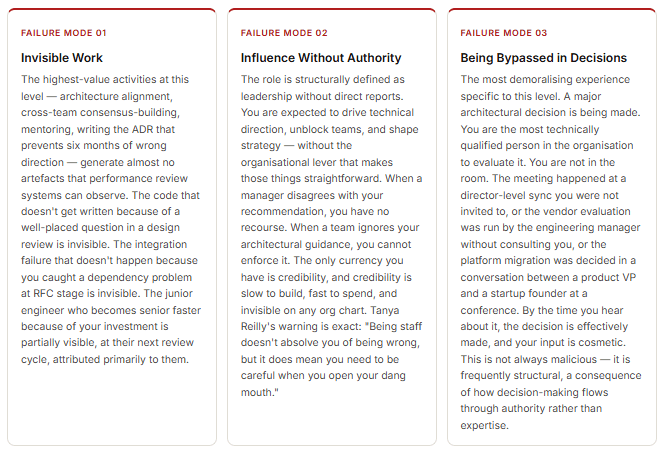
These three failure modes share a common root. The IC track at senior levels operates on influence as a resource, and influence is fundamentally different from authority in one crucial respect: it has to be constantly maintained, extended, and made visible. Authority is delegated by structure and persists by default. Influence is earned through reputation, presence, and the accumulated track record of being right in public — and it decays rapidly if you are absent from decisions, invisible in your work, or unable to translate that work into a language the organisation’s systems can reward.
The Glue Work Trap
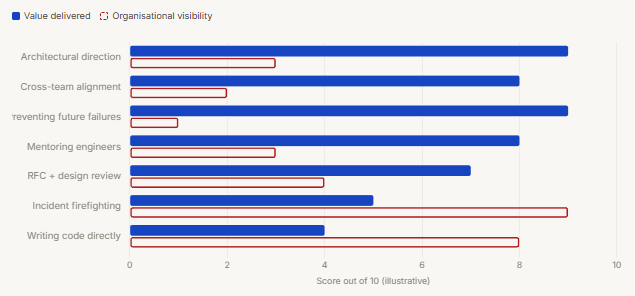
Tanya Reilly’s widely cited essay on “glue work” describes the situation precisely: the work that makes teams succeed — onboarding, alignment, documentation, risk identification, cross-team coordination — is often the least promotable work at every level below staff. At the principal level, the same dynamic applies in a different form. The work that prevents future failure is less visible than the work that solves present problems. Principals who spend their time on prevention get outcompeted for recognition by seniors who spend their time on firefighting, because fires are visible and prevention is not. The organisation is often genuinely grateful for both, but only one generates the kind of artefacts that feed into performance frameworks.
The Visibility Gap: Value Delivered vs. Organisational Visibility at Principal Level
Part 3 — How the Role Works Differently by Company Size
The three failure modes manifest differently depending on where you are. Understanding the specific environment is therefore not just useful context — it is the primary variable that determines which risks you are actually facing and which strategies will help you navigate them.
At a startup or scale-up
The invisible work problem is less severe here, because at small companies, the people who need to see your contributions are in the same room. The bypass problem is also less severe, because fewer people are in the decision-making loop and senior engineers are often structurally close to that loop. The failure mode specific to this size is scope collapse: the principal engineer ends up spending their time on senior engineer work — individual feature delivery, code review, technical debt remediation — because there is nobody else to do it, and the high-level work that the role is supposed to generate gets perpetually deferred. This is the fastest way to become technically excellent and professionally stagnant simultaneously.
At a large tech company
This is where the bypass problem is most severe, because the decision-making infrastructure is furthest from the people with the deepest technical knowledge. At Amazon, for instance, the L7 principal level involves counselling directors and VPs on technical decisions affecting 50–100+ engineers — but those same directors and VPs have staff meetings, budget conversations, and vendor relationships that engineers are not part of. The path to influence at this scale runs almost entirely through sponsors and allies in the management chain, not through technical merit alone. Will Larson’s framing in Staff Engineer is worth quoting directly: “Becoming a Staff engineer is both a promotion and a job change; many immensely talented engineers pursue the first and arrive unprepared for the latter.”
At an enterprise or regulated institution
This is where the invisible work problem is most acute and most consequential, and where Java engineers are most likely to be operating. The work of a principal engineer in a bank or healthcare system — ensuring a migration plan will not introduce a compliance risk, identifying a distributed transaction boundary that will cause problems at scale, noticing that a proposed API change will break twelve downstream systems — is often the most valuable technical work in the organisation. It is also the work least likely to appear in any metric, any performance review framework, or any conversation in a board-level risk committee. Furthermore, the governance weight of large institutions means that decisions that should involve the most senior technical person often get made in procurement committees, vendor evaluation panels, or regulatory working groups where engineering representation is thin.
Principal Engineer Scope and Risk Profile by Context
| Context | Primary failure mode | Decision bypass risk | Invisible work risk | Scope stability |
|---|---|---|---|---|
| Startup (<100 eng) | Scope collapse into senior work | Low | Low | Unstable |
| Scale-up (100–500 eng) | Ambiguous mandate, no sponsor | Medium | Medium | Variable |
| Large tech / FAANG | Being bypassed in director-level decisions | High | Medium | Stable |
| Enterprise / regulated | Invisible prevention work; procurement bypass | High | High | Formally stable |
| Consultancy / services | Client-scoped impact; no org narrative | Variable | High | Project-dependent |
Part 4 — How Java Engineers Specifically End Up Here, and Why That Creates Specific Risks
Java and JVM engineers arrive at the principal level through a pathway that is somewhat different from the pathway taken by engineers in younger, faster-moving stacks — and that difference creates specific vulnerabilities.
The typical Java principal engineer has accumulated deep expertise in long-lived, complex systems: distributed transaction management, JVM internals, Spring’s dependency injection model, Hibernate’s persistence context lifecycle, complex Maven module graphs, the specific failure modes of older enterprise integration patterns. This expertise is genuinely rare and genuinely valuable. It has also, typically, been built over a decade or more in environments where systems are stable, migrations are infrequent, and technical excellence is demonstrated through depth rather than breadth.
That pathway produces two specific vulnerabilities at the principal level. The first is that deep system expertise can become identity. Engineers who have spent ten years as the authority on a particular codebase — the person who knows why the legacy payment service is built the way it is, who understands the exact sequence of decisions that led to the current transaction boundary — are extraordinarily valuable. They are also, structurally, in a fragile position: their influence is concentrated in a specific system’s history rather than distributed across the organisation’s future direction. When that system is migrated, replaced, or decomposed, the expertise that underpinned their influence goes with it, often faster than their title changes.
A principal Java engineer whose influence derives primarily from deep knowledge of a monolith that is being broken into microservices, or a Spring MVC application being migrated to reactive architecture, is in a structurally precarious position. The new systems do not have the accumulated context that made them the authority. The teams building the new systems may have been hired specifically because they bring expertise the incumbent does not have. The most dangerous moment in the career of a deep-specialist principal engineer is often the beginning of a major platform migration — precisely because that is when their most valuable knowledge starts to depreciate and their influence needs to be regrounded in something the new system will need.
The second vulnerability is that the Java and JVM ecosystem is heavily concentrated in regulated industries — banking, healthcare, insurance, government — where the invisible work problem is most severe. The principal Java engineer at a major financial institution doing the quiet work of ensuring that a new API design will not violate GDPR data residency constraints, or that a proposed caching strategy will not introduce eventual consistency into what is legally required to be a strongly consistent ledger, is doing work of enormous value and essentially zero visibility. The compliance officer does not know they prevented a regulatory breach. The board does not see it in the risk dashboard. The engineering manager, charitably, understands it abstractly but does not have a mechanism to reward it concretely.
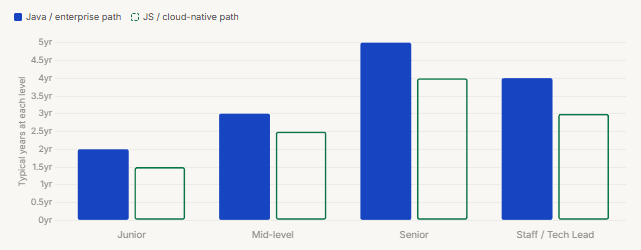
Time to Principal: Java/Enterprise vs. JavaScript/Cloud-Native Paths
These are illustrative figures drawn from industry career ladder data and published progression timelines. Individual paths vary significantly. The key point is directional: Java’s depth-first pathway typically takes longer, and the expertise it builds is less transferable across contexts than the breadth-first expertise common in cloud-native stacks.
Part 5 — Navigating the Role Without Losing Yourself In It
Most career advice at this level focuses on tactics: how to write a promotion packet, how to build a sponsor relationship, how to pick the right project to generate visible impact. These are legitimate and useful. But they sit inside a frame — “how do I succeed at this role” — that deserves to be questioned first, because the role as currently structured in most organisations is not designed well for the people inside it.
Name your archetype and your context explicitly
Will Larson’s four archetypes — tech lead, architect, solver, right hand — are not a taxonomy for self-identification. They are a diagnostic tool for understanding what your organisation actually needs from you versus what you thought the role was. An engineer hired as an architect who is being asked to function as a right hand is not doing the wrong job; they are doing a different job from what they expected, and that difference needs to be a conscious agreement, not an implicit drift. Similarly, understanding that you are a solver in an environment that rewards architects, or a tech lead in an environment that needs an architect, allows you to either reposition or accept the mismatch deliberately rather than discover it at a performance review.
Make the invisible work visible — deliberately and repeatedly
The work that prevents problems is invisible by default. Making it visible requires a discipline that feels counterintuitive to engineers who were trained to let the work speak for itself. Tanya Reilly’s advice is direct: if you are doing glue work or prevention work, you need to name it, document it, and frame it explicitly in the language your organisation’s performance framework understands. This is not self-promotion in a pejorative sense. It is the basic act of translating work that is invisible to organisational systems into a form those systems can process. The alternative — waiting for the work to be noticed — is a strategy that has historically underserved the engineers who are best at it.
Understand where decisions actually get made
At the principal level, the most important skill is not technical. It is organisational topology — understanding the actual network through which decisions travel in your specific organisation, not the one described in the org chart. Decisions at director and VP level are shaped in conversations, vendor relationships, budget cycles, and informal networks that engineers are frequently not party to. Getting into those conversations — through a sponsor in the management chain, through proactive engagement with strategic initiatives, through being present at the point where technical direction is first discussed rather than after it is decided — is not political manoeuvring in a cynical sense. It is the basic requirement for doing the job the role is supposed to involve.
The greatest career risk for a principal Java engineer is allowing deep system expertise to substitute for broad organisational influence. Deep expertise is the foundation — it is what earns the credibility that makes influence possible. But it is not sufficient on its own, and it depreciates faster than it feels like it should, particularly during architectural transitions. The engineers who navigate the principal level well in Java contexts tend to be the ones who understand the business domain as deeply as they understand the technical system — because that is the layer at which organisational decisions are actually made, and the layer at which a principal engineer’s input is hardest to bypass.
What We Have Learned
- The title “principal engineer” describes five structurally different jobs depending on company size, industry, and organisational design. Treating it as a single thing is the first and most common mistake engineers make when pursuing or accepting the role.
- The three structural failure modes — invisible work, influence without authority, and being bypassed in decisions — are features of how the role is typically designed, not failures of individual competence. Recognising them as structural makes them navigable; treating them as personal failures does not.
- Java engineers have a specific vulnerability: their pathway to the principal level tends to run through deep, domain-concentrated system expertise, which is genuinely valuable but highly context-dependent and susceptible to depreciation during major platform transitions.
- The invisible work problem is most severe in the environments where Java is most prevalent — regulated enterprises, financial institutions, healthcare systems — precisely because these organisations have the least sophisticated mechanisms for valuing work that prevents problems rather than solving them.
- Making the invisible visible is a skill, not a personality trait. It requires deliberate documentation of impact, proactive framing in terms the organisation’s systems can process, and the discipline to treat self-advocacy as a professional responsibility rather than an uncomfortable afterthought.
- The most important navigation question is not “how do I get promoted” but “does this organisation have a real version of this role, and am I actually inside it?” The answer to that question determines whether the strategies for succeeding in the role will work — and whether the role is worth staying in at all.