
Senior Developer to Tech Lead: The Skills That Actually Transfer(And the Ones That Don’t)

Most career advice on this transition is either too vague to be useful or too comfortable to be honest. This article is neither. If you are preparing to step up — or currently struggling in the role — here is the specific, engineering-honest account of what changes, what stays, and what will surprise you.
1. This Is Not Actually a Promotion
That headline will irritate some people, so let’s be precise about what it means. Becoming a tech lead typically comes with a title change, usually a salary increase, and is broadly treated by organizations as a promotion. In those senses, it obviously is one. But in the sense that matters most for your day-to-day experience — the nature of the work, the skills that define success, the things that give you satisfaction — it is a lateral move onto a genuinely different track.
Engineering management is a separate career track to software engineering, not the next step in the same one. Many tech companies put senior engineers on the same level as their engineering managers for exactly this reason. The implication is important: if you take a tech lead role expecting it to be “senior engineering with extra responsibilities,” you will be wrong, frustrated, and probably unsuccessful in your first year.
The role demands a fundamental shift in how you measure your own success. As a senior engineer, your success is measured largely by the scope and impact of your own contributions. As a tech lead, it is measured by whether the team delivers — which is a completely different relationship with your work. That shift can feel uncomfortable at first, because all your instincts and habits were built for the former.
Many engineers accept tech lead roles for the wrong reason: because it feels like the next logical step, or because they want more influence, or because they were the best engineer on the team. None of these are bad motivations — but none of them are sufficient preparation for what actually happens on Monday morning. The transition genuinely surprises most people who go through it, even those who thought they were ready.
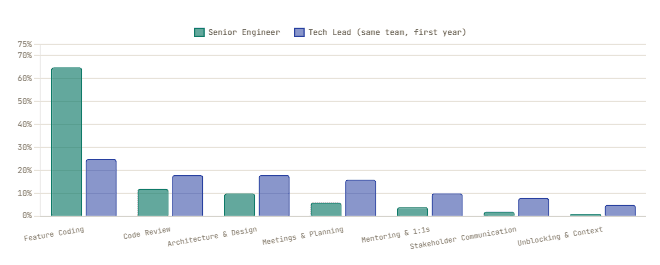
How Work Time Reallocates After the Transition
2. The Skills That Transfer Surprisingly Well
The good news comes first, because it is genuinely good: more transfers than most guides acknowledge. The framing of “technical skills become irrelevant” is wrong, and it causes unnecessary anxiety in engineers who are considering the move.
Systems thinking and decomposition
The ability to look at a complex problem and break it down into coherent, bounded sub-problems — something senior engineers do constantly when designing systems — turns out to be one of the most valuable things a tech lead brings to conversations with product managers and stakeholders. Translating a vague business requirement into a specific technical scope, identifying hidden dependencies before they become blockers, and recognizing when a “simple feature request” will touch six different layers of the stack — these are all applications of the same decomposition skill you built writing code. They just get applied to conversations and plans rather than classes and functions.
The ability to learn fast
Senior engineers are professional learners. The ability to pick up a new framework, read documentation quickly, orient in an unfamiliar codebase — these are muscles that transfer almost directly to the leadership track. The things you need to learn are different (organizational dynamics, influence without authority, stakeholder communication patterns) but the learning process itself uses the same skill. Engineers who have not yet recognized this should: the speed at which you can assimilate new concepts in a technical context will work exactly the same way in a leadership context, once you point it in the right direction.
Credibility in technical conversations
This one is more nuanced than it first appears. Deep technical knowledge genuinely matters in the tech lead role — not because you will write the code, but because the team will look to you to resolve technical disagreements, and stakeholders will need you to translate technical constraints into business language. A tech lead who cannot earn the respect of senior engineers on their team will struggle to guide technical direction. Your domain expertise is a foundation, not an obstacle. The trap is treating it as your primary tool long after the role demands other ones.
Risk intuition
The gut feeling that something is technically risky — that the approach being proposed in a design review has a hidden problem, that the timeline is unrealistic given what the team knows — does not go away. It actually becomes more valuable, because a tech lead’s job includes surfacing risks to stakeholders before they become incidents. Experienced engineers who have seen things go wrong before can recognize the early signals. That pattern recognition transfers directly.
3. The Skills That Transfer — But Must Transform
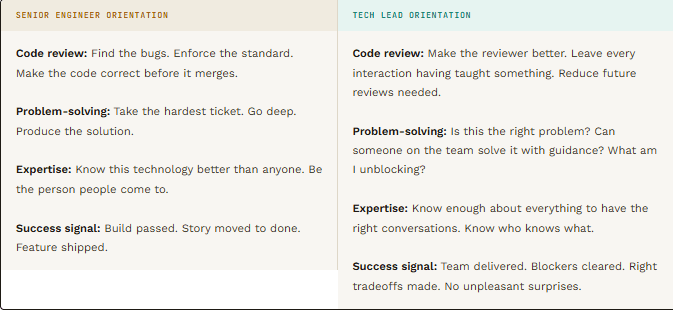
This category is the one most articles miss. There is a group of skills that you genuinely have, that will serve you as a tech lead — but only if they change form. Using them the same way you used them as an individual contributor will make things worse, not better.
Code review → quality culture-setting
As a senior engineer, you do code reviews and they make the code better. As a tech lead, the goal of code review shifts significantly. The review itself is now less important than what the review teaches. A tech lead who does high-quality code reviews that nobody learns from — because the feedback is never discussed, because the reasoning is never explained, because it reinforces dependence rather than independence — is doing less valuable work than a tech lead who runs reviews as deliberate teaching moments. Your instinct to “just fix the problem” during a review is the old habit. The new habit is asking “how does this review leave the engineer better prepared for the next PR?”
Problem-solving → problem-framing
Senior engineers solve problems. Tech leads define which problems the team should be solving. The distinction sounds philosophical until you see it fail in practice. A new tech lead who spends their mental energy solving implementation problems — which frameworks to use, how to structure a particular service — is doing what they are good at, but they are leaving unasked the higher-level questions: Is the team working on the highest-value problems right now? Is this feature request actually the problem the product team thinks it is? Is the architecture discussion we are having a symptom of a deeper misalignment about technical direction? Retraining your instinct from “solve it” to “frame it correctly first” is genuinely hard and genuinely important.
Technical depth → technical breadth
Senior engineers are celebrated for depth — for knowing a technology or a domain more thoroughly than anyone else. Tech leads still need a solid technical foundation, but the direction of growth inverts. Breadth becomes more valuable than depth. You need enough understanding of the database layer, the deployment pipeline, the security model, and the client integration to have informed conversations about all of them, even if you are not expert in any. This is not a comfortable shift for engineers who built their identity around deep expertise. But a tech lead who can only engage deeply with one layer of the stack becomes a bottleneck to every decision that touches a different one.
4. The Skills That Actively Work Against You
This section is the one that gets omitted from polite career advice articles. There are habits and instincts that made you a good senior engineer that will make you a mediocre or poor tech lead if you carry them unchanged into the role. Naming them directly is more useful than softening them.
Heroic individual contribution
If you were the engineer who stayed late to fix the critical bug, who owned the most complex part of the codebase, who stepped in when things were going wrong — that instinct will betray you as a tech lead. The hero-developer model, where one person produces the most and therefore leads, is the exact opposite of what the role requires. Your main value to the team is not in writing the most code. They no longer need a hero-dev cranking out code — they need a force-multiplier that can help everyone level up. Every time you heroically solve a problem that someone on your team could have solved with guidance, you have made the team slightly less capable, not more.
The perfectionist’s eye
One of the hardest things demanded of new tech leads is allowing team members the freedom to do a worse job than you would. That is stated bluntly because the softer framing obscures the actual difficulty. If you review a design proposal and your instinct is “I would have done this differently and I think my way is better,” the senior engineer’s response is to push for the better solution. The tech lead’s response involves a more uncomfortable question: Is my way better enough to justify overriding their ownership of this decision? Will overriding it leave this engineer more capable or less? Is “better” worth the cost in autonomy, morale, and learning? The perfectionist instinct does not serve you in a role where multiplying the output of others depends on their confidence and ownership.
Comfort in the concrete
Senior engineers live and die by concrete outcomes. The ticket is done or it is not. The test passes or it does not. The build is green or it is red. Leadership work produces far fewer clean, immediate feedback loops. You had a difficult conversation with an underperforming engineer — did it help? You will not know for weeks. You advocated for a technical approach in a planning meeting — was it the right call? You may not know for months. Engineers who are addicted to the immediate feedback loop of concrete technical work find leadership viscerally uncomfortable, because the signals come from other places and arrive much more slowly. Recognizing this in advance is the only real preparation you can do.
5. The Real Crisis: Your Professional Identity
Behind all of these specific skill observations is a deeper shift that most articles dance around but rarely name directly: the transition from senior engineer to tech lead is, for many people, a genuine identity crisis.
Engineers build their professional identity around technical competence. They are the people who solve the hard problems. Their credibility comes from their code. Their satisfaction comes from building things. Their value is visible in pull requests and deployment logs. When you move into a tech lead role, all of those identity anchors are pulled. You write less code. Your PRs are smaller or fewer. Your work for two weeks might produce a better planning document and a resolved team conflict — neither of which is as visible or as satisfying as a feature shipped.
“Technical ability isn’t the only basis for suitability for a leadership role. Alongside it are many other strengths: from influencing and persuading, to coaching, to strategic thinking. It’s relatively easy for a technologist to build up new technical competencies. We’re used to that formula. Leadership competencies don’t follow the same formula.”— Thoughtworks, “Techie to Tech Lead: My Five Biggest Mistakes”
The engineers who struggle most in their first year as tech lead are typically not those who lack the skills — they are those who cannot let go of the identity. They keep pulling complex tickets to feel productive. They over-involve themselves in implementation decisions to stay close to the concrete. They measure their days by lines of code reviewed rather than by blockers cleared and context provided. These are all rational responses to identity discomfort. They are also, as the Thoughtworks analysis documents clearly, a reliable path to leadership failure.
The engineers who transition most successfully tend to share a trait: they found the new sources of satisfaction before the old ones fully disappeared. The moment a junior engineer ships something they would not have been able to ship without your support — and you realize that felt good — the identity shift begins. It is not completed by deciding to lead. It is completed by experiencing the rewards of leading and discovering that they are real.
6. The Time Allocation Shock
The numbers are starker than most people expect before they experience them. Lead developers spend less than 60% of their time on programming tasks. Senior developers allocate 70–100% of their time to coding. The shift is real, and it happens faster than most new tech leads anticipate.
Tech Lead Time Categories — A Realistic Week
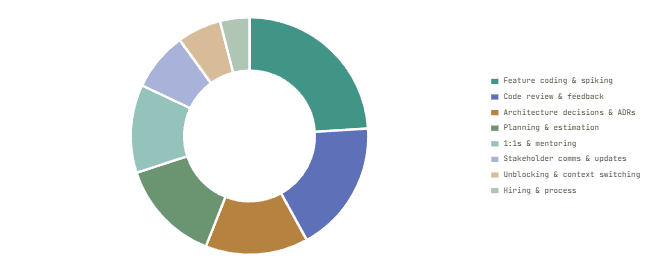
The time allocation shock has two components. The first is simply the volume of meetings, reviews, conversations, and planning work that expands to fill what used to be coding time. The second — less discussed — is the context-switching cost. As a senior engineer, you could protect two or three hours of deep work per day and get significant things done. As a tech lead, your attention is distributed: you are the person three junior engineers have questions for, the person the product manager escalates to when requirements are ambiguous, the person who needs to review the architectural spike before the team can proceed. Deep work becomes a luxury that requires deliberate, proactive protection.
The practical response to this — one that experienced tech leads develop and new ones discover too late — is time blocking. Successful tech leads carve out uninterrupted time for coding by scheduling blocks free of meetings, typically early morning or late afternoon. They cluster meetings to minimize context switching. They set explicit response time expectations for Slack and email, so that “available” does not mean “constantly interrupted.” The technical work does not disappear; it just requires much more intentional infrastructure to protect.
7. The Skills You Have to Build from Scratch
Alongside everything that transfers (well or badly), there is a set of skills that most engineers genuinely start from near-zero when they become a tech lead. These are the ones that cause the most anxiety, because there is no engineering equivalent to practice on.
1.Translating technical concepts into business language
A 2025 Stanford academic survey found that 62% of engineering managers cited cross-functional communication as the most critical skill for technical leadership. Not “communication” in the abstract — specifically, the ability to explain why a refactoring investment matters without using the word “refactoring,” why a technical debt payment is urgent without the listener needing to understand what technical debt is, why a proposed architectural change reduces risk in terms a product manager can evaluate. This is a learnable skill, but it requires practice and most engineers have had very little of it before the transition. The best way to develop it is to start attending cross-functional meetings as an observer before you have the role — note how product managers and business stakeholders frame problems, and reverse-engineer the translation.
2. Giving feedback that improves without deflating
Engineers are used to precise, honest technical feedback. “This implementation has a memory leak in the edge case where the connection pool is exhausted” is excellent engineering communication. Applied to a person’s work or a performance concern, the same precision without care for delivery will damage trust and produce defensiveness rather than improvement. New tech leads consistently underestimate how much the same content lands differently depending on framing, timing, and relationship context. The first dozen difficult conversations will feel unnatural. The goal is not to soften the truth — it is to deliver it in a way the recipient can actually act on.
3. Making architectural decisions under uncertainty
Senior engineers are used to having enough information to justify a technical choice. Tech leads have to make technical decisions — and communicate them with clarity and conviction — on incomplete information, under time pressure, while managing the preferences of engineers who disagree with each other. The architectural decision record (ADR) practice is useful here not just as documentation but as a forcing function: writing down the context, the decision, the alternatives considered, and the trade-offs helps clarify whether you actually have enough information to decide, and gives the team something concrete to interrogate rather than a feeling to argue with.
4. Conflict that is actually your job
As a senior engineer, you could reasonably avoid interpersonal conflict most of the time without it affecting your performance. As a tech lead, addressing team conflicts, performance concerns, and difficult interpersonal dynamics is literally your job. Avoiding them only makes things worse. The natural engineer response to a disagreement between two team members is to redirect attention to the technical question at hand — which usually just defers the underlying tension. New tech leads need to develop the tolerance for sitting in the discomfort of a difficult conversation long enough for something to actually resolve.
5. Maintaining team context as a living model
Tech leads act as information hubs, collecting context from multiple sources and distributing relevant information to appropriate team members. This involves filtering noise from leadership meetings, summarizing key decisions the team needs for effective work, and tracking who knows what across the team. As a senior engineer, the context you needed to maintain was primarily technical. As a tech lead, you also track who is struggling but not saying so, which stakeholder relationships have friction, which engineers are ready for more responsibility, which commitments are at risk. This is ongoing, never-finished work with no clean completion state — which is part of why it feels so different from writing code.
8. The Five Predictable Mistakes
These patterns appear so consistently in first-year tech leads that they deserve their own section. Knowing them in advance does not make you immune to them — but it at least means you can recognize them when they start happening.
| Mistake | What It Looks Like | Why It Happens | The Correction |
|---|---|---|---|
| Trying to code as much as before | Picking up complex tickets, skipping 1:1s to finish implementation, being unavailable because of deep work | Identity comfort. The old feedback loops feel better than the ambiguous new ones. | Deliberately shed 30–40% of your coding workload in the first month. Create the space before filling it. |
| Becoming the decision bottleneck | Everything waits for your sign-off. PRs queue. Designs stall. Team velocity drops. | Mistaking leadership for approval authority. The lead believes their job is to validate every decision. | Distinguish between decisions that genuinely need you (architectural, cross-team, irreversible) and those that the team should own. Write down which is which. |
| Avoiding “people problems” | Unresolved conflicts fester. Performance issues drift for quarters. Team tension is addressed indirectly via process changes. | Discomfort with interpersonal confrontation. The code problem is easier and more satisfying. | Treat human problems with the same urgency as production incidents. Left unaddressed, they compound. |
| Overriding team decisions | Engineers start running designs past you before committing, because they know you will change them anyway. Initiative atrophies. | Perfectionism. The lead has a strong technical opinion and the authority to impose it. | Separate “I would do this differently” from “this will cause real problems.” Only intervene on the latter. |
| Making technical ability the only leadership currency | The lead is respected technically but not followed organizationally. Influence stalls at the boundary of technical decisions. | The lead has not developed the other competencies (communication, trust, stakeholder relationships) and defaults to what works. | Actively invest in the non-technical competencies with the same deliberate learning approach you would apply to a new technology. |
9. Knowing Whether It Is Actually Right for You
The final thing most career guides skip is the honest conversation about whether this path is right for a specific engineer. Not every senior engineer should become a tech lead. Not every engineer who would make an excellent tech lead wants to. The staff engineer track — deepening technical expertise rather than transitioning to leadership — is a legitimate, well-compensated, high-impact career path that deserves equal consideration.
Signals that the tech lead path fits
You find yourself frustrated when others make technical decisions you think are wrong — not because you want to be right, but because you want the team to succeed. When a junior engineer ships something good, your satisfaction is genuine, not performative. You are interested in why the product decisions are being made, not just what the technical decisions are. You find people dynamics as interesting as system dynamics, even if you are not yet skilled in them. Meetings with business stakeholders feel like puzzles, not interruptions.
Signals it may not be the right move — yet
You feel genuine loss at the prospect of coding less — not anxiety, but actual grief. Your identity is so deeply tied to technical excellence that you cannot imagine deriving satisfaction from someone else’s technical excellence. You took the role primarily because it felt like the natural next step, not because leadership work genuinely interests you. You find interpersonal dynamics draining in a way that goes beyond normal discomfort. The idea of spending 40% of your time in ambiguous, feedback-free organizational work feels genuinely wrong.
The staff engineer alternative — equally valid
The staff engineer track (staff engineer → principal engineer → distinguished engineer) offers increasing scope and influence while keeping the focus on technical work. Staff engineers at good organizations own the technical direction of systems, mentor other engineers, and have organizational impact — just through technical decisions rather than people management. If you are being pushed toward tech lead because it seems like the only way up, check whether a strong staff track exists. If it does not, that says something about the organization, not about you. Both tracks are legitimate paths to high-impact engineering careers.
10. What We Have Learned
The senior-to-tech-lead transition is harder, more specific, and more identity-challenging than most career articles acknowledge — and simultaneously more achievable than the vague advice about “soft skills” and “leadership presence” makes it sound. The skills that transfer are real and valuable: systems thinking, the ability to learn fast, credibility in technical conversations, risk intuition. The skills that must transform — code review, problem-solving, technical depth — do so in specific, describable ways that you can prepare for deliberately. And the skills that actively work against you — heroic individual contribution, perfectionism, addiction to concrete feedback — can be named and watched for rather than discovered the hard way.
The through-line of the successful transition is a shift in the definition of success: from what I build to what we build together. That reframing sounds simple and is genuinely difficult, because it requires changing the measure by which you evaluate your own days. The engineers who make this shift well are the ones who find the new satisfaction before the old ones fully disappear — who experience the specific pleasure of a junior engineer shipping something they could not have shipped without their support, and recognize that the tech lead’s job created that outcome. Once that feedback loop is established, the identity transition follows. Until it is, everything else is just grinding through the discomfort. That grinding is normal, expected, and temporary.