Rust VS Go in 2026: The Systems vs Services Split Is Finally Clear — Which One Should You Actually Learn?

The systems vs. services split is no longer theoretical. After years of overlap and hype, real-world adoption data in 2026 finally makes the answer to “which one should I learn?” surprisingly straightforward — if you know what you are actually building.
For a long time, Rust vs Go was a genuinely hard question to answer. Both languages were growing fast, both had passionate advocates, and the use cases they were being applied to were still sorting themselves out. That era is over. In 2026, the split between where Rust wins and where Go wins is no longer ambiguous — it is empirically documented by adoption patterns, salary data, production deployment reports, and the language rankings that actually track real-world usage.
Importantly, this is not a question with a winner. The right framing is not “Rust is better than Go” or vice versa — it is “Rust and Go have converged on different, largely non-overlapping domains, and your situation determines which one is worth learning.” This article makes that determination concrete, backs every claim with sourced data, and ends with the kind of decision framework that actually saves you from spending six months learning the wrong language.
1. What the Numbers Actually Show in 2026
Let’s establish the data baseline before arguing from it. Any Rust vs Go discussion that skips the numbers is working from impression rather than evidence, and the numbers in 2026 paint a notably clearer picture than they did two or three years ago.
1.1 Rust: beloved, rare, and rising fast in critical infrastructure
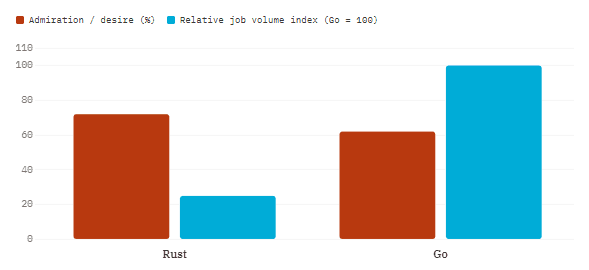
Rust has been the most admired language in the Stack Overflow Developer Survey for nine consecutive years. In 2025, that admiration rate stands at 72% — meaning 72% of developers who used Rust in the past year want to continue using it. For context, that is an extraordinary retention rate for any technology, and it reflects something real: once developers invest in learning Rust’s ownership model, they tend to stay. Even Rust’s build tool, Cargo, rated the most admired cloud development tool in the 2025 survey at 71%.
But admiration is not adoption. ZenRows’ 2025 Rust adoption analysis reports approximately 2.26–2.8 million Rust developers worldwide, with only 709,000 identifying it as their primary language. That is a small pool relative to Go, Java, or Python. In the RedMonk Q1 2026 rankings — which blend GitHub usage with Stack Overflow engagement — Rust sits at #20, notably behind Go at #12. The gap between Rust’s cultural prominence and its raw usage volume is one of the defining tensions of its current position.
What has changed dramatically, however, is where Rust is being used in production. The State of Rust Survey 2024 found that 45.5% of organisations now make non-trivial use of Rust, up from 38.7% in 2023. Commercial usage grew 68.75% between 2021 and 2024. And the companies doing the using are not hobbyists — they are Microsoft, Amazon, Cloudflare, Google, and Meta, all deploying Rust in production workloads at significant scale. Job postings for Rust developers grew 35% year-over-year in 2025, with median US salaries ranging from $145,000 to $185,000.
1.2 Go: steady, dominant, and deeply embedded in the cloud-native stack
Go’s story in 2026 is almost the opposite of Rust’s. Where Rust generates excitement and headlines, Go generates employment. ZenRows’ 2026 Go usage report places it at #7 on the TIOBE index — its highest position ever. RedMonk Q1 2026 has it at #12, consistent with its position over the past three years. More than a million developers are using Go professionally in cloud contexts, and Go’s job market is approximately 3–4× larger than Rust’s in real open positions.
The reason for Go’s stability is structural, not cultural. Kubernetes, Docker, Terraform, and Prometheus — the four tools that form the backbone of modern cloud infrastructure — are all written in Go. That embedding is not a coincidence; it is a deliberate architectural choice repeated by independent teams over a decade. Cloudflare Radar’s 2024 data shows Go now accounts for 12% of all API calls made by clients, up from 8.4% the previous year, overtaking Node.js as the most popular language for automated API requests. Go developer job growth is a more modest 15% annually, but it is growing from a much larger base.
Admiration vs Real-World Job Volume (2025–2026)
2. Why They Look Similar but Are Not
Both Rust and Go are compiled, statically typed, modern systems-ish languages with excellent tooling and strong memory-safety properties. They were both designed to fix problems with older languages. They both produce single-binary executables and have fast build cycles relative to C++. From a distance, they look interchangeable. Up close, their design philosophies are radically different — and those differences determine everything about where each language excels.
2.1 Go’s philosophy: simplicity as a feature
Go was designed by Google engineers who were frustrated with C++ and Java’s complexity. The language is deliberately small: it has no generics (until Go 1.18, and even then they are limited by design), no operator overloading, no inheritance, and no exceptions. The standard library is comprehensive and intentionally self-sufficient — Go culture’s “stdlib first” principle means you reach for third-party packages only when genuinely necessary. Bitfield Consulting’s comparison notes that Go “leaves out or simplifies many advanced features found in other languages” — and this is a deliberate trade-off, not an oversight.
The result is a language that an experienced developer from almost any background can become productive in within two to three weeks. Goroutines and channels make concurrent programming idiomatic and approachable in ways that most languages cannot match. The garbage collector — once a performance liability — has been tuned to millisecond-level pause times in recent versions. Go code is opinionated and consistent: gofmt enforces a single formatting style across the entire ecosystem, eliminating entire classes of code review arguments.
2.2 Rust’s philosophy: safety through explicitness
Rust was designed to replace C and C++ in contexts where their memory safety failures are unacceptable. Its core innovation — the ownership and borrowing system — eliminates entire categories of bugs at compile time: null pointer dereferences, buffer overflows, use-after-free errors, and data races. There is no garbage collector. Memory is managed deterministically through ownership rules that the compiler enforces. The result is code with C-level performance and memory control, but without the security vulnerabilities that C-level code typically carries.
The cost is a steep learning curve. The State of Rust Survey 2024 found that 62% of developers agree Rust requires significantly more effort to learn than other languages. Only 53% consider themselves productive in it — up from 47% in 2023, which shows things are improving, but slowly. The borrow checker — Rust’s compile-time memory safety enforcer — is the specific obstacle: it rejects code that would be valid in any other language because it cannot verify the code’s memory safety. Learning to write code that satisfies the borrow checker is not a matter of hours; it is a matter of weeks or months.
Rust wins when…
- Memory layout and allocation matter precisely
- Latency must be deterministic (no GC pauses)
- The target is embedded, kernel, or bare-metal
- Security vulnerabilities in C/C++ are the problem being solved
- WebAssembly compilation is required
- You are building the next infrastructure layer, not consuming it
Go wins when…
- You need to ship a production service quickly
- The team has mixed experience levels
- You are building CLIs, APIs, or microservices
- Cloud-native tooling integration is a priority
- Hiring is a real constraint
- Operational simplicity matters as much as raw performance
3. The Systems vs Services Split, Defined Precisely
The “systems vs services” framing is common, but it is often left vague. Let’s be precise about what each word means here, because the distinction is the whole point.
Systems work refers to software that operates at or below the application level: operating system components, device drivers, networking stacks, cryptographic libraries, database storage engines, language runtimes, WebAssembly runtimes, compilers, and embedded firmware. In systems work, you are building the infrastructure that other software runs on. You often have no operating system to lean on. Memory allocation is your problem. Latency must be deterministic. Security vulnerabilities in your code put everything above you at risk. This is Rust’s native domain.
Services work refers to software that implements business logic, serves API requests, orchestrates cloud resources, builds developer tooling, or manages distributed systems — typically running on top of a cloud operating system (Kubernetes, a managed runtime, or a PaaS). Here, developer productivity, operational simplicity, and time-to-market are often more important constraints than raw performance. A Go microservice handling 50,000 requests per second with 4ms p99 latency is, in the vast majority of cases, more than sufficient — and it was almost certainly faster to build and cheaper to staff than its Rust equivalent. This is Go’s native domain.
Ask yourself: Am I building something that Kubernetes runs on, or am I building something that runs on Kubernetes? If the former — if you are writing infrastructure that others will depend on — Rust’s investment pays off. If the latter — if you are building services that deploy to existing infrastructure — Go’s productivity multiplier wins almost every time.
4. Where Rust Has Actually Landed in Production in 2026
The most important evidence of Rust’s 2026 position is not what developers say they love — it is where serious organisations have committed their most critical code to it.
4.1 The Linux kernel and Android
The biggest structural news of 2025 for Rust was the Linux kernel’s formal commitment to the language. At the 2025 Kernel Maintainer Summit, the verdict was delivered plainly: “The experiment is done. Rust is here to stay.” Greg Kroah-Hartman confirmed that drivers written in Rust are proving safer than their C counterparts. Android 16 ships with an ashmem allocator built in Rust, deployed on millions of devices. The DRM project will require Rust for new drivers within a year. These are not experiments — they are permanent architectural commitments affecting billions of devices.
4.2 Microsoft’s component-by-component rewrite
Microsoft has already rewritten over 188,000 lines of the Windows kernel and DirectWrite in Rust. At RustConf 2025, Azure CTO Mark Russinovich described the motivation: Win32k.sys had been leaking privilege escalation bugs monthly, and Rust’s ownership model prevents that class of vulnerability at compile time. A job posting from Microsoft Distinguished Engineer Galen Hunt in December 2025 described a team whose goal is to eliminate C and C++ from Microsoft by 2030 using AI-assisted migration. Microsoft subsequently clarified this is a research initiative rather than an immediate commitment — but the direction is unambiguous.
Research by both Google and Microsoft found that approximately 70% of all security vulnerabilities in software are caused by memory safety issues. This is the structural argument behind every major Rust investment at the infrastructure layer — not performance, not developer preference, but an engineering response to a documented, quantified security problem.
4.3 Cloudflare, AWS, and Discord
Cloudflare built Pingora — its proxy handling over a trillion requests per day — in Rust as a replacement for an ageing Nginx setup. In August 2025, they also built Infire, a custom LLM inference engine in Rust that delivers up to 7% faster inference than vLLM, now running Llama 3.1 8B on their edge network. AWS uses Rust extensively for infrastructure-level networking. Discord rewrote their real-time multiplayer syncing server entirely in Rust. Google invested $1 million in the Rust Foundation to improve C++ interoperability. These are not experimental adoption stories — they are production commitments at hyperscale.
5. Where Go Has Actually Landed in Production in 2026
Go’s production story is quieter than Rust’s, because Go is not doing anything surprising. It is doing exactly what it was designed to do — powering cloud-native infrastructure at scale — and it has been doing it reliably for years.
5.1 The cloud-native infrastructure language
Kubernetes, Docker, Terraform, and Prometheus are not just written in Go — they define the operational substrate of the modern cloud. This was not coincidence: these tools chose Go because its characteristics align exactly with what infrastructure software needs — reliable performance, efficient resource usage, fast startup, and single-binary deployment. A Go microservice might use 10–20 MB of RAM at startup, compared to 100–200 MB for an equivalent Java service. When you are running hundreds or thousands of containers, that difference is real money.
5.2 API and microservices dominance
Cloudflare Radar’s 2024 Year in Review reports that Go accounts for 12% of all API calls made by automated clients, up from 8.4% the previous year — overtaking Node.js. Go’s net/http package ships in the standard library and is sufficient for building production HTTP services without reaching for a framework. For teams building internal APIs, developer tooling, CLI tools, or cloud-native services, Go’s batteries-included standard library eliminates entire dependency management headaches that other ecosystems normalise.
5.3 The Kubernetes operator ecosystem
One Go-specific domain that is often overlooked: Kubernetes operator development is overwhelmingly Go. The controller-runtime and client-go libraries, the Operator Framework, and kubebuilder are all Go-native. If your organisation is building custom Kubernetes operators, controllers, or admission webhooks — which is now a common need for platform engineering teams — Go is effectively mandatory.
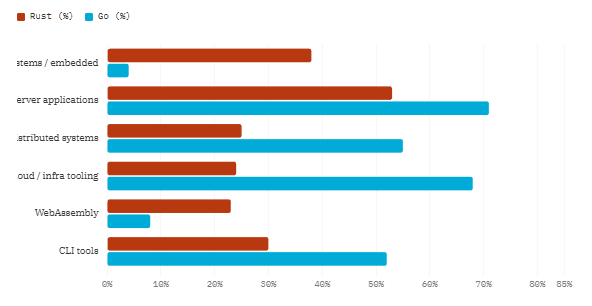
Production Use Case Distribution: Rust vs Go (2025)
6. Performance: The Real Picture, Not the Benchmark Numbers
Performance comparisons between Rust and Go are among the most frequently cited and most frequently misunderstood data points in this discussion. Let’s be precise about what the numbers actually mean.
In raw CPU-bound benchmarks, Rust consistently outperforms Go. The TechEmpower Round 23 benchmarks show Rust’s Actix-web achieving slightly higher raw throughput than Go’s Gin in direct head-to-head testing, with roughly 20% lower memory consumption. For CPU-intensive operations — parsing, cryptography, image processing, compression — Rust’s advantage is real and meaningful.
For I/O-bound workloads — which describes the vast majority of cloud services — the difference narrows considerably. Go’s goroutine scheduler is designed specifically for high-concurrency I/O, and in practice, Go services handling network requests, database queries, and API calls perform comparably to Rust services in most production scenarios. The performance difference between the two languages in a typical microservice is almost never the bottleneck. The database query, the network round-trip, or the serialisation overhead almost always is.
The more practical performance consideration is garbage collection. Go has a garbage collector; Rust does not. For latency-sensitive applications — high-frequency trading, real-time game servers, operating system components — Go’s GC pause times (even tuned to milliseconds) can be disqualifying. For web services with p99 latency requirements in the tens of milliseconds, Go’s GC is entirely adequate. This distinction maps cleanly back onto the systems/services split.
Go’s memory footprint advantage over the JVM is real and operationally significant — a Go microservice at 15–20 MB versus a JVM service at 150–200 MB changes your infrastructure cost at scale. The Rust-vs-Go gap matters far less in practice than the Go-vs-JVM gap for most cloud engineers making language adoption decisions in 2026.
7. The Learning Curve Is Not Symmetric
This deserves its own section, because it is the most practically important difference for developers making a “what should I learn next?” decision.
Go was specifically engineered for learnability. Google’s original design goal included the ability to onboard new engineers quickly to large codebases. An experienced developer from Java, Python, TypeScript, or C# can typically write meaningful Go code within a day and feel comfortable in production within a couple of weeks. The language is genuinely small: you can read the entire language specification in an afternoon. This is not a limitation — it is a deliberate and well-executed design choice.
Rust is a different experience. 62% of Rust developers report it requires significantly more learning effort than other languages, and only 53% consider themselves productive in it even after sustained use. The borrow checker — the mechanism that enforces memory safety at compile time — requires developers to fundamentally rethink how they reason about data ownership, lifetimes, and mutability. There is no shortcut through this. It is intellectual work that must be done.
“For experienced systems programmers, that is Rust. For everyone else building web services, that is Go.”— MKBHD, 2025 developer tools segment, as cited in Tech-Insider’s 2026 Rust vs Go analysis
This asymmetry has staffing implications that often go underweighted in architectural decisions. A team that adopts Rust for services work may find that recruiting becomes significantly harder, that onboarding junior engineers takes six months instead of six weeks, and that the Rust expertise concentrates in two or three senior people who become single points of failure. None of this is a reason to avoid Rust — but it is a reason to adopt it deliberately and specifically, not by default.
8. Which One Should You Actually Learn in 2026?
Here is the honest decision framework. The answer depends almost entirely on one thing: what domain are you working in, or planning to move into?
9. The Decision Framework
Learn Rust if…
- You are working in systems programming, OS components, or embedded firmware
- Your work involves C or C++ codebases with memory safety requirements
- You are building WebAssembly targets for the browser or edge
- You work at a company with serious security requirements (kernel, crypto, proxy layers)
- You are building developer tooling at the performance layer (compilers, runtimes, CLIs)
- You have 6+ months to invest in the learning curve without production pressure
- You are targeting the premium end of the job market ($145k–$185k US median)
Learn Go if…
- You are building APIs, microservices, or cloud-native backends
- You need to be productive in production within 2–3 weeks
- You work with or want to work with Kubernetes, Docker, or Terraform
- You are building platform engineering tooling or internal CLIs
- Hiring and team scaling are real constraints in your organisation
- You are coming from Java and want better performance and simpler operations
- You want the largest job market among modern compiled lang
Two edge cases are worth addressing explicitly. First, if you are coming from Java and your primary goal is better cloud-native performance with operational simplicity, Go is almost certainly the right next step — not Rust. The JVM-to-Go transition is smoother, the job market is immediately larger, and the use cases overlap heavily with Java’s service-layer domain. Second, if you are already a strong C++ systems programmer, Rust is a natural evolution: the conceptual overhead is lower for someone already comfortable with manual memory management, and the safety guarantees it adds on top of C++ semantics are immediately valuable.
| Dimension | Rust | Go | Verdict |
|---|---|---|---|
| Learning curve | Steep — 62% say significantly harder than other languages | Gentle — productive in 2–3 weeks for experienced developers | Go |
| Job market size | Growing fast (35% YoY) but 3–4× smaller than Go | Larger, steadier, 15% annual growth from bigger base | Go |
| Salary premium | $145k–$185k US median (higher premium due to scarcity) | $135k–$175k US median (competitive but less scarce) | Rust |
| Raw CPU performance | Matches C/C++; ~20% lower memory usage vs Go in benchmarks | Excellent; slightly behind Rust in CPU-bound workloads | Rust |
| Concurrency model | async/await with Tokio; powerful but more complex | Goroutines + channels; idiomatic and approachable | Go |
| Memory safety | Compile-time ownership model; no GC; zero runtime surprises | GC-based; safe but non-deterministic pause times | Rust |
| Cloud-native ecosystem | Growing, especially for infra tooling and Wasm | Dominant — Kubernetes, Docker, Terraform, Prometheus | Go |
| Developer admiration | 72% — most admired language (Stack Overflow 2025) | Solid; strong satisfaction, less culturally dominant | Rust |
| Hiring / team scaling | Harder to hire; expertise concentrates | Easier to hire; faster to onboard juniors | Go |
| Overlapping use case | CLIs and server applications (both work; Go wins on team velocity) | Context | |
10. One Language Does Not Preclude the Other
The framing of this article is deliberately decisive, because the question “which should I learn?” deserves a real answer rather than a diplomatic hedge. But it is worth finishing with a broader point: the Rust-Go split is not a wall. Several large organisations run both languages in production, deliberately deployed in their respective domains — Go for services, Rust for the infrastructure layers those services depend on.
Cloudflare is the clearest example: Go powers their DNS and API services; Rust powers Pingora (the proxy) and Infire (the inference engine). The division is intentional. Amazon similarly uses Go for many service-layer tools and Rust for performance-critical infrastructure components. The right question is not “which language for my organisation” but “which layer of our stack does each language serve.”
For an individual developer making a career decision in 2026, the calculus is simpler: Go gives you a larger, more immediately accessible market and faster productivity. Rust gives you a premium, harder-to-enter market and the ability to work on some of the most consequential software in the industry. The split is clear. The choice is yours.
11. What We Learned
The Rust vs Go comparison in 2026 is no longer speculative. Here is the definitive version of what the evidence shows.
- Rust holds 72% developer admiration (Stack Overflow 2025) for the ninth consecutive year and has seen 35% year-over-year job growth — but it sits at #20 on RedMonk, reflecting a large gap between cultural enthusiasm and raw production adoption relative to Go.
- Go holds steady at #12 on RedMonk Q1 2026, powers Kubernetes, Docker, Terraform, and Prometheus, commands over 12% of automated API traffic (up from 8.4% the year before), and provides 3–4× more open job positions than Rust.
- The core division is systems vs services. Rust is the language for code that other software runs on — kernels, drivers, proxies, runtimes, Wasm targets. Go is the language for code that runs on existing infrastructure — APIs, microservices, CLIs, cloud-native tooling.
- Rust’s production credentials in 2026 are substantial and institutional: the Linux kernel committed permanently to Rust at the 2025 Maintainer Summit; Microsoft has rewritten 188,000+ lines of Windows and DirectWrite in Rust; Cloudflare handles over a trillion daily requests through a Rust proxy.
- The learning curve is not symmetric. Go can make an experienced developer productive in 2–3 weeks. Rust requires months of dedicated investment to internalise the borrow checker, and 62% of developers report it is significantly harder to learn than other languages.
- For Java developers specifically, Go is the higher-probability next step: smaller memory footprint than the JVM, better operational simplicity, a much larger job market, and directly overlapping use cases in the services layer. Rust makes sense as a strategic second language — after Go — if you want to move toward infrastructure work.
- The ideal answer for large organisations is deliberate use of both: Go for service-layer velocity and team scalability, Rust for the performance-critical and security-sensitive layers beneath.