
Backward Compatibility Is a Moral Commitment, Not an Engineering Constraint — And We’ve Forgotten What That Means

Java’s ability to run bytecode compiled thirty years ago on a modern JVM is usually described as a technical achievement. Almost never discussed is the ethical architecture that makes it possible — and what breaking-change culture in other ecosystems reveals about who is really being asked to pay for progress.
There is a way engineers talk about backward compatibility that treats it entirely as a technical property — something a runtime either has or does not have, like garbage collection or static typing. Under this framing, Java’s thirty-year commitment to running old bytecode on modern JVMs is simply a design decision, a constraint that the platform has managed well. The engineers who built the JVM made clever choices. Credit to them. Moving on.
That framing is incomplete in a way that matters enormously. Backward compatibility is not merely a technical property. It is a promise made to people who built things on a foundation and cannot easily change them. And like all promises, it has a moral dimension — one that becomes visible only when you look at who bears the cost when it is broken.
Most discussions of language evolution and ecosystem churn stay comfortably inside the engineering frame. They debate migration tooling, deprecation timelines, SemVer discipline, and API design philosophy. These are useful conversations. But they systematically avoid the harder question: in a world where software platforms break compatibility, who pays? The answer, almost invariably, is the people least equipped to absorb the cost — enterprises running regulated systems, teams maintaining healthcare infrastructure, financial institutions operating under compliance frameworks where a migration is not a weekend project but a multi-year programme with its own regulatory approval process.
“If it ain’t broke, don’t fix it” is not ignorance. In a system where an upgrade can trigger a compliance review, an integration regression, or a patient safety audit, it is the only rational engineering position.— A perspective that gets dismissed in ecosystem discussions, but which governs the decisions of most of the world’s critical software infrastructure
Part 1 — The Promise and Why It Is Unusual
Java was first released in 1995. The JVM specification, from the beginning, was designed to guarantee that valid bytecode from earlier versions would run on later runtimes. This was not an accident; it was a deliberate architectural commitment rooted in Java’s original purpose — a language that could be written once and run anywhere, on any device, indefinitely. JetBrains noted, on Java’s 25th anniversary, that Java is “almost unique” in being able to run code from 25 years ago on a modern version. That uniqueness deserves more scrutiny than it usually receives.
Why is it unusual? Because maintaining backward compatibility across three decades, while simultaneously evolving the language to support generics, lambdas, modules, records, sealed classes, and virtual threads, is genuinely hard. Every new language feature creates potential conflicts with existing bytecode semantics. Every JVM optimisation must preserve the observable behaviour of old programs. The Java platform has absorbed this cost deliberately, generation after generation — not because it was easy, but because the people governing it understood that breaking the promise had a human cost on the other side.
The scope of that commitment is visible in the data. Azul’s 2025 State of Java Survey, covering over 2,000 Java professionals worldwide, found that only 1% of organisations contacted were disqualified from the survey because they did not use Java. Furthermore, nearly 70% of respondents said that more than half of their applications are built with Java or run on a JVM. More tellingly, 19% of participants reported still running Java 6 or 7 in production — versions first released in 2006 and 2011 respectively. That is not ignorance. That is the empirical footprint of the promise in action.
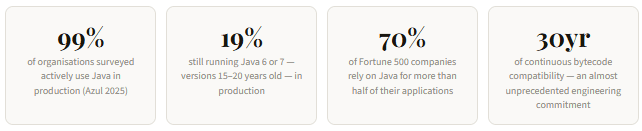
The enterprises running Java 6 in a financial clearing system or a hospital patient record platform are not making an irrational choice. They are making a risk-weighted choice in an environment where the cost of a migration failure — a regulatory breach, a patient safety incident, a settlement delay — is asymmetric and potentially catastrophic. Java’s backward compatibility commitment is what makes that choice rational. It is, in other words, the platform absorbing upgrade risk on behalf of its users — a form of stewardship that has enormous social and economic value and almost no visibility in mainstream engineering discourse.
Part 2 — The Cost-Transfer Model of Breaking Changes
To understand what backward compatibility is morally, it helps to understand what breaking it does economically. When a language runtime, a framework, or a library maintainer introduces a breaking change — even a well-intentioned one, even one announced with a deprecation notice eighteen months in advance — they are making a decision about who pays for the improvement. The maintainer saves the cost of supporting the old API. The downstream user absorbs the migration cost.
This cost transfer is invisible in ecosystems that celebrate rapid evolution, because the people who bear the migration cost are systematically underrepresented in the technical discourse. The developer at a fast-growing startup who migrated from Python 2 to 3 over a weekend writes the blog post. The team at a regional bank that spent eighteen months navigating the same migration through a compliance approval process does not write the blog post. Consequently, the ecosystem’s self-image is shaped disproportionately by the experience of the people for whom the cost was low — and the normative discourse reflects that.
The Python 2 → 3 Case Study
Python 3 was released in 2008. Python 2 reached end-of-life in January 2020 — twelve years later. The Stack Overflow Engineering Blog acknowledged directly that in regulated settings such as healthcare, finance, and government, “it can take a monumental effort to convince people to make the switch,” precisely because security teams control upgrades, pip downloads may be disallowed, and the compliance process for approving a new runtime version is itself a multi-year project. The Python community’s decision to make the break was not wrong in the abstract. But the framing of organisations still on Python 2 as laggards obscured the reality that many were trapped by institutional constraints entirely orthogonal to their technical competence.
SemVer as Permission Structure
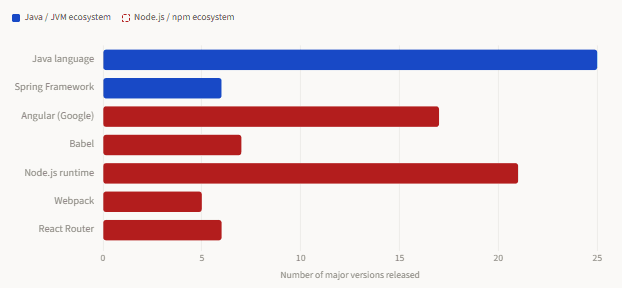
The Node.js and npm ecosystems formalised breaking changes through semantic versioning — the convention that incrementing a major version number signals incompatibility. In theory, this is a reasonable contract. In practice, it has functioned as a permission structure for normalising churn. As one widely cited analysis of SemVer put it: “here’s the problem: people interpret SemVer as permission to make breaking changes.” React Router reached its sixth major version. Node.js itself is on major version 21. Babel reached major version 7. Each major bump is individually defensible; the aggregate effect is an ecosystem where the cost of keeping up with dependencies is a permanent line item in every team’s engineering budget.
Moreover, not everyone follows SemVer strictly. There are cases where patch releases contain breaking changes, and minor releases that add features but break existing ones. The theoretical contract is further undermined by the reality that one breaking change in a single library can cascade through an entire dependency tree, triggering version conflicts and peer dependency warnings in packages that never themselves changed. The cost lands on the downstream user, silently, during an upgrade they were doing for security reasons.
Breaking Change Culture: Major Version Counts Across Ecosystems
Java’s 25 major versions span 30 years with near-total bytecode compatibility maintained throughout. Node.js reached v21 in roughly 10 years. Version count alone does not indicate quality — the relevant comparison is the migration burden imposed on downstream users per major increment.
Part 3 — What Genuine Platform Stewardship Looks Like
Java’s stewardship model is worth examining on its own terms, because it represents a coherent and unusual answer to the question of who should bear the cost of platform evolution. The answer Java has given, consistently, is: the platform bears it. The JVM team absorbs the engineering cost of maintaining compatibility with old bytecode. The language specification team works within the constraint that new features must not break existing semantics. Framework authors who ship on the JVM inherit this commitment and, at their best, honour it.
This does not mean Java never breaks anything. The module system introduced in Java 9 created genuine migration friction, and the deprecation and eventual removal of the Security Manager, Applet API, and various internal sun.* classes have all imposed real costs on downstream users. The difference is one of attitude and proportion. Breaking changes in Java are rare, slow-moving, heavily telegraphed, and treated as genuinely serious events requiring justification. They are not treated as the normal cost of progress to be absorbed by users as a matter of routine.
The Stewardship Principle
Java’s longevity comes from disciplined backward compatibility, a predictable release cadence, and a willingness to adopt modern paradigms — lambdas, records, virtual threads — without breaking existing code. This is not a coincidence. It is the product of a deliberate governance philosophy in which the people who evolve the platform accept responsibility for the people who depend on it.
The Regulated Industry Problem
The case for backward compatibility is strongest — and most invisible in technical discourse — in regulated industries. A hospital system running a patient medication management application on Java 8 is not running it because the engineers are lazy or conservative. It is running it because the application passed a clinical validation process, received regulatory approval, and has accumulated years of operational evidence about its behaviour. The system works. Touching it is risky. And in an environment where an upgrade introduces a regression that affects medication dispensing, the consequences are not a customer complaint or a bad performance review — they are potentially a patient safety incident.
Similarly, in financial services, core banking systems, clearing infrastructure, and regulatory reporting pipelines run on Java versions that would strike a modern startup engineer as archaeological. Azul’s research confirms that all ten of the world’s top ten financial trading companies trust Java for critical systems. The version of Java running in those systems is not a reflection of engineering quality. It is a reflection of the asymmetric risk calculus in environments where stability is a regulatory requirement, not merely a preference.
Who Bears the Migration Cost? A Framework Comparison
| Ecosystem | Breaking change frequency | Primary cost-bearer | Regulated industry fit | Stewardship model |
|---|---|---|---|---|
| Java / JVM | Rare, heavily telegraphed, multi-year deprecation cycles | Platform team absorbs engineering cost | Strong | Platform-bears-cost |
| Python | Major breaks rare but severe (Python 2 → 3 took 12 years to resolve) | Downstream users; enterprises most exposed | Variable | Community-consensus |
| Node.js / npm | Frequent; major version increments normalised; SemVer widely misapplied | Downstream users; SMEs and enterprises most exposed | Weak | Move-fast default |
| Go | Deliberately rare; Go 1 compatibility promise maintained since 2012 | Platform team absorbs engineering cost | Strong | Platform-bears-cost |
| Rust | Rare at language level; crate ecosystem has higher churn | Mixed; language stable, library layer variable | Variable | Language-stable/lib-variable |
Part 4 — The Ethics of Breaking Change Culture
The argument so far has been largely economic: breaking changes transfer cost from platform maintainers to downstream users, and the users least able to absorb that cost are systematically in regulated, high-stakes environments. But there is a deeper ethical claim worth making explicit.
When a framework author or library maintainer decides to introduce a breaking change, they are making a unilateral decision that affects people who were not party to that decision and who may have built significant, irreversible commitments on top of the old interface. In many cases, the downstream users are not developers at all — they are the hospital that deployed a system on a particular Java version, the bank whose clearing infrastructure depends on a particular library, the small development team that built a client’s order management system and no longer has the budget or the access to migrate it. The breaking change affects them as surely as it affects the developer who gets the dependency update notification. But the developer gets the notification and has the agency to respond to it. The others do not.
This is, in structure, the same ethical problem as any situation where an upstream actor externalises cost onto downstream parties who lack the power to negotiate terms. It is usually not malicious. Most breaking changes are made by developers who genuinely believe they are improving their software, serving their users, and following the norms of their ecosystem. The harm is systemic, not intentional — which makes it harder to see and harder to argue against, but no less real.
A different set of values
Java’s governance model reflects a value judgment: the people who maintain a platform are responsible for the people who depend on it, not merely for the people who are following its evolution actively. The Node.js and Python ecosystems, at their worst, reflect a different value judgment — that the responsibility of the maintainer ends at the release, and the upgrade cost is the user’s problem. Neither of these is a technical choice. They are choices about power, responsibility, and who counts as a stakeholder in the platform’s future.
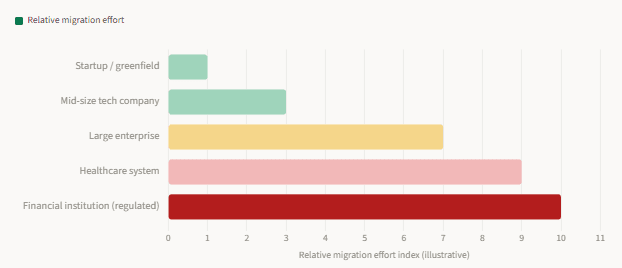
Migration Cost Asymmetry by Organisation Type
The migration effort index is illustrative and reflects the compound cost of compliance reviews, validation processes, integration testing, and institutional approval cycles — all of which scale with regulatory burden, not engineering skill.
Part 5 — What This Means for Java Engineers Today
None of the above implies that Java is perfect, that breaking changes are never justified, or that the platform should refuse to evolve. Java 9’s module system did create genuine migration friction, and the decisions to remove deprecated internal APIs over time are defensible on security and maintainability grounds. The argument is not that change is wrong. It is that the burden of justification should sit with those who break the promise, not with those who built on it.
In practice, this means several things. First, it means treating deprecation notices as what they actually are — beginnings of a conversation about cost, not procedural clearance for a future removal. A deprecation notice does not reduce the migration cost for the hospital system. It simply signals that the cost will eventually be mandatory. Second, it means that the framing of “legacy” as a synonym for “backwards” or “incompetent” should be retired. The enterprise running Java 8 in a regulated environment is not behind. It is making a rational, defensible choice within a constraint set that most technical discourse chooses not to acknowledge.
Third, and most importantly for the Java community specifically: Java’s stewardship model is a competitive advantage and a moral achievement worth defending. The framework authors, library maintainers, and tooling developers who build in the JVM ecosystem inherit a responsibility to carry that model forward. Every time a popular Java library breaks its API in a minor version, it erodes the social contract that Java’s platform-level commitment has worked for thirty years to build. The ecosystem is only as trustworthy as the sum of its commitments.
For Framework and Library Authors
The most important audience for this argument is not Java’s platform team — they understand it deeply and have honoured it consistently. It is the authors of the frameworks, libraries, and tools built on top of the JVM. Every Spring major, every Hibernate migration guide, every Jackson breaking change exists in the context of an ecosystem where the platform has made an extraordinary promise of stability. The question worth sitting with is: what does your library’s compatibility record say about who you think your users are?
What We Have Learned
- Backward compatibility is a promise, not a property. It is a commitment made to people who build on a foundation and cannot easily leave it — and like all promises, breaking it has a moral dimension, not just a technical one.
- The cost of breaking changes is asymmetric. It falls most heavily on regulated industries, enterprises, and organisations with the least flexibility to absorb it — precisely the environments where Java is most deeply embedded and most consequential.
- Java’s stewardship model is unusual and worth defending. The thirty-year commitment to bytecode compatibility is not an accident or a legacy constraint. It is the product of a deliberate governance philosophy in which the platform accepts responsibility for the people who depend on it.
- The Node.js and Python ecosystems represent a different set of values — not necessarily worse in every context, but built on a different assumption about who bears responsibility for ecosystem stability. That assumption should be examined, not treated as a neutral default.
- “Legacy” is not a pejorative. Organisations running old Java versions in production environments are, in most cases, making rational, risk-weighted decisions under genuine institutional constraints. The engineering community’s tendency to frame this as backwardness is a failure of empathy, not a technical insight.
- The framework and library layer is where the commitment is most at risk. Java’s platform-level promise is only as valuable as the ecosystem that builds on it. Authors who break APIs in the JVM ecosystem inherit a responsibility to the same users the platform has served for three decades.