The Hidden Cost of Records: When Java Records Break Your Serialization, JPA, and Reflection-Heavy Code

Records are now a mainstream Java feature — clean, concise, and genuinely useful. But the introductory tutorials skip the part where they quietly break Hibernate, confuse Jackson, corrupt your serialization stream, and make reflection-heavy frameworks do surprising things. This article is for the developers who already know what a record is and want to know why it just failed in production.
When JEP 395 finalized records in Java 16, the community celebrated — and rightly so. The boilerplate reduction is real, the immutability semantics are clear, and the language became meaningfully more expressive. Fast-forward to 2026 and records are everywhere: DTOs, domain value objects, config holders, API response types. That adoption, however, has outpaced the ecosystem’s adaptation to records’ slightly different internal contract.
The trouble is that many of the frameworks we rely on — Hibernate, Jackson, the classic java.io.Serializable mechanism, Lombok, MapStruct, Mockito — were built around a set of assumptions about classes that records quietly violate. A no-arg constructor. Mutable fields. The presence of setters. The ability to subclass. Records offer none of those. And while each framework has been updating to accommodate them, the upgrade paths are uneven, the version dependencies are specific, and the failure modes are often silent until something reaches production.
What this article covers
- Why Hibernate cannot use records as
@Entitytypes — and what it can use them for - The three most common Jackson deserialization failures with records and their exact fixes
- How
serialVersionUIDandObjectInputStreambehave differently for record classes - Which reflection-heavy tools hit the compact constructor and how to route around them
- A compatibility matrix across framework versions so you can check your own stack
1. Hibernate & JPA: The No-Arg Constructor Problem
Let us start with the most common sharp edge. The Jakarta Persistence 3.1 spec is explicit: an entity class must have a public or protected no-argument constructor. Records, by design, do not have one — the compiler generates only the canonical constructor that takes all components as arguments. This means one simple rule applies without exception:
You cannot annotate a Java record with
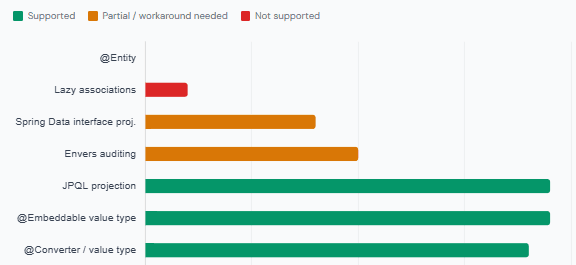
@Entity. Hibernate will either throwInstantiationExceptionat startup or silently fail to hydrate instances from the database. There is no workaround inside the JPA spec.
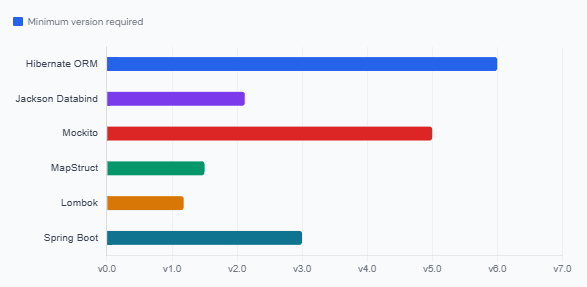
That said, records integrate beautifully with Hibernate in two legitimate ways: as embeddables and as projection targets. Since Hibernate ORM 6.0 (which aligns with Hibernate 6 and Spring Boot 3.x), records are fully supported as @Embeddable value objects and as constructor expression targets in JPQL.
// Works perfectly — record as an @Embeddable value object (Hibernate 6+)
@Embeddable
public record Money(BigDecimal amount, String currency) {}

@Entity
public class Order {
    @Id
    private Long id;

    @Embedded
    private Money total; // fine — Hibernate uses the canonical constructor
}
// Works perfectly — record as a JPQL projection (Spring Data / Hibernate 6+)
public record OrderSummary(Long id, String customerName, BigDecimal total) {}

// In your repository:
@Query("SELECT new com.example.OrderSummary(o.id, o.customer.name, o.total.amount) FROM Order o")
List findAllSummaries();
The projection pattern is particularly powerful: it avoids loading full entity graphs when you only need a read-model slice. The constructor expression tells Hibernate exactly which fields to pull and how to wire them — no reflection guesswork, no proxy subclassing required.
Version dependency
The @Embeddable record support was stabilized in Hibernate ORM 6.0. If you are on Hibernate 5.x (typically Spring Boot 2.x), records as embeddables do not work reliably. Check your spring-boot-starter-data-jpa version — Spring Boot 3.0+ uses Hibernate 6 by default.
Where teams most often go wrong is trying to use records in bidirectional relationships or lazy-loaded associations. Even as embeddables, records containing @OneToMany or @ManyToOne associations will fail — Hibernate needs to instrument (proxy) those fields, and the final fields of a record are not instrumentable. Keep records as leaf-level value objects carrying only primitive or simple typed data.
Hibernate record integration: what works vs. what fails
2. Jackson Deserialization: Three Failures You Will Actually Hit
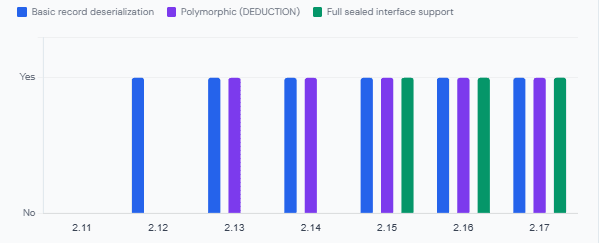
Jackson has supported records since version 2.12, released in November 2020. However, “supported” covers only the happy path. There are three distinct failure patterns that appear regularly in production codebases, and each requires a different fix.
Failure 1 — Missing @JsonCreator on ambiguous constructors
When a record has a single-component canonical constructor, Jackson 2.12+ infers the mapping automatically. But as soon as you add a compact constructor with validation logic, a secondary factory method, or any additional constructor, Jackson gets confused about which one to use for deserialization and throws InvalidDefinitionException.
// Breaks Jackson deserialization if you add ANY secondary constructor
public record Email(String value) {
    public Email {
        // compact constructor with validation
        if (!value.contains("@")) throw new IllegalArgumentException("Invalid email");
    }

    // Jackson sees two constructors and panics
    public static Email of(String raw) {
        return new Email(raw.trim().toLowerCase());
    }
}

// Fix: be explicit
public record Email(String value) {
    @JsonCreator
    public Email(String value) {  // explicit canonical — Jackson knows exactly which to use
        if (!value.contains("@")) throw new IllegalArgumentException("Invalid email");
        this.value = value;
    }
}
Failure 2 — Property name mismatch with @JsonProperty
In a regular class, @JsonProperty("user_name") on a field and on its getter can be placed somewhat loosely. In records, the component name, the accessor method, and the constructor parameter are all the same symbol. If you put @JsonProperty in the wrong place — typically copied from an old POJO pattern — Jackson either silently ignores it or maps to null without warning.
// Wrong — @JsonProperty on a synthesized accessor is ignored in some Jackson versions
public record UserDTO(
    String userName,   // accessor is userName(), Jackson sees "userName"
    int age
) {}

// Right — annotate the component in the canonical constructor parameter
public record UserDTO(
    @JsonProperty("user_name") String userName,
    int age
) {}
Failure 3 — Polymorphic deserialization without a type discriminator
Jackson’s @JsonTypeInfo mechanism relies on an empty default constructor to create an instance before populating type information. Records have no such constructor. When a record participates in a polymorphic hierarchy — for example, a sealed interface with several record implementations — Jackson will throw InvalidTypeIdException unless you configure a fully custom deserializer or use the DEDUCTION-based type resolver introduced in Jackson 2.12.
// Sealed interface + record subtypes — works with Jackson 2.12+ DEDUCTION
@JsonTypeInfo(use = JsonTypeInfo.Id.DEDUCTION)
@JsonSubTypes({
    @JsonSubTypes.Type(SuccessResponse.class),
    @JsonSubTypes.Type(ErrorResponse.class)
})
public sealed interface ApiResponse permits SuccessResponse, ErrorResponse {}

public record SuccessResponse(String data) implements ApiResponse {}
public record ErrorResponse(String code, String message) implements ApiResponse {}
DEDUCTION infers the subtype from which fields are present in the JSON, so it does not need to instantiate a blank object first. It works well for sealed hierarchies where each subtype has a distinct field shape. However, if two record subtypes have overlapping field names, deduction will fail silently and return the wrong type.
Jackson record deserialization support by version
3. Java Serialization: The serialVersionUID Trap
Classic Java object serialization (java.io.Serializable) interacts with records in a way that is technically specified — but the spec introduces a breaking change that is easy to stumble over when migrating existing DTOs to records.
For ordinary classes, the serialization stream encodes field names and types, and ObjectInputStream uses reflection to write into those fields. For record classes, the serialization spec mandates a fundamentally different path: deserialization always invokes the canonical constructor, passing component values extracted from the stream. This sounds fine — until you consider what it means in practice.
If you convert an existing
SerializablePOJO to a record, any serialized bytes produced by the old class will fail to deserialize with the new record class, even with the same field names andserialVersionUID. The wire format is structurally incompatible because the old stream contains field assignments; the new reader expects constructor arguments.
Additionally, readObject, writeObject, readResolve, and writeReplace are silently ignored for record classes. If your POJO used readObject to decrypt a field on deserialization, that logic simply does not run after the migration. The compact constructor is the only place where you can intercept deserialization — which, to be fair, is a cleaner design. But it means the migration is not a drop-in replacement.
// BEFORE — classic Serializable POJO with custom readObject
public class UserSession implements Serializable {
    private static final long serialVersionUID = 1L;
    private String userId;
    private String token;

    private void readObject(ObjectInputStream in) throws IOException, ClassNotFoundException {
        in.defaultReadObject();
        this.token = decrypt(this.token); // custom hook
    }
}

// AFTER — record migration; the compact constructor IS the deserialization hook
public record UserSession(String userId, String token) implements Serializable {
    @Serial
    private static final long serialVersionUID = 2L; // bump — wire format changed

    public UserSession {
        // compact constructor: validate / transform on both construction AND deserialization
        token = decrypt(token);
        if (userId == null || userId.isBlank()) throw new IllegalArgumentException("userId required");
    }

    private static String decrypt(String raw) { /* ... */ return raw; }
}
Note the explicit bump to serialVersionUID = 2L. This is not just good practice — it is necessary. If you leave it at 1L, old serialized bytes with the POJO format will attempt to deserialize into the record and produce a StreamCorruptedException or, worse, corrupt data without an exception if field positions happen to align. Bumping the UID forces a clean break and surfaces the incompatibility immediately.
4. Reflection-Heavy Frameworks: Lombok, MapStruct, and Mockito
A surprising number of popular tools operate by generating or manipulating class bytecode based on assumptions about fields and mutability. Records violate those assumptions at the language level, and each tool has adapted differently.
Lombok
Lombok and records largely overlap in purpose — both exist to reduce boilerplate. Mixing them is mostly unnecessary, but teams sometimes try to apply @Builder or @With to records. As of Lombok 1.18.24+, @Builder on a record is supported and generates a builder that delegates to the canonical constructor. However, @Data, @Setter, and @EqualsAndHashCode are redundant and will trigger warnings — records already provide all of those semantics. The real danger is older Lombok versions (pre-1.18.22) that attempt to generate setters and fail because record components are final.
MapStruct
MapStruct 1.5+ supports records as mapping targets via constructor injection. The mapper detects the canonical constructor and matches source fields by name. However, if a source field name differs from the record component name, @Mapping(target = "fullName", source = "name") annotations must be applied at the mapper method level — not on the record itself, because records do not have setter-style injection points.
// MapStruct 1.5+ — record as mapping target
public record PersonDTO(String fullName, int age) {}

@Mapper
public interface PersonMapper {
    @Mapping(target = "fullName", source = "name") // field name differs
    PersonDTO toDTO(Person person);
}
Mockito
This is the one that surprises teams the most. Mockito.mock(SomeRecord.class) fails on Mockito versions below 5.0 because mock creation requires subclassing, and records are implicitly final — they cannot be subclassed. The standard workaround before Mockito 5 was to use MockMaker.INLINE (via mockito-inline artifact), which uses instrumentation rather than subclassing.
# For Mockito < 5.x: add mockito-inline dependency (Maven)
# In pom.xml test scope:
# <dependency>
#   <groupId>org.mockito</groupId>
#   <artifactId>mockito-inline</artifactId>
#   <version>4.11.0</version>
#   <scope>test</scope>
# </dependency>

# For Mockito >= 5.0: inline is the default mock-maker; no extra dep needed
Mockito 5.0, released in January 2023, made the inline mock maker the default, so if your project is on Spring Boot 3.x (which pulls Mockito 5.x transitively), record mocking works out of the box. But Gradle or Maven dependency overrides can accidentally downgrade Mockito, so it is worth confirming the actual version in use.
Framework minimum versions for reliable record support
5. The Compact Constructor and Reflection Surprises
The compact constructor is one of the most elegant parts of the records spec. But its interaction with the JVM’s reflection API produces one consistently surprising result: Class.getDeclaredConstructors() returns the canonical constructor — not a compact constructor. From the JVM’s perspective, the compact constructor is compiled into the canonical constructor. There is only ever one constructor in the bytecode.
This matters when frameworks use reflection to inspect constructor parameters and match them to dependency injection candidates. Spring Framework 6.x handles this correctly since it was updated alongside the records adoption curve. However, older DI containers and libraries that call Constructor.getParameterCount() or Constructor.getParameterAnnotations() may see unexpected results if they expect annotations placed on compact constructor parameters to survive into bytecode.
Annotations on record components are propagated by the compiler to three targets simultaneously: the component field, the accessor method, and the canonical constructor parameter — but only if the annotation’s
@Targetincludes the corresponding element types. If you define a custom validation annotation with@Target(FIELD)only, it will not appear on the constructor parameter. Frameworks that inspect constructor parameters (Bean Validation, Spring’s@Validated) will silently skip it.
// Custom annotation — correct @Target for record component usage
@Target({ ElementType.FIELD, ElementType.METHOD, ElementType.PARAMETER, ElementType.RECORD_COMPONENT })
@Retention(RetentionPolicy.RUNTIME)
@Constraint(validatedBy = {})
@NotBlank
public @interface ValidEmail { /* ... */ }

// Now the annotation propagates correctly to all three locations on the record
public record ContactForm(
    @ValidEmail String email,
    @NotBlank String subject
) {}
Note the inclusion of ElementType.RECORD_COMPONENT, added in Java 16. Without it, annotation processors and validation frameworks will not see the annotation on the component declaration itself — even though the compiler may still propagate it to field and parameter targets depending on the tool.
6. When to Use Records and When Not To
Given all of the above, here is a practical decision table for teams evaluating record adoption. The goal is not to avoid records — they are genuinely excellent for the right use cases — but to be clear-eyed about where they save time and where they introduce friction.
| Use case | Use a record? | Notes |
|---|---|---|
| Immutable DTO / API response type | Yes, ideal | Exactly the design centre of records |
JPA entity (@Entity) | No | Spec requires no-arg constructor; use regular class |
JPA embeddable (@Embeddable) | Yes (Hibernate 6+) | Leaf value objects only — no associations |
| JPQL / Spring Data projection | Yes, excellent fit | Clean read-model slicing |
| Jackson serialization target | Yes (Jackson 2.12+) | Use @JsonCreator when multiple constructors exist |
| Polymorphic Jackson hierarchy | With care | Use DEDUCTION type info; avoid overlapping fields |
Classic Serializable migration | Only if wire compat breaks | Bump serialVersionUID; move logic to compact constructor |
| Mockito mock target | Mockito 5+ only | Inline mock maker required on earlier versions |
| MapStruct mapping target | Yes (MapStruct 1.5+) | Use @Mapping at mapper method level for name mismatches |
| Spring Bean / DI component | No | Records cannot be Spring beans; they are not subclassable |
| Event sourcing / domain event | Yes, excellent fit | Immutability is a feature for event types |
| Mutable builder pattern target | Partial (Lombok 1.18.24+) | Lombok @Builder on records works; avoid mixing @Data |
7. A Pre-Flight Checklist Before Adopting Records
Before introducing records into an existing production codebase, it is worth working through this checklist. None of these steps are complex individually — but missing any one of them tends to produce a failure that is hard to diagnose because the error messages are rarely descriptive.
Pre-flight checklist
1. Confirm Hibernate ORM version is 6.0 or higher (Spring Boot 3.0+ satisfies this).
2. Confirm Jackson version is 2.12 or higher; use @JsonCreator wherever a record has more than one constructor path.
3. If migrating a Serializable POJO, bump serialVersionUID and move all readObject logic to the compact constructor.
4. Check all custom annotations for @Target — add RECORD_COMPONENT and PARAMETER if they will be used on record components.
5. Confirm Mockito version is 5.0+ if records appear in unit test subjects.
6. For MapStruct mappings, confirm version 1.5+ and move all @Mapping annotations to the mapper interface, not the record.
7. Search the codebase for any record types that extend beyond value-object scope — anything that has been given a @Component, @Service, @Entity, or @Repository annotation.
8. What We’ve Learned
Records are a genuinely good addition to the Java language, and the failure modes covered here are not arguments against using them. They are arguments for using them deliberately. The recurring theme across every section is that records carry a different contract to the JVM than regular classes — no no-arg constructor, final fields, no subclassing — and every framework that predates Java 16 was built around the old contract.
Hibernate needs version 6 and an embeddable-first mindset. Jackson needs an explicit @JsonCreator wherever ambiguity exists. Classic serialization needs a clean wire-format break and a compact constructor that absorbs old readObject logic. Mockito needs version 5. The pattern is the same each time: upgrade to the framework’s record-aware version, move your customization into the canonical or compact constructor, and stop expecting field-based mutation to be available. Do that, and records will simplify your codebase without adding surprises.