
JavaScript has always been defined by flexibility. That flexibility made it the most widely used language in the world—but also one of the most misunderstood. For years, developers have navigated quirks, inconsistent patterns, and a “you can do anything” philosophy that often came at the cost of maintainability.
However, something important is changing.
JavaScript is gradually evolving into a more predictable, structured, and self-documenting language—not by abandoning its dynamic nature, but by layering stronger conventions and capabilities on top of it.
1. From Chaos to Conventions
In its early days, JavaScript allowed multiple ways to solve the same problem—with little guidance on which one was correct. Over time, the ecosystem compensated:
- Style guides
- Linters
- Framework conventions
Today, many of those “external rules” are becoming part of the language or its standard tooling.
Features introduced over the years—like let/const, arrow functions, modules, and async/await—have already reduced ambiguity. But the more recent direction goes further: JavaScript is becoming easier to reason about at scale.
2. The Rise of Type Safety (Without Leaving JavaScript)
A major driver of this shift is TypeScript.
While not technically JavaScript, TypeScript has effectively become the default way to write serious JavaScript applications. It introduces static typing, enabling developers to catch errors before runtime.
What is interesting is not just its popularity—but its influence.
Many modern JavaScript proposals are now designed with type systems in mind. This signals a broader alignment between dynamic and static paradigms.
In practice:
- APIs are becoming more self-descriptive
- Tooling provides stronger guarantees
- Refactoring is safer and faster
JavaScript is not becoming a statically typed language—but it is increasingly type-aware.
3. ECMAScript Evolution: Smaller Features, Bigger Impact
The evolution of JavaScript is now steady and incremental through the ECMAScript standard.
Recent additions and proposals focus on reducing friction rather than adding complexity. Examples include:
- Improved pattern matching (proposal stage)
- Records and tuples (immutable data structures)
- Better error handling ergonomics
You can track proposals here: https://tc39.es/
These changes may seem small individually, but collectively they push JavaScript toward clarity and consistency.
4. Runtime Innovation: JavaScript Beyond the Browser
Another major shift is happening at the runtime level.
Traditionally, JavaScript ran in:
- Browsers
- Node.js servers
Now, new runtimes are redefining expectations.
Deno
Deno emphasizes:
- Secure-by-default execution
- Native TypeScript support
- Modern standard library
Bun
Bun focuses on:
- Extreme performance
- Built-in tooling (bundler, test runner)
- Reduced dependency overhead
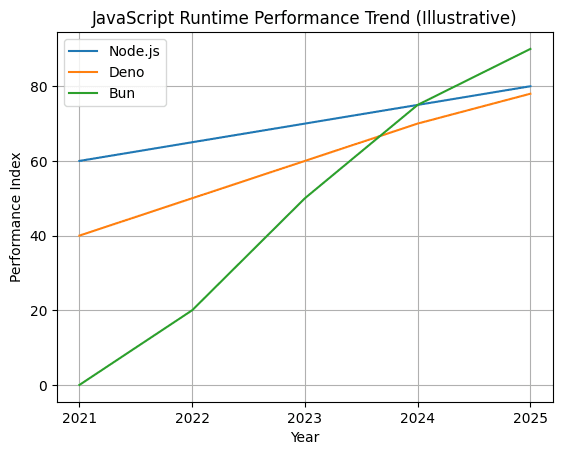
These runtimes are not just alternatives—they are pushing the ecosystem toward faster, simpler, and more integrated workflows.
Runtime Innovation: JavaScript Beyond the Browser
5. Frameworks Are Getting Smarter, Not Bigger
Interestingly, frameworks are also evolving—but not in the direction many expected.
Instead of growing heavier, modern frameworks aim to:
- Reduce client-side JavaScript
- Shift work to build time or the server
- Optimize rendering strategies
This is visible in ecosystems around:
- Next.js
- SvelteKit
The trend is clear: less JavaScript shipped, more intelligence applied.
6. The Push Toward Predictability
All these changes point to a common goal: predictability.
Developers increasingly want:
- Fewer runtime surprises
- More compile-time feedback
- Clearer mental models
JavaScript is adapting—not by removing flexibility, but by guiding it.
This is a delicate balance. Too much structure, and JavaScript loses its identity. Too little, and large-scale systems become difficult to maintain.
So far, the ecosystem is managing that balance well.
7. What This Means for Developers
If you are working with JavaScript today, the direction is worth noting:
- Expect tighter integration with type systems
- Expect runtimes to become more opinionated
- Expect frameworks to prioritize performance over abstraction
At the same time, core JavaScript remains approachable—one of its greatest strengths.
8. What We Have Learned
JavaScript is undergoing a gradual but meaningful transformation. While it remains a flexible and dynamic language, it is becoming more structured, predictable, and aligned with modern development needs. The influence of TypeScript, the evolution of ECMAScript, and the emergence of new runtimes like Deno and Bun all contribute to this shift. Rather than changing its identity, JavaScript is refining it—making it better suited for large-scale, maintainable applications without losing its accessibility.