Go 1.24’s Range-Over Functions and Generics Ergonomics: Is Go Finally Growing Up, or Compromising Its Identity?

Every new feature reopens the same debate. An honest look at what Go 1.24 actually shipped, what it means technically, and whether the simplicity-first philosophy is being honoured or eroded.
1. Go’s Identity and Why It Matters
Go was not designed to be the most powerful language. It was designed to be the most readable one at scale. That was the whole point. And that is precisely what makes every new feature worth arguing about.
When Robert Griesemer, Rob Pike, and Ken Thompson sat down at Google in 2007 with a whiteboard and a list of frustrations, they were not building a language for individuals. They were building one for teams — large teams, working across enormous codebases, where onboarding speed and code review clarity mattered more than expressive power. The result was a language deliberately stripped of features that felt redundant to its creators: no inheritance, no exceptions, no operator overloading, no generics (initially), minimal implicit behaviour.
That philosophy paid off. Go ranks among the top ten most used languages worldwide as of 2024, and adoption in AI-serving and edge computing has grown rapidly. Docker, Kubernetes, and Terraform are all written in Go. The language found its niche and held it firmly. But holding a niche while the world moves forward requires making choices — and recently, Go has been making some.
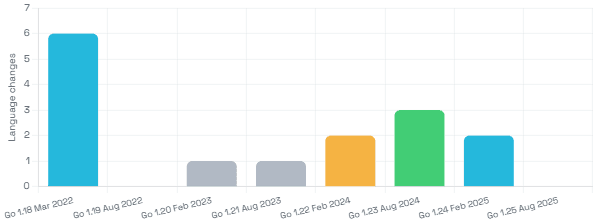
Go 1.18 introduced generics in 2022. Go 1.22 fixed the loop variable capture bug. Go 1.23 introduced range-over-function iterators as a language feature. Go 1.24, released in February 2025, fully stabilised generic type aliases. And Go 1.25, following six months later in August 2025, simplified the language spec itself. Each step is defensible individually. Taken together, they raise a question that the Go community has been debating with increasing intensity: is this still the same language?
2. The Road to Go 1.24
Go 1.18 · March 2022
Generics land — after a decade of “no”
Type parameters, type constraints, and the any alias arrive. The most requested feature in Go’s history, resisted for 12 years on grounds of complexity. The community celebrated; the debate started.
Go 1.22 · February 2024
Loop variable semantics fixed
A notorious gotcha — all goroutines in a loop capturing the same variable — finally fixed. Also introduced integer range iteration: for i := range 10. Both changes touched the language semantics directly.
Go 1.23 · August 2024
Range-over functions — a new iteration model
The iter package ships. Push iterators using a yield callback pattern become first-class citizens. Ranging over user-defined containers is now possible without hacks.
Go 1.24 · February 2025
Generic type aliases — the missing piece
Go 1.24 fully supports generic type aliases: a type alias may be parameterized like a defined type. The iterator ecosystem, standard library, and user code all benefit immediately from proper naming and abstraction.
Go 1.25 · August 2025
Spec simplified — “core types” removed
The notion of core types is removed from the language spec in favour of explicit prose where needed. The Go spec presents fewer concepts, making it easier to learn the language. A spec simplification arriving two years after generics — itself a sign of a team thinking carefully about long-term clarity.
3. Range-Over Functions: What Actually Shipped
The headline feature of Go 1.23 — stabilised and expanded in Go 1.24 — is the ability to use a function as the target of a for...range loop. This sounds simple, but it resolves a decade-long gap in the language: Go had no standard iterator protocol for user-defined types.
Before Go 1.23, if you built a custom data structure — a tree, a graph, a priority queue, a paginated result set — and you wanted users to iterate over it cleanly, you had three bad options. You could expose internal implementation details (breaking encapsulation). You could require users to call a callback-style ForEach method (inversion of control, harder to compose). Or you could return a channel and have users range over that (goroutine overhead, complex semantics). None of these felt like idiomatic Go.
For Go 1.23, the decision was to support both for/range over user-defined container types, and a standardized form of iterators, extending the for/range statement to support ranging over function types. The result is an iteration model that is consistent with existing range semantics, requires no new keywords, and composes naturally with the standard library’s slices, maps, and bytes packages.
Standard Library Expansion in Go 1.24: The bytes and strings packages in Go 1.24 add several iterator-returning functions: Lines, SplitSeq, SplitAfterSeq, FieldsSeq, and FieldsFuncSeq — all returning iterators over subslices or substrings. This is the standard library adopting its own new protocol, which is a strong signal about the intended direction.
4. How Push Iterators Work
The mechanics are worth understanding directly, because the signature is the thing that has prompted the sharpest community reactions. When Go speaks of an iterator, it means a function with one of three specific types. They are called push iterators because they push out a sequence of values by calling a yield function. The two most common signatures are defined in the new iter package:
go · iter package — Seq and Seq2 types
package iter

// Seq iterates over a single value per step (like a slice)
type Seq[V any]    func(yield func(V) bool)

// Seq2 iterates over a key/value pair per step (like a map)
type Seq2[K, V any] func(yield func(K, V) bool)
In practice, writing an iterator means returning a function that accepts a yield callback and calls it for each value. Consuming an iterator is simply a matter of ranging over the function. The consumer side — the most common side — is completely transparent:
go · Writing and consuming a custom iterator
package main

import (
    "fmt"
    "iter"
)

// A simple generic stack using a linked list
type Stack[T any] struct { items []T }

func (s *Stack[T]) Push(v T) { s.items = append(s.items, v) }

// All returns an iterator — readable, composable, no internals exposed
func (s *Stack[T]) All() iter.Seq[T] {
    return func(yield func(T) bool) {
        for i := len(s.items) - 1; i >= 0; i-- {
            if !yield(s.items[i]) {
                return // consumer broke out — respect it
            }
        }
    }
}

func main() {
    s := &Stack[string]{}
    s.Push("first")
    s.Push("second")
    s.Push("third")

    // Consumer side: familiar range syntax, no yield visible
    for v := range s.All() {
        fmt.Println(v)
    }
    // Output: third, second, first
}
The consumer experience is clean. The producer experience — writing iterators — requires understanding the yield pattern, and this is where the community is divided. As one widely-read post describes it: the function signature for writing an iterator is a little mind-bending the first time, but once you’ve written it once, it’s not so bad — comparable to HTTP middleware functions, which cause an initial confusion but become intuitive quickly. Others are less forgiving.
Real Edge Cases to Know: The Go 1.24 iterator implementation has some non-obvious behaviours: if an iterator function recovers from a panic propagated from the loop body, the runtime will create a new runtime panic implicitly. Additionally, the yield callback must not be called after the iterator function returns — doing so causes a runtime crash. These are things to understand before writing production iterators.
5. Generic Type Aliases: The Quiet Companion
Less discussed but arguably as important for day-to-day ergonomics is Go 1.24’s completion of generic type aliases. A type alias is simply an alternative name for an existing type. Before Go 1.24, aliases could not be parameterised — which created an awkward situation for the iter package itself. You could define a type alias for a concrete type, but not for a generic one.
With Go 1.24, that limitation is removed. This matters because it allows library authors to give readable names to complex generic function signatures without introducing new concrete types. For the iterator ecosystem specifically, it means iter.Seq[string] can be used as a type alias in API signatures that were previously forced to spell out the full func(yield func(string) bool) everywhere — which is both noisy and harder to document.
Furthermore, generic type aliases open the door for more expressive re-exports in packages that wrap other packages — a common pattern in large codebases. Teams that manage internal SDK layers over third-party dependencies have already reported this being one of the most practically useful changes in recent Go releases.
6. Go 1.25: The Spec Cleaned Up
Go 1.25 was released in August 2025, bringing improvements across tools, runtime, compiler, linker, and standard library. Notably, however, no user-visible language features were added in Go 1.25 — the language remains stable. That restraint is itself a statement.
What Go 1.25 did do at the language level was tidy up the spec. The notion of core types was removed from the language spec in favour of explicit prose where needed. Core types were an abstract concept introduced in Go 1.18 to handle how generics interacted with operations like indexing and channel operations. They were technically correct but conceptually awkward — a reader trying to understand how close(ch) worked on a generic channel had to first learn what a core type was.
The Go 1.25 spec reverts those sections to their pre-generics prose wherever possible and adds targeted paragraphs for generic cases. The result: the Go spec now presents fewer concepts, making it easier to learn the language, and opens the door for more flexible future rules. It is the kind of cleanup that gets little fanfare but speaks directly to the team’s long-term commitment to intellectual honesty about the language’s complexity.
Beyond the spec, Go 1.25 introduced an experimental new garbage collector (GOEXPERIMENT=greenteagc) and an experimental encoding/json/v2 package. The GC in particular is significant: benchmarks show 10–40% reduction in GC overhead for GC-heavy workloads, with improved performance for small object-intensive applications.
7. The Debate: Growing Up or Selling Out?
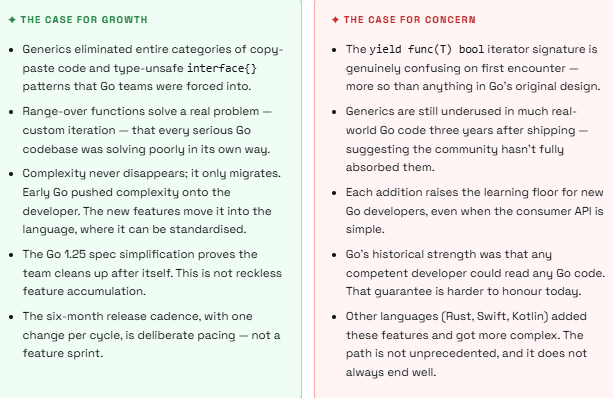
The question the title poses is not rhetorical — it is genuinely contested, and both sides have reasonable arguments. Here is where each camp stands.
The case for growth
8. Complexity Never Disappears — It Only Migrates
The most intellectually honest framing of this debate comes from an observation that originated in the Perl community and has been doing quiet rounds in Go discussions: complexity never disappears; it only migrates. In early Go, the language’s extreme simplicity pushed complexity onto the developer.
This is worth sitting with. The Go codebases that existed before generics were not simpler in any absolute sense. They were full of duplicated logic, unsafe type casts, and interface-wrapping patterns that required discipline to manage correctly. The complexity was there — it was just invisible to the language specification. It lived in the gap between what Go could say and what developers needed to express.
Generics, iterators, and generic type aliases move some of that complexity from the gap into the language itself. The language spec becomes slightly more complex; real codebases become slightly less so. Whether that trade is worth it depends entirely on where you sit in the ecosystem — writing a standard library, building a domain-specific internal tool, or teaching Go to new engineers — and those positions have genuinely different answers.
Rob Pike’s “Simplicity Is Complicated” Still Applies: In his 2015 talk, Pike argued that achieving simplicity in a language is genuinely hard work — not the absence of work. The Go team’s approach is not reckless feature creep, but slow, deeply considered debate — a cautious response to real-world pain points experienced by the community. Whether you agree with specific decisions, the deliberateness of the process is hard to dispute.
9. Go vs the Field: Feature Density Snapshot

Go Language Feature Additions by Version
| Feature | Go | Rust | Kotlin | Java 21+ |
|---|---|---|---|---|
| Generics | Since 1.18 (2022) | Native (2010+) | Native | Since Java 5 |
| Custom iterators | Since 1.23 (2024) | Native traits | Iterator interface | Iterable / Stream |
| Error handling model | Explicit returns | Result<T,E> + ? | try/catch + Result | Checked exceptions |
| Async / concurrency | Goroutines + channels | async/await | Coroutines | Virtual threads (21) |
| Spec learning curve | Low — growing | High | Medium | Medium-high |
| Backward compatibility | Go 1 guarantee | Editions model | Strong | Strong |
| Binary deploy model | Single static binary | Single static binary | JVM dependency | JVM dependency |
10. A Verdict That Holds Both Things at Once
The honest answer to “is Go growing up or compromising its identity?” is that it is doing both simultaneously — and that this is neither a contradiction nor a failure. It is what maturity looks like for a language in its second decade.
Go is growing up in the sense that it is acquiring the tools that serious software engineering at scale actually requires. The absence of a standard iterator protocol was a genuine gap. The absence of generic type aliases was a real ergonomic limitation. Filling those gaps does not make Go worse; it makes it complete enough to be used honestly in the situations where it already dominates — cloud infrastructure, microservices, CLI tooling, and high-performance API services.
And Go is doing something that languages rarely do well: it is growing up without losing the plot. Go maintains a rare commitment to backward compatibility — code written a decade ago still compiles and runs today. That kind of trust is priceless for organisations maintaining production systems across years or even decades. The six-month cadence, the spec simplification in 1.25 after the complexity introduction in 1.18, and the experimental opt-in approach for the new GC and JSON package — these are not signs of a team chasing trends. They are signs of a team managing a language with genuine care.
The legitimate concern is not that Go is adding features. It is that each addition raises the minimum knowledge required to read unfamiliar Go code fluently. That bar is higher now than it was in 2018, and it will be higher still in 2028. Whether that is acceptable depends on your use case, your team, and your tolerance for the tradeoff between expressiveness and approachability. There is no universal answer — but knowing the question precisely is the starting point.
The Practical Takeaway for Teams: If you are on a Go team today: adopt range-over functions for any new custom container types or data pipeline abstractions. The consumer syntax is clean enough for code review. Generic type aliases are worth using immediately in any package that re-exports iterator-returning functions. The Go 1.25 experimental GC is worth testing in staging for GC-heavy workloads — but keep it behind a flag in production until it graduates in a future release.
11. What We Have Learned
Go 1.24 and its broader context represent the most consequential period of language evolution since Go 1.0. Here is the concise version:
- Range-over functions (Go 1.23, stabilised in 1.24) give Go a standard iterator protocol for the first time. Consumer syntax is clean; producer syntax requires understanding the
yieldpattern. - Generic type aliases (Go 1.24) complete the generics story by allowing parameterised aliases — critical for readable API design in library code.
- Go 1.25 made zero language changes but simplified the spec by removing “core types” — a meaningful act of intellectual tidying that opens the door for more flexible generics rules ahead.
- The experimental GC in Go 1.25 shows 10–40% reduction in GC overhead for small object-intensive workloads. The experimental JSON v2 package finally addresses long-standing marshalling limitations.
- The philosophical debate is real but often mis-framed. Complexity does not disappear when features are withheld — it migrates into developer workarounds. The question is where the tradeoff sits, not whether complexity exists.
- Go’s identity is intact — single binaries, goroutine concurrency, the Go 1 compatibility promise, and a deliberate six-month release cadence are all unchanged. The language is more expressive than it was in 2018; it is not a different language.
- The learning floor is higher. This is the legitimate cost. Teams onboarding new Go developers should account for it — and the community should be honest about it rather than insisting Go is still as simple as it was at Go 1.