
Why do smart developers implement patterns they don’t fully understand — and what does it say about the way we build software today?
Picture this: a developer runs into a cryptic error at 11 PM. They paste it into Google, land on a Stack Overflow thread, find an answer with 847 upvotes, copy the solution, and move on. The bug disappears. They never ask why it worked.
This scene plays out millions of times a day across the software industry. And while it feels perfectly reasonable in the moment, it points to something much deeper — a widespread psychological pattern that researchers and engineers have started calling Cargo Cult Programming.
The term itself is borrowed from a fascinating anthropological phenomenon. After World War II, some Pacific Islander communities, having observed the arrival of cargo-laden military planes, built replica airstrips and wooden “control towers” hoping to attract more goods. The rituals looked right. They just lacked the underlying understanding that made them work. Sound familiar?
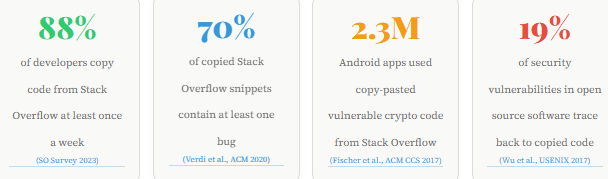
The numbers are striking. However, before we rush to judge anyone, it’s worth asking a more important question: why does this happen in the first place? The answer, as it turns out, is deeply psychological.
1. The Brain Shortcut We Can’t Resist
Humans are fundamentally wired to copy. Social learning — the ability to observe and replicate others’ behaviours — is one of our most powerful cognitive tools. For most of human history, copying someone who already knew how to do something was not laziness. It was survival.
In cognitive psychology, this is closely linked to what Nobel laureate Daniel Kahneman calls “System 1 thinking” — the fast, automatic, low-effort mode our brains prefer. When a developer is under deadline pressure, mentally fatigued, or simply unsure, the brain automatically reaches for the fastest path to a working result. Copy-paste is that path.
Furthermore, there is a phenomenon psychologists call cognitive offloading — the tendency to delegate mental effort to tools or external systems. Stack Overflow, GitHub Copilot, and even official documentation have become external cognitive prosthetics. They don’t just help us work faster; they quietly encourage us to think less.
The internet didn’t create cargo cult programming. It just gave it a jet engine.— Jeff Atwood, Co-founder of Stack Overflow, Coding Horror
As a result, the pattern is not a sign of stupidity — it’s a sign of a brain doing exactly what brains are designed to do. That’s precisely what makes it so persistent and so hard to break.
2. Authority Bias: Trusting the Upvote Count
Stack Overflow introduced something deceptively powerful: a social ranking system for knowledge. An answer with 4,000 upvotes and a green checkmark carries an almost gravitational authority. Even experienced developers feel it.
This is authority bias in action — the well-documented psychological tendency to give disproportionate weight to information that appears to come from a credible or high-status source. In medicine, it’s why nurses sometimes hesitate to question a doctor’s wrong prescription. In development, it’s why we trust a highly-voted Stack Overflow answer even when it contradicts official documentation.
Interestingly, research by Nasehi et al. (2012) found that the most upvoted Stack Overflow answers are not necessarily the most correct — they are often the most concise and immediately copy-pasteable. The community, perhaps unwittingly, optimises for speed of use, not depth of understanding.
2.1 Why Developers Copy Code Without Reading Further
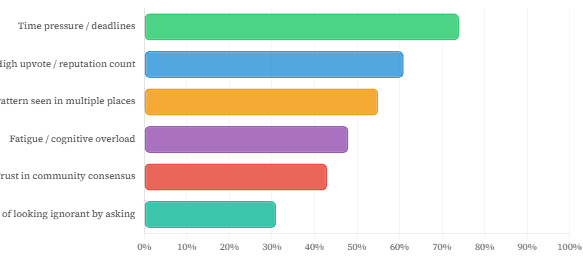
Moreover, authority bias is amplified by something called the halo effect. When a developer has a high reputation score on Stack Overflow, we subconsciously assume all their answers are trustworthy — even on topics far outside their demonstrated expertise. The number next to their username does the thinking for us.
3. Social Proof and the Herd Dynamic
Closely related to authority bias is social proof — Robert Cialdini’s term for our tendency to look to others when we’re uncertain about what to do. In ambiguous situations, we assume that if many people are doing something, it must be right.
In software development, social proof manifests in several notable ways. Consider npm packages: a library with 10 million weekly downloads feels safe to depend on. A library with 200 weekly downloads triggers hesitation — even if it’s better-written, more secure, and more appropriate for your use case. The crowd has already voted, and we follow.
Similarly, when a pattern appears repeatedly on Stack Overflow, in tutorials, in YouTube videos, and in blog posts, it begins to feel like the way to do something. Developers internalise it as a best practice — not because they evaluated it critically, but because they saw it everywhere. This is how anti-patterns become industry norms.
3.1 The Copy-Paste Risk Spectrum: Common Code Sources Compared

Furthermore, social proof interacts with normalisation. When everyone around you copies code, it stops feeling like a shortcut and starts feeling like standard procedure. Junior developers observe senior developers doing it. Senior developers assume everyone else has already validated the snippet. Nobody checks. The behaviour gets baked into the team culture.
4. The Stack Overflow Culture: Built for Speed, Not Understanding
To be fair to Stack Overflow, it was designed with a specific and genuinely useful goal: create a high-quality, searchable archive of programming Q&A. And by that measure, it has been remarkably successful. However, the incentive structures built into the platform have had some unintended consequences.
The platform rewards answers that get accepted quickly. Questions that are too broad, too exploratory, or that ask “why does this work?” are frequently closed as off-topic. The culture, therefore, evolved to produce solutions rather than understanding. You get the fish, but you rarely learn to fish.
| Platform / Source | Primary Design Goal | Encourages Understanding? | Copy-Paste Risk |
|---|---|---|---|
| Stack Overflow | Fast, searchable Q&A archive | Rarely — rewards brevity | High |
| GitHub Copilot / AI tools | Accelerate code writing | No — autocomplete by design | High |
| MDN Web Docs | Comprehensive reference | Yes — contextual explanations | Low |
| Official language docs | Authoritative language reference | Yes — designed for depth | Low |
| Medium / Dev.to tutorials | Content discovery & SEO | Varies widely | Medium |
| Peer code review | Collaborative quality control | Yes — dialogue-driven | Low |
Consequently, an entire generation of developers has grown up learning through fragments. They know what to type to make something work, but not always why it works. This is not a moral failing — it’s a rational adaptation to an environment that rewards speed and penalises deep questioning.
5. Imposter Syndrome: The Quiet Accomplice
There is one more psychological force worth examining, and it’s one that rarely gets talked about in this context: imposter syndrome. A 2018 study published in ACM’s CSCW found that imposter syndrome is disproportionately prevalent in software engineering compared to many other technical fields.
When you feel like you don’t fully belong — like everyone else somehow knows more than you do — you become less likely to ask clarifying questions and more likely to silently adopt whatever the high-upvote answer says. After all, if 3,000 people thought it was correct, who are you to question it?
Additionally, asking “can you explain why this works?” in a team meeting can feel exposing. Copying quietly and moving on feels safe. In this way, imposter syndrome and cargo cult programming reinforce each other in a self-sustaining loop that is difficult to interrupt without a deliberate cultural change.
6. When Cargo Cult Meets Security: The Real-World Cost
Up to this point, this might all sound fairly abstract. However, the consequences are very concrete — especially in security-sensitive code.
In a landmark 2017 study, Fischer et al. at ACM CCS analysed over 1.3 million Android apps and found that a significant proportion contained the same insecure cryptographic code — all of which traced back to a handful of Stack Overflow answers. The answers were not written by cryptographers. They were written by developers solving a specific problem at a specific moment. Then they were copied, and copied, and copied again.
Below is a representative example of the type of insecure pattern that was widely copied — using a static, hardcoded key for AES encryption. This is not recommended for production use and is shown here purely for educational illustration:
# Python illustration: INSECURE static key (educational purposes only)
# This pattern was widely copied from Stack Overflow and is NOT safe for production.
# A static key means every instance of your app uses the same encryption key.
# Anyone who reverse-engineers one app can decrypt all encrypted data everywhere.

from cryptography.fernet import Fernet

# ❌ WRONG — hardcoded static key (this is the cargo cult anti-pattern)
STATIC_KEY = b'YjFkZjQ4ZDEtMjM0NS00OGE3LTk4NzMtYzEyMzQ1Njc4OTBh'

# ✅ CORRECT — generate a unique key per user/session and store it securely
secure_key = Fernet.generate_key()
print("Generated secure key:", secure_key)
The insecure version worked — in the sense that it encrypted and decrypted data without errors. However, it left millions of users exposed. That is the defining characteristic of cargo cult code: it mimics the shape of a solution without capturing its substance.
7. Breaking the Pattern: Practical Steps That Actually Work
Fortunately, understanding the psychology gives us clear leverage points. The solution is not to shame developers for copying code — that would ignore the very real pressures they’re operating under. Instead, it means designing better habits, better environments, and better incentives.
- The “one-step-back” rule. Before pasting any snippet, spend 60 seconds reading the surrounding context of the answer — not just the code block. Why did the person ask this question? Does your situation actually match theirs? This single habit catches a large share of misapplied solutions. See Jeff Atwood’s discussion on reading before copying.
- Reach for official docs first. Before Stack Overflow, check the official documentation. MDN, Python Docs, and framework-specific docs are more verbose, but they tell you why something works — which means you’ll remember it and adapt it correctly next time.
- Use “explain before you paste” in code reviews. If a team member introduces a non-trivial pattern, make it a light cultural norm to be able to explain it in one sentence. Not as an interrogation — just as a conversation. This builds shared understanding without creating fear. Google’s engineering review guidelines embed similar principles.
- Run a static analysis pass on security-critical code. Tools like Semgrep or Bandit can catch insecure patterns that came from cargo cult copying — especially in cryptography, authentication, and input handling — before they reach production.
- Normalise “I don’t know why this works.” Psychologically, the most powerful thing a senior engineer can do is say this out loud. It signals that curiosity is valued over performance, which breaks the imposter syndrome loop that keeps people copying silently instead of asking openly.
8. What We Have Learned
Cargo cult programming is not a character flaw — it is a predictable outcome of the way human psychology interacts with modern development culture. We copy because our brains are wired to learn socially and to conserve effort. We trust high-upvote answers because authority bias and social proof are deeply embedded cognitive shortcuts. We stay silent when we don’t understand because imposter syndrome makes questioning feel dangerous. And the platforms we rely on — Stack Overflow, package registries, AI code tools — often optimise for speed of delivery over depth of understanding.
Ultimately, the path forward is not to stop using these powerful resources. It is to use them more deliberately — to treat copy-paste as a starting point for understanding, not a substitute for it. The developers and teams that do this consistently are not just more secure and more productive. They are also, perhaps counterintuitively, faster in the long run, because they build intuition that transfers instead of patterns that eventually fail.