
The Attention Economy of Code Reviews: What Cognitive Psychology Says About Effective Reviews

Every pull request competes for a scarce resource: your reviewer’s attention. In an era where developers juggle multiple projects, endless notifications, and back-to-back meetings, code review has become an exercise in attention management as much as quality control.
Yet most organizations treat code review as if attention were infinite. They create 500-line pull requests, expect thorough reviews within hours, and wonder why critical bugs slip through. The problem isn’t reviewer negligence—it’s that we’ve designed a process fundamentally at odds with how human cognition actually works.

Let’s examine code review through the lens of cognitive psychology and attention economics to understand what makes reviews effective and why so many fail.
1. The Cognitive Load Problem
Code review demands intense cognitive effort. Reviewers must simultaneously hold multiple mental models: the current codebase architecture, the intended change, potential edge cases, performance implications, and security concerns. This isn’t casual reading—it’s active problem-solving under constraint.
1.1 Working Memory Limits
Research by cognitive psychologist George Miller famously identified that humans can hold approximately seven items in working memory at once. Modern research suggests the real number is closer to four for complex items.
During code review, each function, variable relationship, and logical branch occupies working memory slots. Once you exceed working memory capacity, comprehension degrades rapidly. You start skimming instead of analyzing, missing subtle bugs that a fresh mind would catch.
The Attention Paradox: The larger and more important a pull request, the less thorough attention it receives. Reviewers experiencing cognitive overload resort to pattern matching and superficial checks rather than deep analysis.
1.2 The Optimal Review Size
A landmark study by SmartBear analyzing code review data found that defect density increases dramatically beyond 400 lines of code. Reviews of 200-400 lines found the most defects per hour of review time.
The data reveals a clear inflection point:
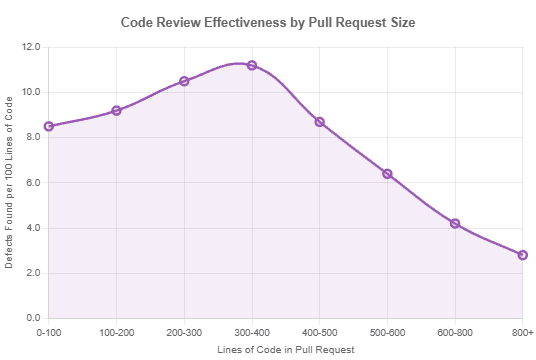
| Review Size | Defects Found | Review Time | Effectiveness |
|---|---|---|---|
| 0-200 lines | High per line | 30-60 min | Excellent |
| 200-400 lines | Highest total | 60-90 min | Optimal |
| 400-800 lines | Declining per line | 90+ min | Moderate |
| 800+ lines | Severely reduced | 2+ hours | Poor |
Beyond 400 lines, reviewers enter what psychologists call vigilance decrement—the documented decline in attention during prolonged monitoring tasks. Your brain literally cannot sustain the required focus level.
2. The Psychology of Criticism
Code review is fundamentally an act of criticism. Even constructive feedback triggers psychological defense mechanisms that impact both reviewer and author behavior.
2.1 The Negativity Bias
Humans exhibit what psychologists call negativity bias—negative feedback has approximately 3-5 times the psychological impact of positive feedback. A single harsh review comment can overshadow ten constructive ones.
This bias creates two problems in code review:
For reviewers: Fear of seeming negative makes them soften legitimate concerns or avoid commenting altogether. Studies show reviewers are significantly less likely to flag issues in code written by senior developers or teammates they have close relationships with.
For authors: Even neutrally-worded criticism feels personal. Research on code review conflicts found that 68% of disagreements stemmed from perceived tone rather than technical substance.
2.2 The Sandwich Method Doesn’t Work
Many teams adopt the “sandwich method”—wrapping criticism between positive comments. Psychological research suggests this backfires. Recipients either dismiss the criticism as insincere or, worse, become confused about what actually needs fixing.
What Works Better: Be specific, focus on code rather than the coder, and explain the “why” behind your concern. Instead of “this function is poorly named,” try “calling this processData makes it hard to know it’s specifically validating user input—what about validateUserInput?”
2.3 Ego Depletion and Review Quality
The concept of ego depletion suggests that self-control and willpower are finite resources. Being diplomatic requires self-control—suppressing your initial reactions to frame criticism constructively.
This explains why review quality degrades throughout the day. Your third code review is noticeably harsher or more terse than your first, not because you care less, but because you’ve depleted the mental resources needed for diplomatic communication.
3. Confirmation Bias in Code Reviews
Perhaps no cognitive bias impacts code review more profoundly than confirmation bias—the tendency to seek information that confirms existing beliefs while ignoring contradictory evidence.
3.1 The “Looks Good To Me” Problem
Reviewers unconsciously assume code is correct and scan for evidence supporting that assumption. This is why superficial reviews produce comments like “LGTM” (Looks Good To Me) despite containing obvious bugs.
A Microsoft Research study found that reviewers spend 80% of their time understanding code intent and only 20% actively looking for defects. When code seems reasonable at first glance, confirmation bias prevents deeper scrutiny.
// Reviewer sees this and thinks "standard validation logic" function validateEmail(email) { if (email.includes('@') && email.includes('.')) { return true; } return false; } // But misses that user@.com passes validation // And that this accepts user@domain without TLD
The code follows familiar patterns, so reviewers accept it without deep analysis. Their brain takes a cognitive shortcut, assuming “this looks like email validation I’ve seen before, so it’s probably correct.”
3.2 Checklist Paradox
Organizations often combat confirmation bias with review checklists. Ironically, checklists can worsen the problem by creating what psychologists call “checkbox mentality”—reviewers feel satisfied after checking items off, even if they didn’t deeply engage with each point.
Research on aviation safety checklists found they’re most effective when kept extremely short (under 10 items) and when teams understand the “why” behind each item rather than mechanically checking boxes.
3.3 Breaking the Bias
Some techniques help combat confirmation bias:
Adversarial reviewing: Explicitly adopt a mindset of “how could this break?” rather than “does this work?” This mental shift changes your default assumption from correct to suspect.
Context switching: Review code 30-60 minutes after reading the description. This temporal gap prevents the author’s explanation from priming your interpretation.
Testing-first review: Look at tests before implementation. This forces you to form independent expectations about behavior before seeing the actual code.
4. Async Reviews vs Pair Programming: Different Failure Modes
Asynchronous code review and pair programming represent opposite ends of the collaboration spectrum, each with distinct cognitive advantages and failure modes.
4.1 The Async Context Problem
Asynchronous review suffers from what cognitive scientists call context-dependent memory—our ability to recall information improves when we’re in the same context where we learned it.
When you review code hours or days after it was written, you lack crucial context:
- What problem was the author actively solving?
- What alternatives did they consider and reject?
- What constraints influenced their decisions?
- What assumptions are they making about the broader system?
Pull request descriptions attempt to bridge this gap, but they’re static documents that can’t answer follow-up questions or clarify confusion in real-time. The result is significant cognitive overhead spent reconstructing context before meaningful review can begin.
4.2 The Pair Programming Flow State
Pair programming eliminates context loss because both developers share mental context continuously. The navigator maintains high-level architectural awareness while the driver focuses on implementation details—a natural division of cognitive labor.
Research on pair programming effectiveness by Laurie Williams found pairs produce code with 15% fewer defects while taking only 15% more time—a net efficiency gain when you factor in debugging time saved.
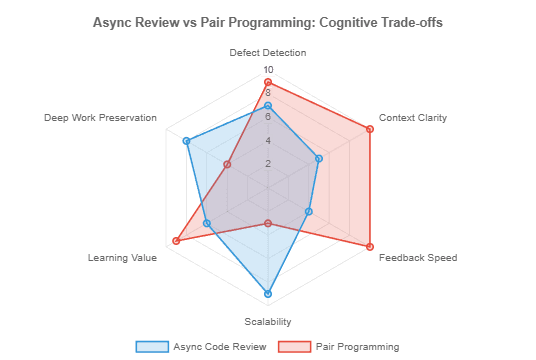
4.3 Different Cognitive Loads
| Aspect | Async Review | Pair Programming |
|---|---|---|
| Context Overhead | High – must reconstruct author’s thinking | Low – shared continuous context |
| Attention Span | Limited by vigilance decrement | Extended through social accountability |
| Feedback Latency | Hours to days | Immediate |
| Communication Richness | Text-only (high misinterpretation risk) | Voice + screen + body language |
| Scalability | Excellent – reviewers work independently | Poor – requires synchronous time |
| Deep Work Disruption | Moderate – can batch reviews | High – constant interaction |
4.4 Why Async Reviews Fail Silently
The most insidious problem with asynchronous review is silent failure—reviewers approve code without deep understanding because admitting confusion feels socially costly.
In pair programming, saying “I don’t follow this logic” is natural conversation. In async review, writing “I don’t understand this” feels like admitting incompetence. So reviewers approve code they don’t fully grasp, rationalizing that their confusion is probably due to missing context rather than problematic code.
This social pressure creates a quality gap that metrics rarely capture. Your code review process might show 100% review coverage while actual comprehension hovers around 60%.
4.5 Why Pair Programming Fails Loudly
Pair programming fails differently—when it fails, everyone knows. Personality conflicts, mismatched skill levels, or simple exhaustion from constant interaction make pairing obviously ineffective.
The cognitive load of continuous collaboration is substantial. Research on social facilitation shows that being observed improves performance on simple tasks but impairs performance on complex tasks. For difficult programming problems, the pressure of having someone watch can actually reduce code quality.
5. Designing Reviews for Human Cognition
Understanding these cognitive constraints suggests concrete improvements to code review practices:
5.1 Size Limits as Policy
Enforce maximum PR sizes not as suggestions but as hard limits. The data overwhelmingly supports 200-400 lines as optimal. Larger changes should be split across multiple PRs or reviewed in shorter sessions with breaks.
Implementation Tip: Configure your CI/CD pipeline to flag PRs over 400 lines, requiring explicit justification for why the change couldn’t be split. This shifts the burden from reviewers asking for smaller PRs to authors justifying large ones.
5.2 Cognitive Load Indicators
Not all lines of code are equal. Consider these factors when estimating review difficulty:
- Cyclomatic complexity: Branching logic demands more working memory than linear code
- Novel patterns: Unfamiliar architectures require significantly more cognitive effort
- Cross-system changes: Modifications spanning multiple services multiply context-switching cost
- Concurrency code: Race conditions and thread safety analysis are cognitively expensive
A 300-line PR that’s mostly straightforward CRUD operations is lighter cognitive load than 150 lines of novel concurrency primitives.
5.3 Time-Aware Review Scheduling
Respect circadian rhythms and ego depletion. Research on cognitive performance shows peak analytical ability occurs mid-morning (roughly 10am-noon for most people), with significant decline after lunch and late afternoon.
Schedule complex reviews during cognitive peak hours. Use afternoon time for simpler reviews or non-analytical tasks like running tests and verifying documentation.
5.4 The Two-Pass Review
Split reviews into two cognitive modes:
- First pass (understanding): Read code without commenting. Build mental models of what it does and why. This pass is about comprehension, not judgment.
- Second pass (analysis): Now that you understand the change, actively look for issues. Your working memory isn’t split between understanding and critiquing.
This approach aligns with how our brains naturally process complex information—we can’t effectively analyze what we don’t yet understand.
5.5 Positive Reinforcement Systems
Combat negativity bias by normalizing positive feedback. Some teams require reviewers to identify at least one thing done well before listing concerns. This isn’t empty praise—it helps authors distinguish between “this needs work” and “you’re a bad developer.”
6. The Hybrid Future
The optimal solution likely isn’t choosing between async review and pair programming—it’s knowing when to use each based on cognitive demands.
- Use pair programming for: Complex architectural decisions, unfamiliar domains, onboarding new team members, and debugging subtle issues. The cognitive cost of pairing pays dividends when context-sharing is critical.
- Use async review for: Straightforward implementations, well-understood patterns, and changes to code the reviewer knows well. The scalability and flexibility of async review work when context overhead is low.
- Hybrid approach: Start with brief synchronous discussion (10-15 minutes) to establish context, then conduct formal review asynchronously. This gives reviewers the context they need without the sustained attention demands of full pairing.
7. What We’ve Learned
Code review effectiveness isn’t about finding more bugs—it’s about respecting the cognitive limits of human attention and working within those constraints.
Working memory constrains review depth. Humans can hold approximately four complex items in working memory. Beyond 400 lines of code, reviewers exceed this capacity and resort to pattern matching rather than deep analysis. The optimal review size is 200-400 lines, where defect detection peaks.
Criticism triggers psychological defenses. Negativity bias means critical feedback carries 3-5 times the psychological weight of positive feedback. This makes reviewers hesitant to comment honestly and makes authors defensive even about neutral technical concerns. Effective criticism is specific, focuses on code rather than the coder, and explains reasoning.
Confirmation bias undermines thoroughness. Reviewers unconsciously assume code is correct and scan for supporting evidence rather than actively searching for defects. Checklists can worsen this by creating checkbox mentality. Counter-bias techniques include adversarial reviewing (asking “how could this break?”) and reviewing tests before implementation.
Async review suffers from context loss. Without shared context, reviewers spend cognitive effort reconstructing the author’s thinking before meaningful analysis begins. Pull request descriptions can’t answer follow-up questions or clarify confusion in real-time, creating substantial overhead.
Pair programming trades context for scalability. Pairing eliminates context loss and enables immediate feedback but requires synchronous time and creates sustained cognitive load through constant interaction. Research shows pairs produce 15% fewer defects while taking only 15% more time—a net gain considering debugging time saved.
Different approaches have different failure modes. Async reviews fail silently—reviewers approve code they don’t fully understand because admitting confusion feels socially costly. Pair programming fails loudly—personality conflicts and exhaustion are immediately obvious, but the problems are transparent.
Design processes around cognitive reality. Enforce PR size limits (200-400 lines), schedule complex reviews during cognitive peak hours (mid-morning), use two-pass reviews (understanding then analysis), and normalize positive feedback to counter negativity bias.
The future is hybrid. Use pair programming when context-sharing is critical (architecture decisions, unfamiliar domains) and async review when context overhead is low (straightforward implementations, familiar patterns). Combine approaches with brief synchronous kickoffs followed by async formal review.
Effective code review recognizes that attention is finite, criticism is psychologically complex, and human cognition has fundamental limits. The best review processes work with these constraints rather than pretending they don’t exist.