The Anthropology of Legacy Systems: What Ancient Code Reveals About Developer Culture

Every codebase tells a story. Like archaeologists brushing dust from ancient pottery, developers who inherit legacy systems uncover layers of history, each revealing the priorities, pressures, and personalities of those who came before.
Walk into any established tech company, and you’ll find them: systems built in the early 2000s, still humming along in production. These aren’t museum pieces. They’re living artifacts that process millions of transactions, serve thousands of users, and hold together entire business operations. But they’re also time capsules, preserving a record of how developers thought, worked, and solved problems in different eras.
1. The Geological Layers of Technology
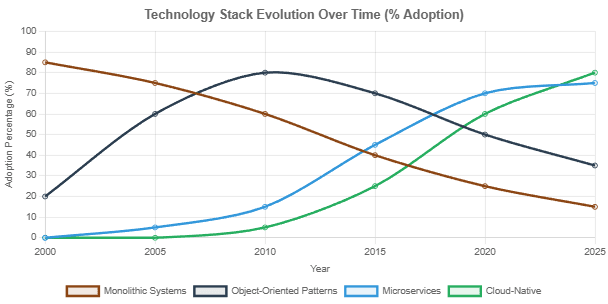
Just as geologists read Earth’s history in rock strata, developers can trace technological evolution through the layers of a codebase. The pattern is remarkably consistent across industries.
1.1 The Foundation Layer (Late 1990s – Early 2000s)
At the bottom, you’ll often find Perl or Classic ASP, sometimes COBOL in financial institutions. This is the bedrock. Comments here are sparse, almost apologetic. Variable names like tmp2 or x1 reveal an era when memory was expensive and descriptive names felt wasteful. The code is dense, procedural, and remarkably efficient for its time.
1.2 The Object-Oriented Revolution (Mid-2000s)
Above this sits the Java and C# layer. Here, everything became an object. You’ll find classes named AbstractFactoryManagerSingleton and architectural patterns implemented with almost religious devotion. This era worshipped design patterns, sometimes to a fault. Comments become more frequent but often redundant: // Set the user name above user.setName(name);.
1.3 The Agile Transition (Late 2000s – Early 2010s)
The next stratum shows the influence of agile methodologies. Code becomes more modular. Test files appear. Comments shift from “what” to “why.” You start seeing TODO markers, ticket numbers in commit messages, and evidence of sprint-driven development. The architecture fragments slightly as teams gained autonomy.
1.4 The Modern Microservices Era (Mid-2010s – Present)
At the top, the most recent additions: Node.js services, Python APIs, React frontends. Everything is containerized. Comments reference Jira tickets and Slack conversations. The code is cleaner, more purposeful, but also more distributed and harder to trace end-to-end.
2. What Comments Reveal About Culture
Comments are the hieroglyphics of code. They’re not just technical notes; they’re emotional records. A well-placed comment can reveal everything about a team’s culture.
2.1 The Optimists
Some teams leave hopeful breadcrumbs: // TODO: Refactor this when we have time. That time never comes. These comments accumulate like New Year’s resolutions, documenting good intentions and the reality of shipping pressure.
2.2 The Battle-Scarred
Other comments tell war stories: // DO NOT REMOVE: This fixes the Halloween bug of 2015. These are tribal knowledge, passed down like cautionary tales. They mark the spots where something went terribly wrong once, and nobody wants to risk it happening again.
2.3 The Frustrated
Then there are the darker annotations: // I have no idea why this works, but it does or // This shouldn't be necessary but here we are. These reveal deadline pressure, technical debt, and the compromises teams make when perfection loses to pragmatism.
3. Architecture as Social Structure
The way code is organized reveals how teams were organized. Conway’s Law states that systems mirror the communication structures of the organizations that build them. Legacy codebases prove this beautifully.
A monolithic architecture with tightly coupled modules? That suggests a small, co-located team where everyone knew what everyone else was doing. Microservices with well-defined APIs and extensive documentation? That points to distributed teams, possibly across time zones, who couldn’t just tap someone on the shoulder to ask a question.
Dependencies tell stories too. When you see one component awkwardly calling another through a convoluted path, you can almost hear the organizational friction. Maybe those teams didn’t get along. Maybe they reported to different VPs with conflicting priorities. The code remembers these tensions long after the org chart has changed.
4. The Evolution of Error Handling
Nothing reveals a team’s maturity like error handling. Early layers often ignore errors entirely or catch them with silent swallows. As you move up through time, you see evolution: proper logging appears, then structured logging, then observability platforms.
This progression mirrors the journey from “make it work” to “make it reliable” to “make it observable.” Each stage reflects what was possible with available tools and what the business prioritized at that moment.
5. The Human Artifacts
Sometimes you find purely human touches. A function named after someone’s dog. Easter eggs left by developers who knew they were leaving. ASCII art in the comments. These moments of personality remind us that code isn’t written by machines—it’s written by people having human experiences.
You might find a flurry of commits at 3 AM, telling the story of a production outage. Or months of meticulous, measured changes that suggest a stable, well-planned project. Commit messages themselves are cultural artifacts. Compare “fix bug” to “Fix issue #1234: Resolve race condition in user session management” and you see the professionalization of software development in action.
6. What We’ve Learned
Legacy code is more than technical debt—it’s a historical record. Each layer represents the constraints, knowledge, and culture of its time. The shift from monoliths to microservices wasn’t just architectural; it reflected how we learned to organize teams and manage complexity. The evolution from sparse comments to detailed documentation shows our growing understanding that code is communication.
These old systems teach us humility. Today’s best practices will be tomorrow’s legacy code. The “modern” solutions we’re implementing now will someday look as quaint as Perl CGI scripts do today. Perhaps the most important lesson is this: be kind to your future archaeologists. Document your decisions. Explain the “why.” Leave breadcrumbs for those who’ll inherit your work.
Because legacy code isn’t just about the past—it’s about recognizing that we’re all part of a continuum. We stand on the shoulders of developers who solved problems with the tools they had, under pressures we might not understand. And someday, someone will excavate our code and wonder what we were thinking.
Treat your codebase like the historical document it will become.