
OAuth 2.1 and Modern Authentication Patterns: What’s Deprecated and What’s Recommended

OAuth 2.0 powered billions of secure API requests daily, but its flexibility created dangerous implementation pitfalls. Enter OAuth 2.1—a consolidation of security best practices that makes features like PKCE mandatory for all clients. This isn’t a revolution; it’s an evolution that eliminates the vulnerabilities developers consistently got wrong.
1. Why OAuth 2.1 Matters Now
Since OAuth 2.0’s release in 2012, the security landscape has transformed dramatically. OAuth 2.1 consolidates years of security learnings into a single, unified specification rather than forcing developers to cross-reference dozens of RFCs and best practice documents.
The reality is stark: according to Okta’s 2024 State of Secure Identity Report, 41% of security incidents involving credential compromise originated from excessive user authority. OAuth 2.1 directly addresses these systemic issues.
2. What’s Been Deprecated
2.1 Implicit Grant Flow: Gone for Good
The implicit grant (response_type=token) is completely omitted from OAuth 2.1. This flow was originally designed for single-page applications that couldn’t handle authorization codes, but it exposed access tokens directly in URL fragments—visible in browser history, referrer headers, and server logs.
Why it was dangerous: Any JavaScript running in the browser could access these tokens. No sender-constraint mechanisms existed to bind tokens to specific clients. OAuth 2.1 now requires the authorization code flow with PKCE for all client types, including SPAs.
Migration path: Switch all single-page applications to authorization code + PKCE. Modern browsers support CORS and secure cross-origin requests, eliminating the original justification for implicit flow.
2.2 Resource Owner Password Credentials: No Longer Acceptable
The Resource Owner Password Credentials grant is omitted from OAuth 2.1. This grant type required users to hand their passwords directly to third-party applications—exactly what OAuth was designed to prevent.
Why it failed: It bypassed the entire security model of OAuth. Applications collecting user passwords couldn’t support multi-factor authentication, couldn’t respect consent screens, and created massive password reuse risks.
What to use instead: Authorization code flow for user authentication, or client credentials flow for service-to-service communication.
2.3 Wildcard Redirect URIs: Strictly Forbidden
OAuth 2.0 allowed flexible redirect URI matching with wildcards and partial patterns. OAuth 2.1 requires strict, exact redirect URI matching to close a common security gap where fuzzy matching made it easier for attackers to exploit misconfigured apps.
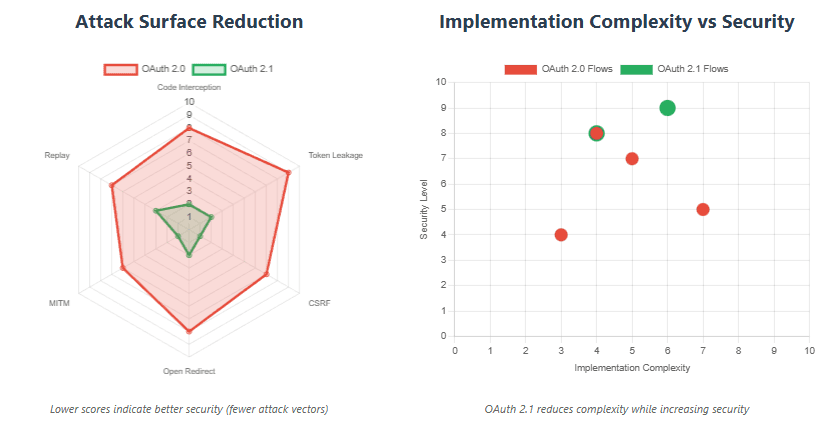
The vulnerability: Attackers exploited loose pattern matching to perform open redirect attacks, intercepting authorization codes or tokens by manipulating redirect URIs. Several successful attacks exploiting flaws in pattern-matching implementations have been observed in the wild.
3. What’s Now Mandatory
3.1 PKCE for Everyone
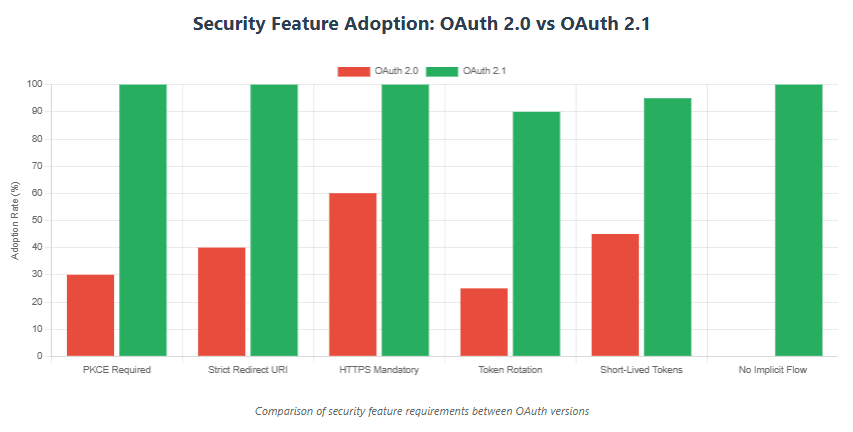
Proof Key for Code Exchange (PKCE) is now mandatory for all OAuth clients using the authorization code flow. Originally designed for mobile apps, PKCE prevents authorization code interception attacks.
How PKCE works:
- Client generates a cryptographically random
code_verifier(minimum 43 characters) - Client creates
code_challengeby hashing the verifier with SHA-256 - Client sends the challenge with the initial authorization request
- When exchanging the code for tokens, client proves possession by presenting the original verifier
- Authorization server validates the match
Implementation requirement: Use cryptographically secure random generation for code verifiers. Authorization servers MUST support and enforce code_challenge and code_verifier parameters.
3.2 Exact String Matching for Redirect URIs
No more convenience at the cost of security. Every redirect URI must be pre-registered and matched exactly—character for character, including protocol, domain, path, and query parameters.
Exception: Port numbers in localhost redirection URIs for native apps may vary to support dynamic port allocation during development.
3.3 HTTPS Everywhere
OAuth 2.1 mandates HTTPS to ensure all communication between client and server is encrypted. No exceptions. HTTP connections cannot prevent man-in-the-middle attacks or token interception.


4. Modern Token Handling Practices
4.1 Short-Lived Access Tokens
Access tokens should expire within minutes or hours, not days or weeks. Short expiration windows limit the damage from token leakage.
Best practice: Issue access tokens with 15-60 minute lifespans. Use refresh tokens for obtaining new access tokens without re-authentication.
4.2 Refresh Token Rotation
OAuth 2.1 recommends rotating refresh tokens after every use, with automatic invalidation of reused tokens. Each refresh operation issues both a new access token and a new refresh token, invalidating the previous refresh token.
Security benefit: If an attacker steals a refresh token and attempts to use it, the legitimate client will fail on its next refresh attempt—immediately signaling a security breach.
4.3 Secure Token Storage
Never store tokens in:
- URL parameters
- Browser local storage (without additional encryption)
- Application logs
- Client-side code repositories
Store tokens in secure platform-specific storage like Keystore on Android, Keychain Services on iOS and macOS, or Credential Locker on Windows.
For web applications: Use HTTP-only, secure cookies with SameSite attributes. This prevents JavaScript access and reduces XSS attack surfaces.
4.4 Token Transmission
OAuth 2.1 prohibits tokens in query strings—access tokens belong exclusively in Authorization headers or POST request bodies. URLs appear in logs, browser history, and referrer headers. Never put tokens there.
5. Common Pitfalls and How to Avoid Them
5.1 Pitfall 1: Over-Permissive Scopes
According to a 2024 Auth0 survey, 74% of security incidents originated from excessive permissions, not software exploits.
Solution: Apply principle of least privilege. Request only the specific scopes needed for each operation. Use granular permissions like read:user_profile or write:transaction instead of broad all privileges.
5.2 Pitfall 2: Missing State Parameter
The state parameter is crucial for preventing CSRF attacks—ignoring it compromises authorization process security.
Solution: Generate unique, unpredictable state values for each authorization request. Validate state matches when receiving the callback. Store state server-side, bound to the user session.
5.3 Pitfall 3: Treating OAuth as Authentication
OAuth 2.0 is not an authentication protocol—this is one of the most common implementation mistakes. OAuth handles authorization (what you can access), not authentication (who you are).
Solution: Use OpenID Connect for authentication. OIDC extends OAuth 2.0 with an identity layer, providing ID tokens that verify user identity. Don’t build custom authentication on OAuth alone.
5.4 Pitfall 4: Ignoring Token Revocation
Applications must handle token invalidation gracefully. Tokens can be revoked by users, administrators, or automated security processes.
Solution: Implement token revocation endpoints. Check for invalid_grant errors during refresh attempts. Integrate with services like Google’s Cross-Account Protection for proactive revocation notifications.
5.5 Pitfall 5: Trusting Mutable Identifiers
Using mutable identifiers like email addresses instead of immutable claims can lead to account takeover when domains expire and are repurchased.
Solution: Always use the immutable sub (subject) claim for user identification. Email addresses and domains can change ownership—the sub claim cannot.
6. Migration Checklist
Immediate Actions:
- Audit all OAuth implementations for deprecated flows
- Migrate implicit grant flows to authorization code + PKCE
- Remove any resource owner password credential grants
- Implement PKCE for all clients, even confidential ones
- Enforce exact redirect URI matching
- Verify all endpoints use HTTPS exclusively
Token Security:
- Reduce access token lifespans to under 1 hour
- Implement refresh token rotation
- Move tokens out of local storage into HTTP-only cookies or secure platform storage
- Remove tokens from URL parameters and logs
- Implement token revocation endpoints
Scope Management:
- Review all permission requests for least privilege
- Document each scope with clear descriptions
- Implement incremental authorization—request scopes only when needed
- Monitor and log scope usage patterns
Testing and Monitoring:
- Integrate OAuth security testing into CI/CD pipelines
- Enable real-time monitoring for token usage anomalies
- Maintain audit logs of token issuance, refresh, and revocation
- Conduct regular penetration testing focused on OAuth flows
7. Advanced Security Measures
7.1 Demonstration of Proof of Possession (DPoP)
For high-security applications, adopt DPoP to bind tokens to client instances in scenarios where mTLS is impractical. DPoP creates cryptographic proof that the client presenting a token is the same client it was issued to.
7.2 Sender-Constrained Tokens
Use mechanisms like Mutual TLS or DPoP for sender-constraining access tokens to prevent token replay attacks. These techniques bind tokens to specific clients at the cryptographic level.
7.3 Resource Indicators
Restrict access tokens to specific resource servers (audience restriction). The authorization server should associate access tokens with certain resource servers, and every resource server must verify tokens are intended for them.
8. Real-World Impact
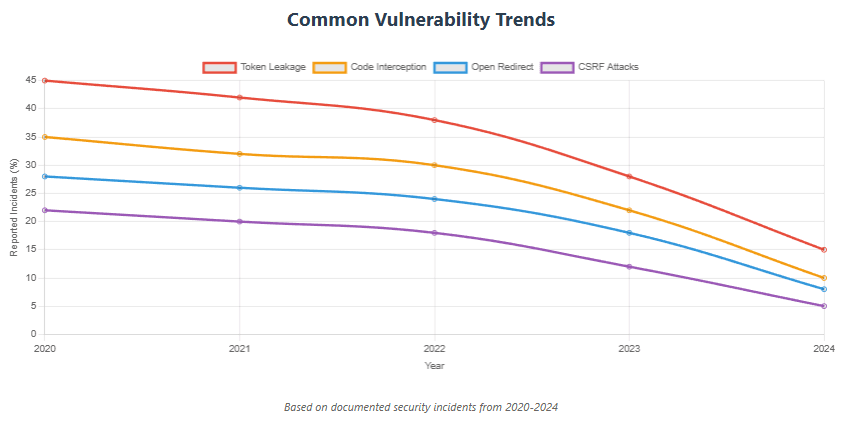
In 2018, a Facebook vulnerability exposed access tokens of millions of users due to improper session token handling and incomplete OAuth flow validation. These aren’t theoretical concerns—they’re documented breaches affecting millions.
Applications using OAuth 2.1 with enforced PKCE saw a 70% reduction in authorization code interception attacks. The security improvements are measurable and significant.
9. Tools and Resources
- Official OAuth 2.1 Specification: OAuth 2.1 Draft
- Security Best Practices: RFC 9700 – OAuth 2.0 Security Best Current Practice
- PKCE Implementation Guide: RFC 7636
- OAuth Threat Model: RFC 6819
- Testing Tool: OWASP OAuth Cheat Sheet
Major platforms like Auth0, Okta, WorkOS, and Keycloak already support OAuth 2.1 requirements. If you’re building custom implementations, ensure your authorization server and client libraries align with these standards.
10. What We’ve Seen
OAuth 2.1 represents a maturation of the OAuth framework—consolidating a decade of security learnings into mandatory requirements. The deprecated implicit and password flows created attack vectors developers consistently implemented incorrectly. PKCE is now required universally, not optional. Redirect URIs must match exactly. Token handling follows strict security guidelines.
These changes aren’t arbitrary restrictions—they’re responses to documented breaches and systematic vulnerabilities observed in production systems. By mandating what was previously optional, OAuth 2.1 eliminates entire classes of security bugs before they reach production.
For developers, the message is clear: security isn’t an afterthought you add later. It’s baked into OAuth 2.1’s requirements from day one. Adopt these patterns now, audit existing implementations, and build authorization systems that protect users by default rather than by exception.