
Foundations and Implications of Generative AI: Reshaping Creativity and Automation Across Industries

The emergence of generative artificial intelligence represents one of the most transformative technological developments of the 21st century. Unlike traditional AI systems designed to recognize patterns or make predictions based on existing data, generative AI creates entirely new content—text, images, music, code, and even video—that previously required uniquely human creativity and expertise. At the heart of this revolution lie sophisticated models like Generative Pre-trained Transformers and multimodal systems that blur the boundaries between human and machine-generated content, fundamentally reshaping how we approach creativity, knowledge work, and automation across virtually every field of human endeavor.
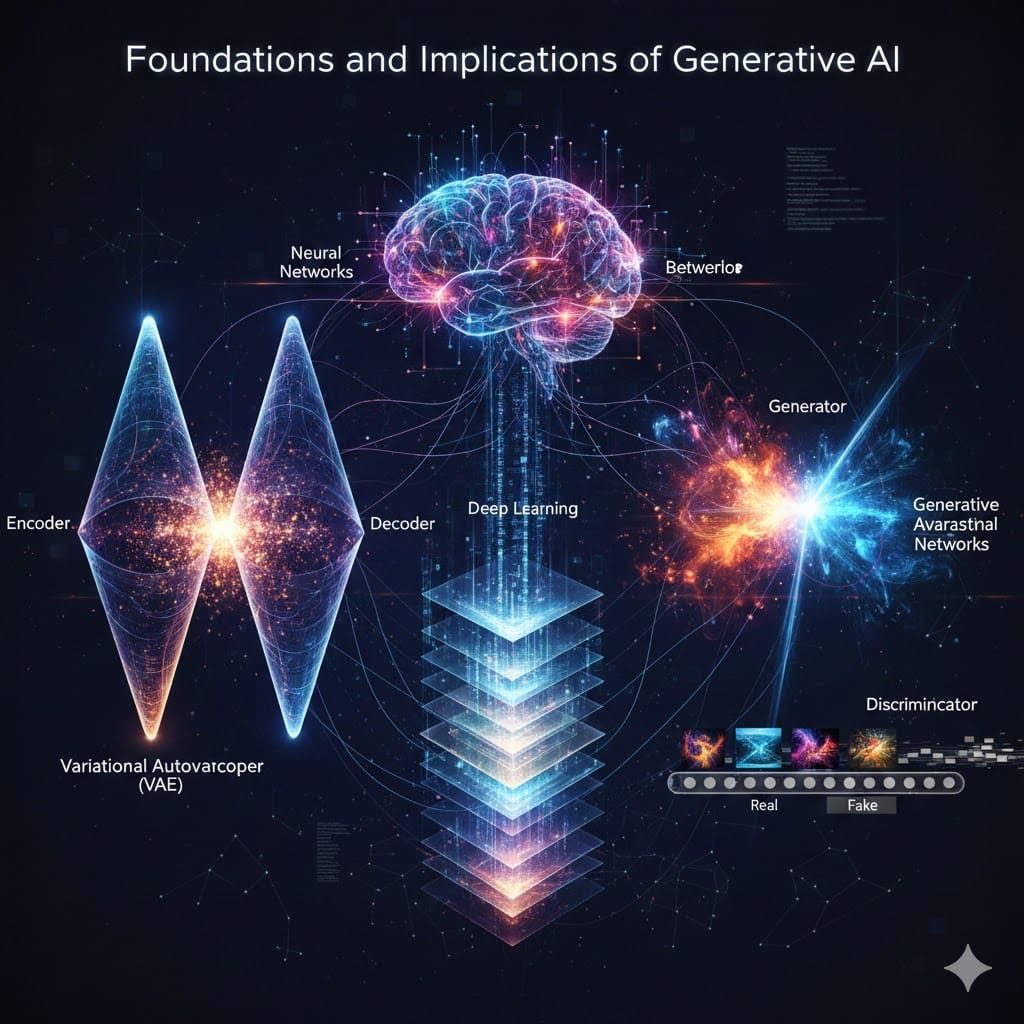
Understanding the Foundation: What Makes Generative AI Different
Generative AI refers to a class of artificial intelligence systems capable of creating new content based on patterns learned from vast amounts of training data. According to IBM’s comprehensive analysis, generative AI is artificial intelligence capable of generating text, images, videos, or other data using generative models, often in response to prompts entered by the user. This capability fundamentally distinguishes it from discriminative AI, which focuses on classification and prediction tasks.
The theoretical foundation rests on several key principles that separate generative systems from their predecessors. Traditional machine learning models typically learn to map inputs to outputs—recognizing whether an image contains a cat or a dog, for instance. Generative models, by contrast, learn the underlying probability distribution of the training data itself, enabling them to generate new samples that could plausibly have come from the same distribution.
This distinction becomes clearer when we examine how these systems operate. According to McKinsey’s research, generative AI starts with a prompt that could be in the form of a text, an image, a video, a design, musical notes, or any input that the AI system can process. The system then responds by generating new content based on learned patterns, whether that’s completing text, generating images from descriptions, or creating music that follows certain stylistic conventions.
The Architecture of Creation
The technical architecture underlying modern generative AI reveals the sophistication of these systems. Most contemporary generative models rely on deep neural networks with multiple layers that process information hierarchically, extracting increasingly abstract features as data moves through the network.
Core Architectural Components:
| Component | Function | Example Application |
|---|---|---|
| Transformer Architecture | Processes sequential data using attention mechanisms to understand context and relationships | Language models like GPT-4, translation systems |
| Diffusion Models | Gradually removes noise from random data to generate coherent outputs | Image generation (DALL-E, Midjourney, Stable Diffusion) |
| Generative Adversarial Networks (GANs) | Two networks compete—one generates content, one evaluates it | Photorealistic image generation, deepfakes |
| Variational Autoencoders (VAEs) | Compresses data into latent representations then reconstructs variations | Data augmentation, style transfer |
| Multimodal Fusion Systems | Processes and generates across multiple data types simultaneously | GPT-4V, Gemini (text, image, audio combined) |
The transformer architecture, introduced in the landmark 2017 paper “Attention Is All You Need,” revolutionized how machines process sequential information. Rather than processing data sequentially, transformers use attention mechanisms that allow the model to focus on relevant parts of the input regardless of position, dramatically improving the ability to understand context and relationships across long sequences of data.
The Evolution: From GPT to Multimodal Intelligence
The development of Generative Pre-trained Transformers marks a watershed moment in AI history. According to Simplilearn, GPT stands for Generative Pre-Trained Transformer, an AI model created by OpenAI that uses deep learning to generate human-like text based on prompts. The “pre-trained” aspect proves crucial—these models learn from massive text corpora before being fine-tuned for specific tasks, allowing them to develop broad linguistic and conceptual understanding.
The progression from GPT-1 to GPT-4 illustrates the exponential growth in capability:
GPT Model Evolution:
| Model | Release | Parameters | Key Capabilities | Paradigm Shift |
|---|---|---|---|---|
| GPT-1 | 2018 | 117 million | Basic text completion, coherent paragraphs | Demonstrated pre-training effectiveness |
| GPT-2 | 2019 | 1.5 billion | Longer coherent text, multiple styles | Raised concerns about misinformation potential |
| GPT-3 | 2020 | 175 billion | Few-shot learning, multiple tasks without fine-tuning | Enabled practical applications at scale |
| GPT-4 | 2023 | ~1 trillion (estimated) | Multimodal input, advanced reasoning, nuanced understanding | Human-level performance on many benchmarks |
The leap to multimodal systems represents the latest frontier. While early generative models focused on single data types—text or images—modern systems process and generate across multiple modalities simultaneously. According to research highlighted by Uncodemy, multimodal AI models can understand and generate content across different formats, making them incredibly versatile for tasks that require integration of visual, textual, and auditory information.
These multimodal capabilities unlock entirely new applications. A system that can understand an image and describe it in text, or take a text description and generate a corresponding image, bridges the gap between different forms of human expression and communication. Models like GPT-4V, Google’s Gemini, and similar systems can analyze medical images while referencing clinical notes, design products based on verbal descriptions and visual references, or create educational content that seamlessly integrates explanations with custom illustrations.
Reshaping Creativity: The Artistic Renaissance
Perhaps nowhere has generative AI’s impact been more visible or controversial than in creative fields. The technology simultaneously democratizes creative capabilities and challenges fundamental assumptions about authorship, originality, and the nature of creativity itself.
In visual arts, tools like DALL-E, Midjourney, and Stable Diffusion have transformed image creation. According to comprehensive industry analyses, generative AI is revolutionizing creative industries by automating content generation, enhancing personalization, and pushing the boundaries of innovation. Artists can now generate concept art in minutes that previously required hours or days, explore hundreds of visual variations rapidly, and create in styles they might not personally master.
Creative Industry Applications:
| Field | Traditional Process | With Generative AI | Transformation Impact |
|---|---|---|---|
| Graphic Design | Manual design iterations over days/weeks | Generate multiple concepts in minutes; rapid A/B testing | 70% faster concept development |
| Music Composition | Extensive training, manual composition | AI-assisted melody generation, style transfer | Democratizes music creation; enables new hybrid genres |
| Creative Writing | Individual effort, lengthy drafting process | AI-assisted ideation, drafting, editing | Accelerates content production by 40-60% |
| Film Production | Months of pre-production, storyboarding | Rapid scene visualization, script analysis | Reduces pre-production time by 50% |
| Game Development | Large teams creating assets manually | Procedural generation of environments, characters, narratives | Enables smaller teams to create AAA-quality content |
The democratization effect proves particularly significant. Individuals without formal training can now create professional-quality visual content, compose music, or generate written material that previously required years of skill development. This accessibility has sparked intense debate about the value of traditional artistic training and the role of human creativity in an age of machine generation.
However, the transformation extends beyond mere production efficiency. Generative AI enables entirely new creative workflows where humans and machines collaborate iteratively. According to Adobe’s research, artists use AI as a collaborator rather than a replacement, with 73% of creative professionals reporting that AI tools enhance rather than diminish their creative process. The most successful creators use generative AI as a partner in the creative process—generating initial concepts, exploring variations, handling repetitive tasks, and allowing human creativity to focus on high-level direction, emotional resonance, and conceptual innovation.
Automation Across Industries: Practical Transformations
Beyond creative applications, generative AI reshapes knowledge work and automation across virtually every industry sector. The technology’s ability to understand context, generate coherent outputs, and adapt to different domains makes it remarkably versatile.
Healthcare and Life Sciences
In healthcare, generative AI accelerates drug discovery, personalizes treatment plans, and enhances diagnostic capabilities. According to Deloitte’s analysis, generative AI can analyze vast medical databases to identify potential drug candidates, predict protein structures, and simulate molecular interactions—work that previously required years of laboratory experimentation.
Key Healthcare Applications:
- Drug Discovery: Generating molecular structures with desired properties, reducing development time from years to months
- Medical Imaging Analysis: Creating synthetic training data to improve diagnostic algorithms while protecting patient privacy
- Personalized Treatment Plans: Synthesizing patient data, medical literature, and treatment outcomes to recommend optimized care pathways
- Clinical Documentation: Automatically generating clinical notes from doctor-patient conversations, reducing administrative burden by up to 70%
Business and Enterprise Operations
Corporate environments leverage generative AI for everything from customer service to strategic analysis. According to McKinsey’s research, generative AI could add the equivalent of $2.6 trillion to $4.4 trillion annually across all use cases, with significant impacts on marketing, sales, software development, and operations.
Enterprise Impact Matrix:
| Function | Primary Use Cases | Efficiency Gain | Strategic Value |
|---|---|---|---|
| Customer Service | Chatbots, automated responses, sentiment analysis | 50-70% reduction in response time | 24/7 availability, consistent quality |
| Marketing | Content generation, ad copy, personalization | 60% faster campaign development | Hyper-personalization at scale |
| Software Development | Code generation, debugging, documentation | 30-40% productivity increase | Democratizes technical skills |
| Legal | Contract analysis, document generation | 50% reduction in routine document processing | Frees expertise for complex analysis |
| Finance | Report generation, risk analysis, forecasting | 40% faster report production | Enhanced scenario modeling |
Education and Knowledge Dissemination
Educational institutions explore generative AI for personalized learning, content creation, and assessment. The technology adapts to individual learning styles, generates custom practice problems, provides instant feedback, and creates educational content tailored to specific curricula or student needs.
According to educational technology research, generative AI tutoring systems can provide personalized instruction that adapts to each student’s pace and learning style, potentially addressing one of education’s most persistent challenges—the inability of traditional classroom settings to accommodate diverse learning needs effectively.
Theoretical Implications: Challenging Our Understanding
The rise of generative AI forces us to reconsider fundamental questions about intelligence, creativity, and consciousness. These philosophical implications extend far beyond technical considerations, touching on issues of human identity, labor economics, and the nature of knowledge itself.
The Nature of Creativity
Generative AI challenges traditional conceptions of creativity as an exclusively human capacity. When a machine generates a novel image that evokes emotional responses, composes music that moves listeners, or writes prose that engages readers, we must ask: Is this creativity? According to philosophical analyses, the question becomes not whether machines can be creative, but whether the process or the output defines creativity.
Some argue that true creativity requires intentionality, consciousness, and lived experience—qualities machines lack. Others suggest that if the output is indistinguishable from human creativity, the process becomes philosophically irrelevant. This debate has practical implications for copyright law, artistic value, and how we understand human uniqueness.
Knowledge and Understanding
Generative AI models appear to demonstrate understanding of complex concepts, yet they possess no consciousness or subjective experience. This paradox raises profound questions about the nature of knowledge and understanding. Do these systems truly “understand” language and concepts, or do they merely perform sophisticated pattern matching that simulates understanding?
According to cognitive science perspectives, the answer may lie somewhere between. While AI lacks human-like consciousness, it may possess a different form of understanding—one grounded in statistical patterns and relationships rather than subjective experience. This challenges our anthropocentric views of intelligence and understanding.
Labor and Economic Disruption
The automation potential of generative AI presents both opportunities and challenges for the global workforce. According to Goldman Sachs research, generative AI could expose the equivalent of 300 million full-time jobs to automation, with particular impact on knowledge workers previously considered immune to technological displacement.
Workforce Impact Analysis:
| Job Category | Exposure Level | Likely Transformation | Human Advantage Areas |
|---|---|---|---|
| Content Creation | High (70-80%) | AI generates drafts; humans refine, direct, strategize | Emotional intelligence, cultural nuance, original vision |
| Customer Service | High (60-80%) | AI handles routine queries; humans manage complex issues | Empathy, complex problem-solving, relationship building |
| Software Development | Medium (40-60%) | AI generates code; humans architect systems | System design, business logic, innovation |
| Healthcare | Low-Medium (20-40%) | AI augments diagnosis; humans make final decisions | Clinical judgment, patient relationships, ethical decisions |
| Education | Low-Medium (30-50%) | AI personalizes learning; humans provide mentorship | Motivation, character development, complex feedback |
However, history suggests that technological disruption often creates new categories of work while eliminating old ones. The challenge lies in managing the transition period and ensuring that benefits are distributed equitably rather than concentrated among those who control the technology.
Ethical Considerations and Challenges
The rapid deployment of generative AI raises numerous ethical concerns that society must address thoughtfully and urgently. These challenges span technical, social, and philosophical domains, requiring multidisciplinary approaches to resolve.
Bias and Fairness
Generative AI models inherit biases present in their training data, potentially amplifying societal prejudices. According to research from MIT, when AI models are trained on AI-generated data, they can experience model collapse, where performance deteriorates and biases become amplified. Models trained on internet data reflect historical biases around race, gender, culture, and socioeconomic status, potentially perpetuating discrimination when deployed in consequential domains like hiring, lending, or criminal justice.
Addressing these biases requires not just technical solutions but fundamental questions about fairness, representation, and whose values should guide AI development. The challenge intensifies as generative AI creates content that may appear authoritative while embedding subtle biases difficult for users to detect.
Misinformation and Deepfakes
The same capabilities that make generative AI valuable for legitimate content creation enable the production of convincing misinformation. Deepfake videos, synthetic news articles, and fabricated images threaten information ecosystems already strained by digital misinformation.
According to security researchers, the sophistication of AI-generated content has reached a point where distinguishing authentic from synthetic material becomes increasingly difficult for average users. This poses existential threats to trust in media, democratic processes, and shared understanding of reality.
Misinformation Risk Assessment:
- Political Manipulation: Synthetic videos of political figures making statements they never made
- Financial Fraud: AI-generated voices impersonating executives to authorize fraudulent transactions
- Social Engineering: Personalized phishing attacks using AI-generated content tailored to individual targets
- Historical Revisionism: Fabricated historical documents or media that blur the line between fact and fiction
Intellectual Property and Ownership
Generative AI’s training on copyrighted material without explicit permission raises complex legal questions. According to ongoing legal analyses, multiple lawsuits challenge whether training AI models on copyrighted works constitutes fair use, and whether AI-generated content that mimics an artist’s style infringes on their rights.
Beyond legal questions lie deeper philosophical issues: If an AI model generates content, who owns it? The model creator? The user who crafted the prompt? The original artists whose work informed the model’s training? These questions lack clear answers and will likely require new legal frameworks specifically designed for the AI era.
Environmental Impact
The computational resources required to train and run large generative AI models carry significant environmental costs. According to environmental impact assessments, training a single large language model can emit as much carbon as five cars over their entire lifetimes. As AI deployment scales, the aggregate environmental impact becomes a serious concern requiring attention and innovation in energy-efficient AI architectures.
The Path Forward: Responsible Development and Deployment
Navigating generative AI’s transformative potential while addressing its challenges requires thoughtful governance, technical innovation, and societal dialogue. Several key principles should guide this path forward.
Technical Safeguards
Developing robust technical approaches to make generative AI systems safer and more reliable remains paramount. This includes adversarial training to improve robustness, watermarking and provenance tracking for AI-generated content, alignment techniques to ensure systems behave according to human values, and improved interpretability to understand how models make decisions.
According to Anthropic’s research on AI safety, constitutional AI approaches that embed ethical principles directly into model training show promise for creating systems that naturally respect boundaries and decline harmful requests without rigid rule-based filtering.
Regulatory Frameworks
Governments worldwide grapple with how to regulate generative AI effectively. According to policy analyses, effective regulation must balance several competing priorities: encouraging innovation while preventing harm, protecting existing rights while accommodating new technologies, and maintaining national competitiveness while establishing international standards.
Key Regulatory Considerations:
- Transparency Requirements: Mandating disclosure when content is AI-generated
- Liability Frameworks: Determining responsibility when AI systems cause harm
- Data Governance: Establishing rules for training data collection and use
- Impact Assessments: Requiring evaluation of high-risk AI applications before deployment
- Democratic Governance: Ensuring public input into how powerful AI systems are developed and deployed
Education and Literacy
Widespread AI literacy becomes essential as generative AI permeates daily life. Educational systems must adapt to teach not just how to use AI tools, but how to evaluate AI-generated content critically, understand AI capabilities and limitations, recognize potential biases and errors, and think creatively about AI’s role in society.
According to educational researchers, this extends beyond technical education to encompass philosophical and ethical dimensions, preparing citizens to participate meaningfully in decisions about AI’s societal role.
Collaborative Development
The most successful path forward likely involves collaboration among multiple stakeholders. Technology companies, academic researchers, policymakers, ethicists, affected communities, and the general public all have legitimate stakes in how generative AI evolves. Creating forums for genuine multi-stakeholder dialogue and incorporating diverse perspectives into development processes can help ensure that generative AI serves broad societal interests rather than narrow commercial or political goals.
What We Have Learned
The rise of generative AI represents a inflection point in human technological development. Systems capable of creating novel content across text, images, audio, video, and code are not merely incremental improvements over previous AI capabilities but represent qualitative shifts in what machines can do and how they interact with human creativity and labor.
The theoretical foundations reveal sophisticated architectures—transformers, diffusion models, GANs, and multimodal systems—that learn probability distributions from vast training data and generate new samples that could plausibly belong to those distributions. The progression from early GPT models with millions of parameters to modern systems with trillions shows exponential growth in capability, with multimodal systems now bridging different forms of human expression and communication.
In creative fields, generative AI simultaneously democratizes content creation and challenges fundamental assumptions about authorship and creativity. Tools that once required years of training now become accessible to novices, while professional creators leverage AI as collaborative partners rather than replacements. The 70% faster concept development in graphic design, 50% reduction in film pre-production time, and ability for small teams to create AAA-quality game content demonstrate profound practical impacts.
Across industries, generative AI drives automation that was previously impossible. Healthcare benefits from accelerated drug discovery and personalized treatment plans, enterprises gain efficiency through automated customer service and content generation, and education moves toward truly personalized learning at scale. The $2.6 to $4.4 trillion in potential annual economic value underscores the magnitude of this transformation.
The theoretical implications extend to foundational questions about intelligence, creativity, and consciousness. When machines generate content indistinguishable from human creation, we must reconsider what creativity means and whether it resides in process or output. The paradox of systems that appear to understand without consciousness challenges anthropocentric views of intelligence and knowledge.
Ethical challenges demand urgent attention. Bias amplification, misinformation potential, intellectual property disputes, and environmental impacts all require thoughtful solutions balancing innovation with safety. The 300 million jobs potentially exposed to automation raise questions about economic disruption and wealth distribution that societies must address proactively rather than reactively.
The path forward requires technical safeguards, thoughtful regulation, widespread AI literacy, and genuine multi-stakeholder collaboration. Constitutional AI approaches, transparency requirements, impact assessments, and democratic governance can help ensure that generative AI serves broad societal interests. Education systems must adapt to prepare citizens not just to use AI tools but to think critically about their role in society.
Looking ahead, generative AI will likely become increasingly sophisticated, multimodal, and integrated into daily life. The technology’s trajectory suggests continued rapid advancement, with systems becoming more capable, accessible, and potentially more aligned with human values. Success will be measured not by technical capability alone but by whether we successfully harness this transformative technology to enhance human flourishing while mitigating its risks and addressing its challenges equitably.
Generative AI represents neither utopia nor dystopia but a powerful tool whose impact depends entirely on how we choose to develop, deploy, and govern it. The decisions we make today about AI’s role in society will shape not just technological futures but fundamental aspects of human work, creativity, and self-understanding for generations to come. Understanding these theoretical foundations and practical implications equips us to participate meaningfully in these crucial decisions that will define our shared technological future.