
There’s something magical about code that writes itself. Metaprogramming—the practice of writing programs that manipulate other programs—sits at the intersection of engineering and artistry, power and responsibility, elegance and danger.
When you write metaprogramming code, you’re not just solving a problem. You’re creating a tool that creates solutions. It’s one level of abstraction higher, which makes it simultaneously more powerful and more perilous. In Java, this takes many forms: reflection that lets you inspect classes at runtime, annotations that add metadata, and bytecode manipulation that transforms compiled code before it runs.
But when does this technical capability become art? And when does art become irresponsible indulgence?
The Canvas of Metaprogramming
Java offers several tools for metaprogramming, each with its own aesthetic qualities and practical implications.
Reflection: Looking in the Mirror
Reflection allows inspection of classes, interfaces, fields and methods at runtime without knowing their names at compile time, and can instantiate new objects and invoke methods. It’s the most accessible form of metaprogramming, built into the language since the earliest versions.
Reflection feels like archaeology. You’re excavating the structure of code, discovering what exists, what’s hidden, and what connections run beneath the surface. When you use reflection to automatically serialize objects, you’re essentially saying “I trust the structure enough to navigate it blindly.” There’s beauty in that trust, and danger in that blindness.
Popular frameworks demonstrate reflection’s artistic potential. Spring’s dependency injection scans your codebase, identifies components, wires dependencies, all without you writing the connection code. Hibernate uses reflection to inspect entity classes and map their fields to database columns, processing annotations to configure mappings. These frameworks don’t just work—they create an experience, a way of thinking about your application that feels almost declarative.
Annotations: Metadata as Poetry
Annotations are constraints that liberate. By adding metadata to your code, you’re having a conversation with future processors—compilers, runtime frameworks, analysis tools. You’re saying “this thing you’re looking at has special meaning.”
The elegance of annotations is in their restraint. A simple @Override or @Test communicates intent without cluttering implementation. Testing frameworks like JUnit use reflection to discover and execute test methods marked with annotations. The annotation is pure signal, no noise.
But annotations can also become verbose metadata graveyards, configurations so complex they overshadow the code they annotate. The line between helpful and harmful is subjective, contextual, and easy to cross.
Bytecode Manipulation: Surgery on Reality
Bytecode manipulation frameworks like ASM and Javassist are used by libraries such as Spring and Hibernate, most JVM languages, and even IDEs. This is metaprogramming at its most powerful and precarious.
ASM provides event-based and tree-based APIs for manipulating bytecode, with the event-based approach being more performant and lightweight. With bytecode manipulation, you’re not just looking at compiled code—you’re rewriting it. You can add logging to methods, modify behavior, inject entirely new capabilities, all without touching source code.
This is where metaprogramming becomes truly artistic. Bytecode manipulation consists of modifying classes at runtime, used extensively by frameworks to inject dynamic behavior. You’re working at a level of abstraction where the constraints of the language itself become negotiable. Want to add a method to a class you don’t control? Change how a framework method executes? Intercept calls and redirect them? Bytecode manipulation makes it possible.
It’s also where things get ethically murky.
When Practical Becomes Beautiful
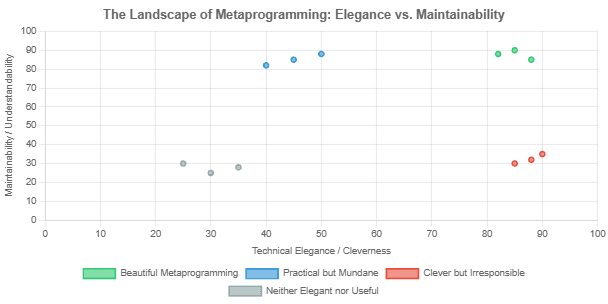
Not all metaprogramming is art. Most of it is plumbing—necessary infrastructure that makes other code work. But occasionally, metaprogramming transcends utility and becomes genuinely elegant.
The Characteristics of Beautiful Metaprogramming
It solves a real problem that can’t be solved better another way. Beautiful metaprogramming doesn’t exist to show off. It addresses genuine complexity or repetition that would otherwise plague a codebase. Serialization frameworks, ORMs, dependency injection—these justify their complexity by eliminating far more complexity elsewhere.
It’s transparent when it needs to be, invisible when it can be. The best metaprogramming feels natural. Users shouldn’t need to think about how it works. But when they do need to understand it—for debugging, extending, or optimizing—the mechanisms should be discoverable and comprehensible.
It has clear boundaries. Metaprogramming that touches everything is dangerous. Beautiful implementations have well-defined scopes. They affect specific classes, specific annotations, specific contexts. They don’t leak their magic into unrelated code.
It fails gracefully. When metaprogramming encounters unexpected inputs or situations, it should provide clear error messages and predictable fallback behavior. Cryptic reflection exceptions or silent bytecode failures are the opposite of art—they’re cruelty.
The Ethics of Clever Code
Metaprogramming amplifies the age-old tension between clever code and maintainable code. Because metaprogramming operates at a higher level of abstraction, its cleverness can be proportionally more destructive.
The Clever Code Problem
Clever code is problematic because if it’s not understandable it’s not maintainable, and debugging it takes energy that could be applied to higher value activities. This applies doubly to metaprogramming. When regular code is clever, at least you can step through it. When metaprogramming is clever, the behavior might be generated dynamically, modified at runtime, or executed through reflection—making debugging exponentially harder.
The boundary between clever and clean code is found when form and function work together, with code that is concise enough to be elegant yet clear enough to avoid confusion. For metaprogramming, this balance is even more delicate.
The Metaprogramming Responsibility Principle: The power of code that writes code comes with the responsibility to make that generation transparent, predictable, and debuggable. If your metaprogramming makes the system harder to understand than the problem it solves, it’s not clever—it’s selfish.
When Cleverness Is Justified
Sometimes cleverness is the right choice. When you’re building a framework that thousands will use, the complexity you absorb saves complexity for everyone downstream. Tools like FindBugs use ASM to analyze bytecode and locate bug patterns, while static analysis tools determine code complexity. The cleverness here serves a purpose.
But there’s a test: Can you explain it? If you can’t articulate why your metaprogramming solution is necessary, why it’s structured the way it is, and what alternatives you considered, you probably shouldn’t implement it.
Real-World Patterns
The Good: Reducing Boilerplate
Consider Project Lombok, which uses annotation processing to generate boilerplate code like getters, setters, and constructors. You annotate a class with @Data, and Lombok generates all the standard methods. This is metaprogramming as labor-saving device. It’s practical, transparent, and optional—you can always see the generated code if you need to.
The Questionable: Magic Behavior
Some frameworks use reflection to scan your entire classpath at startup, discover annotated classes, and wire them together based on conventions you might not even know exist. This works until it doesn’t. When something goes wrong, you’re debugging not just your code but the framework’s introspection logic, its dependency resolution algorithm, and its error handling—all of which is metaprogramming you didn’t write.
The Dangerous: Runtime Class Generation
Bytecode manipulation can generate entirely new classes at runtime, creating types that never existed in source code. This is incredibly powerful for implementing proxies, mocks, and dynamic implementations. It’s also a maintenance nightmare when something breaks, because the problematic code literally doesn’t exist in your codebase—it was generated during execution.
Principles for Responsible Metaprogramming
Document extensively. If you’re writing code that generates or modifies other code, explain what it does, why it does it, and how to debug when it breaks. Comments are optional for normal code; they’re mandatory for metaprogramming.
Provide escape hatches. Let users opt out of the magic. If your framework uses reflection to autowire dependencies, provide a way to wire them manually. If you’re generating code, let developers see or modify the generated output.
Make the magic debuggable. When dealing with bytecode manipulation, it’s important to take small steps, verify bytecode passes both JVM and ASM verifiers, and be aware of class loading considerations. Add logging. Provide introspection tools. Make it possible to understand what your metaprogramming is doing at runtime.
Consider the maintenance burden. Every line of metaprogramming you write is a line that future maintainers—possibly including future you—will need to understand and modify. Is the abstraction worth the cognitive overhead?
Default to boring solutions. Use the oldest, most boring, obvious approach that any beginner would understand—no magic, no frameworks, no anything requiring extra knowledge. Only reach for metaprogramming when the alternative is genuinely worse.
The Aesthetic Dimension
Beyond practical concerns, there’s something genuinely beautiful about well-executed metaprogramming. It’s the programming equivalent of recursion or fractals—patterns that reference themselves, creating layers of meaning.
When you write an annotation processor that generates code based on annotations, you’re creating a feedback loop between declaration and implementation. When you use reflection to implement a generic algorithm that works on any object structure, you’re achieving a kind of universality that feels almost mathematical.
This beauty isn’t just aesthetic—it’s intellectual. It represents a level of abstraction that compresses complexity, that finds patterns in patterns. It’s the same satisfaction a mathematician feels proving a theorem or a musician feels finding the perfect harmonic progression.
But beauty without purpose is indulgence. The art of metaprogramming lies in knowing when that intellectual elegance serves the code and when it merely serves your ego.
What We’ve Learned
Metaprogramming in Java—through reflection, annotations, and bytecode manipulation—represents a powerful set of tools that blur the line between practical engineering and creative expression. Reflection enables runtime introspection and manipulation, annotations provide declarative metadata, and bytecode manipulation allows transformation of compiled code itself.
The aesthetics of metaprogramming emerge when implementations solve real problems elegantly, remain transparent when necessary, maintain clear boundaries, and fail gracefully. Beautiful metaprogramming reduces complexity elsewhere in the codebase rather than merely showcasing technical capability.
The ethics of clever metaprogramming hinge on responsibility. Code that writes code must be understandable, debuggable, and justified by genuine need. The power to manipulate program structure comes with the obligation to make that manipulation transparent and maintainable. When cleverness obscures rather than illuminates, it crosses from art to irresponsibility.
Practical guidelines include extensive documentation, providing escape hatches, making magic debuggable, considering maintenance burden, and defaulting to simpler solutions. Metaprogramming should be the exception that justifies its complexity, not the default that impresses other developers.
Ultimately, metaprogramming is art when it transcends mere utility to achieve intellectual elegance—but only if that elegance serves the codebase and its maintainers rather than the programmer’s ego. The best metaprogramming makes the impossible possible while making the possible simple. Everything else is just showing off.