Understanding the Java Memory Model: Visibility, Ordering, and the Guarantees Most Developers Miss

Why the JMM is the invisible contract behind every concurrent Java program — and what breaks when you misread it.
Most Java developers write concurrent code by reasoning about it as if it executes exactly in the order it’s written, one visible step after another, shared across every thread instantly. That mental model is comforting, and it is not what the Java Virtual Machine actually promises. The real contract is called the Java Memory Model, formalized in JSR-133, and it’s considerably stranger and more permissive than most code assumes — right up until a race condition surfaces in production that no amount of staring at the source code explains.
Why a Memory Model Is Needed at All
Compilers reorder instructions. CPUs execute out of order and cache aggressively. Multi-core systems don’t share a single unified view of memory the instant a write happens — each core can hold its own cached copy, updated on its own schedule. All of this is legal and, for single-threaded code, invisible, because the JVM only guarantees that a single thread observes its own actions in the order it wrote them — the so-called as-if-serial rule. The moment a second thread starts reading state that the first thread is writing, all bets about ordering and visibility are off unless something in the program explicitly puts them back on.
The Java Memory Model exists to define exactly what “something” means: the precise set of actions that force a write in one thread to become visible, in the right order, to a read in another thread. Without it, “thread-safe” would be an unfalsifiable claim — there’d be no formal way to say whether a given piece of concurrent code is guaranteed to work, or merely happens to work on today’s JVM and today’s CPU.
The Core Concept: Happens-Before, Not Time
The central idea in the JMM isn’t wall-clock ordering — it’s the happens-before relationship. If action A happens-before action B, then A’s effects are guaranteed visible to B. Critically, happens-before is not the same as “happened earlier in real time.” Two actions can occur in strict chronological order and still have no happens-before relationship between them, which means the JVM is free to let the second thread observe a stale or reordered view of memory, even though, to a human watching a clock, the write clearly came first.
This is the part that breaks intuition hardest: code that looks correct, and even behaves correctly in testing, can be relying entirely on the absence of a guarantee rather than the presence of one. It works because your specific JVM, your specific CPU, and your specific load happened not to expose the reordering — not because the code is actually safe.
The Three Ways to Establish Happens-Before
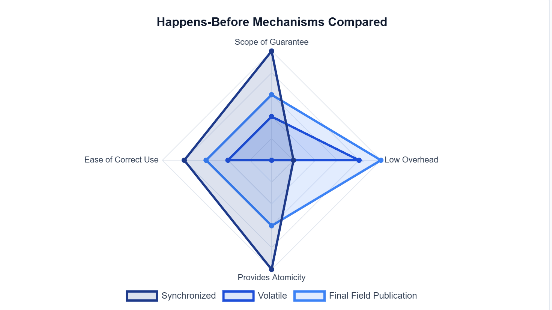
The JMM gives Java developers a small number of deliberate tools to force the relationship into existence, each with a different scope and cost.
Synchronized Blocks and Monitors
Releasing a lock happens-before any subsequent acquisition of that same lock by another thread. This is the oldest and broadest guarantee: everything a thread did before releasing the monitor becomes visible to whatever thread next acquires it, covering not just one variable but the entire set of writes made under that lock.
Volatile Fields
A write to a volatile field happens-before any subsequent read of that same field. This is narrower and cheaper than a lock — it establishes visibility and ordering for that specific field, and prevents the compiler and CPU from reordering normal reads and writes across it, without the mutual exclusion overhead of acquiring a monitor.
Final Field Safe Publication
Since JSR-133, a properly constructed object’s final fields are guaranteed visible, fully initialized, to any thread that obtains a reference to that object — provided the reference doesn’t escape the constructor before it finishes. This is what makes immutable objects safely shareable across threads without any explicit synchronization at all, as long as construction is done correctly.
| Mechanism | What it guarantees | Common mistake |
|---|---|---|
| Synchronized block/method | All writes before unlock are visible after the next lock on the same monitor | Synchronizing on different locks in reader and writer, providing no real guarantee |
| Volatile field | Visibility and ordering for that specific field only | Assuming volatile makes compound operations like increment atomic |
| Final field safe publication | Fully constructed state visible without synchronization | Letting this escape the constructor before it completes |
The Classic Break: Double-Checked Locking Before JSR-133
The textbook example of misreading the JMM is the pre-2004 double-checked locking pattern for lazy singleton initialization: check if an instance exists, and only synchronize to create it if it doesn’t, to avoid paying lock overhead on every subsequent call. It looked correct and passed most testing, and it was broken. The problem was reordering: constructing an object and assigning the reference to a field are not guaranteed to happen in that order from another thread’s point of view. A second thread could see a non-null reference to an object whose constructor hadn’t actually finished running yet, and start reading half-initialized fields.
JSR-133 fixed the practical workaround by strengthening volatile’s semantics specifically so that declaring the singleton field volatile restores the ordering guarantee needed to make double-checked locking safe again. The lesson embedded in that history is durable: a pattern that “obviously” works by inspection can be silently relying on an ordering guarantee the language never actually promised.
Visibility Is Not Atomicity — The Volatile Misconception
The single most common misreading of the JMM today is treating volatile as a general-purpose thread-safety fix. Volatile guarantees that a read sees the latest write and that surrounding operations aren’t reordered around it. It does not make compound actions atomic. A volatile counter++ is still a read, an increment, and a write — three separate steps — and two threads can interleave those steps and lose an update, even though every individual read and write is perfectly visible to the other thread. Visibility answers “will you see the latest value.” Atomicity answers “can this operation be split into observable pieces by another thread.” The JMM’s happens-before guarantees only ever address the first question.
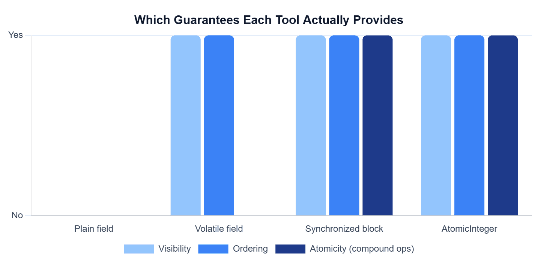
This is exactly why classes like java.util.concurrent.atomic.AtomicInteger exist: they provide genuine atomic read-modify-write operations, which is a strictly stronger guarantee than volatile alone was ever designed to offer.
A Practical Checklist Before Trusting Concurrent Code
Before assuming a piece of concurrent code is correct, check:
- Is there an actual happens-before relationship between the write and the read, or just an assumption that it “usually works”?
- If using volatile, does the code only need visibility — or does it also need atomicity for a compound operation?
- Do the reader and writer synchronize on the exact same monitor, not merely “a” lock?
- Does any object reference escape its constructor before construction fully completes?
- Would this code still be correct if the compiler or CPU reordered every instruction the JMM doesn’t explicitly forbid it from reordering?
What We Learned
The Java Memory Model isn’t a performance detail or an academic footnote — it’s the actual contract that determines whether concurrent code is guaranteed correct or merely observed to work under today’s conditions. Happens-before, not chronological time, is what determines visibility between threads, and only three mechanisms — synchronized monitors, volatile fields, and safely published final fields — are specified to establish it. The double-checked locking saga shows how easily “obviously correct” code can rely on an ordering guarantee that was never actually promised, and the volatile misconception shows how easily visibility gets confused with atomicity, which the JMM never bundles together. Reading the JMM correctly means asking, for every piece of shared state, not “does this look thread-safe” but “which specific happens-before relationship makes it so.”