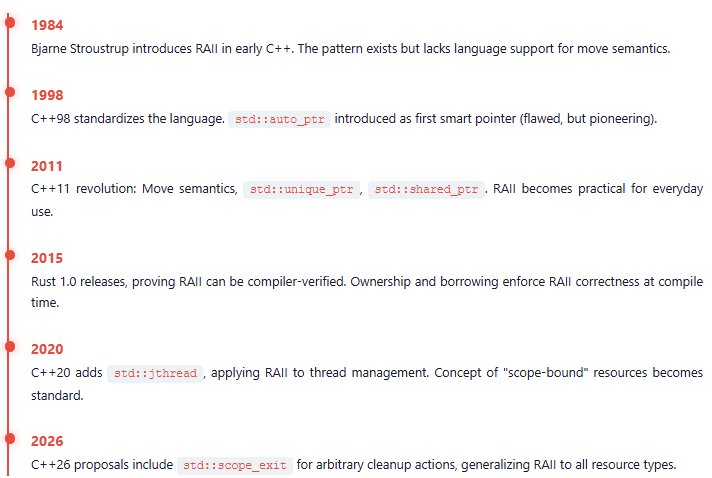
In 1984, Bjarne Stroustrup faced a problem that would define C++ for decades to come: how do you manage resources reliably in a language without garbage collection? His answer—Resource Acquisition Is Initialization (RAII)—became one of the most influential design patterns in programming history, eventually inspiring Rust’s ownership system and proving that deterministic destruction could be more powerful than automatic memory management.
Today, in 2026, RAII remains the cornerstone of modern C++. It’s the reason smart pointers work, why mutexes unlock automatically, why file handles close themselves, and why critical systems from operating systems to game engines choose C++ over garbage-collected languages. Understanding RAII isn’t just about learning C++—it’s about understanding a fundamental approach to resource management that challenges the dominance of garbage collection.
1. The Core Problem: Resources Beyond Memory
Before diving into RAII, we need to understand what it solves. When most developers think about resource management, they think about memory. Garbage collectors handle memory, so the problem is solved, right? Wrong.
Programs manage far more than memory. Consider a typical application that:
- Opens database connections (limited pool, must be released promptly)
- Locks mutexes (holding too long causes deadlocks)
- Opens file handles (operating systems limit these per process)
- Allocates GPU memory (separate from CPU memory, not tracked by GC)
- Holds network sockets (each consumes kernel resources)
- Manages hardware devices (exclusive access required)
Garbage collectors only handle memory on the heap. For everything else, you need a different strategy. Languages like Java introduced finalizers—methods called “eventually” by the garbage collector before an object is collected. This sounds reasonable until you realize the critical flaw: eventually is not good enough.

The Problem with Finalizers
- No timing guarantees
- May never run at all
- Run on unpredictable threads
- Can’t handle time-sensitive resources
- Exception handling is dangerous
The RAII Solution
- Deterministic execution
- Always runs on scope exit
- Predictable order (reverse construction)
- Perfect for time-sensitive resources
- Exception-safe by design
2. RAII Explained: The Pattern That Changes Everything
RAII is deceptively simple. Despite the confusing name (a historical artifact that even Stroustrup acknowledged was poorly chosen), the concept boils down to three ironclad rules:
- Acquire resources in constructors: When you create an object, the constructor acquires whatever resources it needs—memory, file handles, locks, whatever. If acquisition fails, the constructor throws an exception.
- Hold resources as class invariants: While the object exists, it maintains the resource. The resource’s lifetime is bound to the object’s lifetime.
- Release resources in destructors: When the object goes out of scope, its destructor is automatically called and releases the resources. This is guaranteed by the C++ language specification.
The genius lies in leveraging C++’s core language features: automatic storage duration, scope exit, and stack unwinding. The compiler guarantees destructors run. Not “probably run” or “eventually run”—they will run, in reverse order of construction, even if exceptions are thrown.
Manual Resource Management (Disaster Waiting to Happen)
void processData() {
    std::mutex m;
    m.lock();  // Acquire lock

    processFile();  // What if this throws?

    if (!validateData()) {
        return;  // Forgot to unlock!
    }

    m.unlock();  // Only unlocks if we get here
}
RAII (Automatic, Exception-Safe)
void processData() {
    std::lock_guard<std::mutex> lock(m);
    // Lock acquired automatically

    processFile();  // Exception? No problem

    if (!validateData()) {
        return;  // Lock automatically released
    }

    // Lock released here too
}
In the RAII version, there’s no way to forget to unlock the mutex. The language guarantees it happens. This isn’t just convenient—it’s the difference between correct and incorrect programs at scale.
3. The Smart Pointer Revolution
RAII’s killer application is smart pointers. Before C++11, memory management in C++ was manual and error-prone. Developers had to pair every new with a delete, leading to three catastrophic bugs:
- Memory leaks: Forgetting to delete allocated memory
- Double-free: Deleting the same memory twice
- Use-after-free: Accessing memory after it’s been deleted
Smart pointers apply RAII to memory management. std::unique_ptr, std::shared_ptr, and std::weak_ptr are RAII wrappers that acquire heap memory in their constructors and release it in their destructors. The result? Modern C++ code rarely calls new or delete explicitly.
Modern C++ Memory Management (Zero Manual Deallocation)
class GameEngine {
    // Old way: Entity* player = new Entity();  // Must remember to delete!
    // New way: Smart pointer handles everything
    std::unique_ptr<Entity> player;

    std::vector<std::shared_ptr<Texture>> textures;
    std::shared_ptr<AudioSystem> audio;

public:
    GameEngine() {
        player = std::make_unique<Entity>("Player");
        audio = std::make_shared<AudioSystem>();
    }

    // No destructor needed! Smart pointers clean up automatically
    // Even if constructor throws, partial objects are cleaned up
};
The Microsoft C++ documentation emphasizes that modern C++ achieves memory safety through design patterns rather than runtime checks. RAII eliminates entire categories of bugs at compile time, with zero runtime overhead.
4. Why Deterministic Destruction Beats Garbage Collection
The debate between garbage collection and manual memory management often misses the point. The real question isn’t which is “better”—it’s which properties your system requires. For certain classes of applications, RAII’s deterministic destruction is not just preferable but essential.
Timing Guarantees
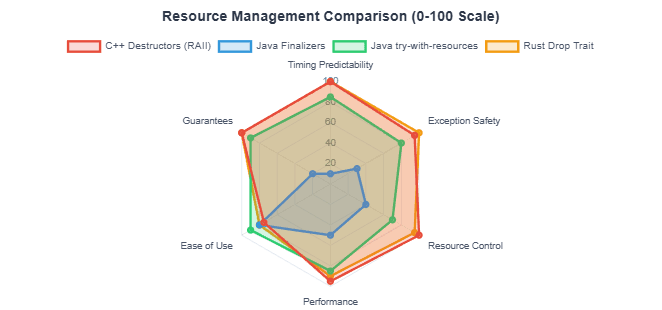
In C++, when an object goes out of scope, its destructor runs immediately—not eventually, not when memory pressure triggers collection, but right now. For a mutex, this means the lock is released the instant you no longer need it. For a file, it means the data is flushed and the handle released before the next line of code executes.
Java’s finalizers, deprecated in Java 9 and replaced with Cleaners, offer no such guarantees. The Java language specification explicitly states that finalizers may not run at all. Real-world example: a long-running GUI application died with OutOfMemoryError because thousands of graphics objects sat in the finalizer queue, waiting to be finalized, but the finalizer thread was running at lower priority than the application thread.
Exception Safety
C++ guarantees that when an exception is thrown, the stack unwinds and destructors are called in reverse order of construction. This isn’t a feature—it’s the foundation of exception-safe code in C++.
Exception Safety Through RAII
void complexOperation() {
    std::lock_guard<std::mutex> lock1(mutex1);     // Acquired
    std::unique_ptr<Data> data = loadData();       // Acquired
    std::lock_guard<std::mutex> lock2(mutex2);     // Acquired

    processData(data.get());  // If this throws...

    // Destructors run in reverse order:
    // 1. lock2 released
    // 2. data freed
    // 3. lock1 released
    // All automatic, all guaranteed
}
Try implementing equivalent exception safety in Java. You need try-with-resources for each resource, nested try-finally blocks, or careful manual unwinding. RAII makes it automatic.
Non-Memory Resources
Garbage collectors were designed to solve memory management. They weren’t designed for—and aren’t good at—managing resources that aren’t memory. Database connections, file handles, GPU memory, and hardware locks all need prompt, deterministic cleanup. RAII handles these perfectly; garbage collection requires manual intervention.
| Aspect | C++ Destructors (RAII) | Java Finalizers | Java try-with-resources |
|---|---|---|---|
| Execution Timing | Immediate on scope exit | Unpredictable, maybe never | Predictable (end of try block) |
| Order | Reverse construction order | Undefined | Reverse declaration order |
| Thread | Same thread as construction | Unpredictable GC thread | Same thread |
| Exception Safety | Automatic via stack unwinding | Dangerous (can hide exceptions) | Good (with careful coding) |
| Guarantees | Always runs (unless process crash) | May never run | Always runs (in try scope) |
| Overhead | Zero runtime cost | GC overhead + queue processing | Minimal |
5. How RAII Influenced Rust’s Drop Trait
When Mozilla designed Rust, they faced the same fundamental problem as C++: how to manage resources safely without garbage collection. Their answer? Adopt RAII’s core principles and enforce them at compile time through the ownership system.
Rust’s Drop trait is a direct descendent of C++ destructors. When a Rust value goes out of scope, its drop method is called automatically—just like C++ destructors. But Rust takes it further by making ownership explicit and checked by the compiler.
C++ RAII
class FileHandle {
    FILE* handle;

public:
    FileHandle(const char* name) {
        handle = fopen(name, "r");
        if (!handle) throw FileError();
    }

    ~FileHandle() {
        if (handle) fclose(handle);
    }

    // Prevent copying (C++11+)
    FileHandle(const FileHandle&) = delete;
    FileHandle& operator=(const FileHandle&) = delete;
};
Rust Drop Trait
struct FileHandle {
    handle: File,
}

impl Drop for FileHandle {
    fn drop(&mut self) {
        // Close happens automatically
        // Compiler enforces single ownership
    }
}

// Ownership transfer is explicit
fn use_file(handle: FileHandle) {
    // handle is moved, ownership transferred
} // drop c
The Rust documentation explicitly states: “Rust enforces RAII, so whenever an object goes out of scope, its destructor is called and its owned resources are freed.” This isn’t coincidence—it’s deliberate inheritance of C++’s most successful pattern.
The key difference? Rust’s compiler statically verifies that resources are used correctly. C++ lets you shoot yourself in the foot (you can still call delete manually, copy RAII objects incorrectly, etc.). Rust makes the mistakes compile-time errors. Both languages prove that deterministic destruction is superior to garbage collection for systems programming.
6. The Standard Library: RAII Everywhere
Modern C++’s standard library is built on RAII from the ground up. Nearly every standard library class follows the pattern:
| Category | Standard Library Classes | RAII Behavior | Benefit |
|---|---|---|---|
| Mutex Management | std::lock_guardstd::unique_lockstd::scoped_lock | Acquire locks in constructors, release in destructors | Deadlocks from forgotten unlocks become impossible |
| File Handling | std::fstreamstd::ifstreamstd::ofstream | Open files in constructors, flush and close in destructors | File handle leaks eliminated entirely |
| Memory Management | std::unique_ptrstd::shared_ptrstd::weak_ptr | Allocate memory in constructors, deallocate in destructors | Manual new/delete becomes obsolete |
| Containers | std::vectorstd::stringstd::map | Allocate storage in constructors, free in destructors | Users never think about memory management |
| Thread Management | std::thread (C++11)std::jthread (C++20) | Join or detach threads automatically in destructors | Thread leaks impossible with modern APIs |
| Scope Guards | std::scope_exit (C++26 proposal) | Execute arbitrary cleanup code on scope exit | Ultimate generalization of RAII pattern |
7. When Manual Memory Management Beats Garbage Collection
RAII enables manual memory management to be safer than garbage collection for certain use cases. This seems counterintuitive, but the data backs it up.
Real-Time Systems
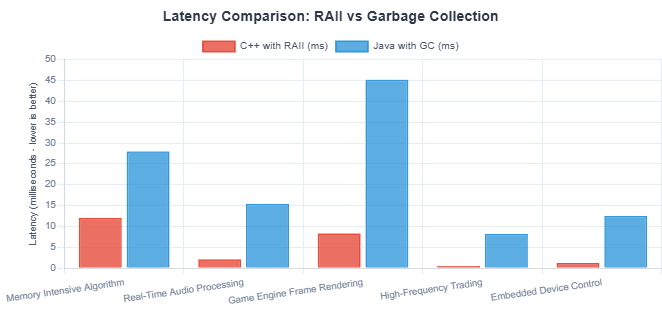
Garbage collection introduces unpredictable pauses. For systems requiring deterministic latency—game engines, audio processing, high-frequency trading, robotics—these pauses are unacceptable. A 100ms GC pause in a game engine causes visible stuttering. In a trading system, it costs money. In a medical device, it could cost lives.
RAII provides deterministic cleanup with zero runtime overhead. Memory is freed immediately when objects go out of scope, with predictable timing. No background threads. No unpredictable pauses. Perfect for real-time constraints.
Memory-Constrained Environments
Garbage collectors require overhead—typically 2-5x more memory than the actual data to operate efficiently. Embedded systems, IoT devices, and resource-constrained environments can’t afford this overhead. RAII delivers minimal memory usage with deterministic cleanup.
Performance-Critical Code
Google’s performance studies consistently show C++ outperforming garbage-collected languages by 2-10x for memory-intensive algorithms. The reason? Manual control over allocation and deallocation patterns, optimized through RAII wrappers, eliminates GC overhead while maintaining safety.
8. The Dark Side: Where RAII Gets Complex
RAII isn’t perfect. It has sharp edges that developers must understand:
Move Semantics Complexity
RAII objects often shouldn’t be copied (copying a mutex lock would create two locks to the same mutex—disaster). Before C++11, preventing copying was awkward. C++11 added move semantics, but the rules are complex. When should a class be movable but not copyable? What happens when you move from an object—is it still valid?
The Rule of Five: If you implement any of destructor, copy constructor, copy assignment, move constructor, or move assignment, you should probably implement all five. Or use
=defaultand=deleteto be explicit about your intentions. Forgetting this causes subtle bugs.
Exception Safety Requires Discipline
Destructors must never throw exceptions. If a destructor throws during stack unwinding (because another exception is being handled), the program terminates immediately. This means destructors must be written with extreme care.
Order Dependencies
Destructors run in reverse order of construction. If object A’s destructor uses object B, but B was constructed first (and thus will be destructed last), you have a problem. Managing destruction order dependencies requires careful design.
9. The Evolution: From Footgun to Foundation
10. Practical Guidelines: Using RAII Effectively
1. Prefer Standard Library RAII Wrappers
Don’t reinvent the wheel. Use std::unique_ptr instead of raw pointers. Use std::lock_guard instead of manual lock/unlock. The standard library has solved these problems correctly.
2. Make Resources Class Members
If a class owns a resource, the resource should be a member variable managed through RAII. Don’t store raw pointers or manual handles.
Good RAII Design
class Database {
    std::unique_ptr<Connection> conn;
    std::vector<std::unique_ptr<PreparedStatement>> statements;

public:
    Database(const std::string& connString) {
        conn = std::make_unique<Connection>(connString);
        // If this throws, conn's destructor runs automatically
    }

    // No manual cleanup needed - destructors handle everything
};
3. Design for Movability
Modern C++ is built around move semantics. RAII classes should generally be movable but not copyable (unless copying genuinely makes sense for your resource).
4. Never Let Exceptions Escape Destructors
Wrap all potentially-throwing destructor code in try-catch blocks. Log errors, but never let them propagate.
5. Document Lifetime Requirements
If your class depends on other objects living longer than it does, document this clearly. Better yet, redesign to eliminate the dependency.
11. What We’ve Learned
Resource Acquisition Is Initialization transformed C++ from a language where resource leaks were common into one where they’re rare. By binding resource lifetime to object lifetime and leveraging C++’s deterministic destruction guarantees, RAII eliminates entire classes of bugs that plague garbage-collected languages.
The pattern’s genius lies in leveraging core language features—automatic storage duration, scope exit, stack unwinding, and constructor/destructor pairs—to make resource management automatic and exception-safe. When implemented correctly through smart pointers and standard library wrappers, RAII enables manual memory management to be safer than garbage collection for critical systems.
Java’s finalizers demonstrated why non-deterministic cleanup fails: they may never run, run on unpredictable threads, and cannot handle time-sensitive resources. Even Java 9’s Cleaners, while better, lack the deterministic guarantees that make RAII reliable. The dispose pattern and try-with-resources in Java are essentially manual implementations of what RAII provides automatically.
Rust’s adoption of RAII through the Drop trait, combined with compile-time ownership verification, proves the pattern’s enduring value. Modern C++ (C++11 and beyond) makes RAII practical through move semantics, perfect forwarding, and a standard library built on RAII principles from the ground up. Smart pointers, lock guards, file streams, and containers all demonstrate RAII in action.
For real-time systems, embedded devices, game engines, and performance-critical applications, RAII’s deterministic destruction beats garbage collection’s unpredictable pauses. The zero-overhead principle means correct resource management costs nothing at runtime—safety without sacrifice. This is why operating systems, databases, game engines, and high-frequency trading platforms choose C++ over languages with garbage collection.