Mention “monads” to most developers and watch their eyes glaze over. The term carries baggage: intimidating mathematical jargon, abstract category theory, Haskell tutorials featuring burritos and space suits. Yet here’s the secret nobody tells you upfront: if you’ve used Java’s Optional, JavaScript’s Promises, or pretty much any modern programming language’s error handling, you’ve already been using monads. You just didn’t call them that.
Monads aren’t mystical constructs from the mathematical heavens. They’re design patterns that solve a specific, practical problem: how do you elegantly compose operations that have context or side effects? Once you see the pattern, you’ll spot it everywhere in your daily code.
1. The Pattern You Already Know
Let’s start with something familiar. Imagine you’re building a user profile system where any piece of information might be missing. Without Optional, your Java code might look like this:
// The old way: null-check hell User user = getUser(id); if (user != null) { Address address = user.getAddress(); if (address != null) { String city = address.getCity(); if (city != null) { return city.toUpperCase(); } } } return "UNKNOWN";
This nested pyramid of null checks is painful. Now watch what Optional does:
// With Optional: chain operations naturally return getUser(id) .flatMap(user -> user.getAddress()) .flatMap(address -> address.getCity()) .map(city -> city.toUpperCase()) .orElse("UNKNOWN");
Suddenly your code reads linearly. The Optional handles the “might be missing” context automatically. You just describe the transformations. This is monadic composition in action, and you probably use it without thinking about the mathematics underneath.
2. What Makes Something a Monad?
Here’s where we peek under the hood, but I promise to keep it grounded. A monad is any type that follows three simple rules and implements two basic operations. That’s it. No PhD required.
The Two Operations
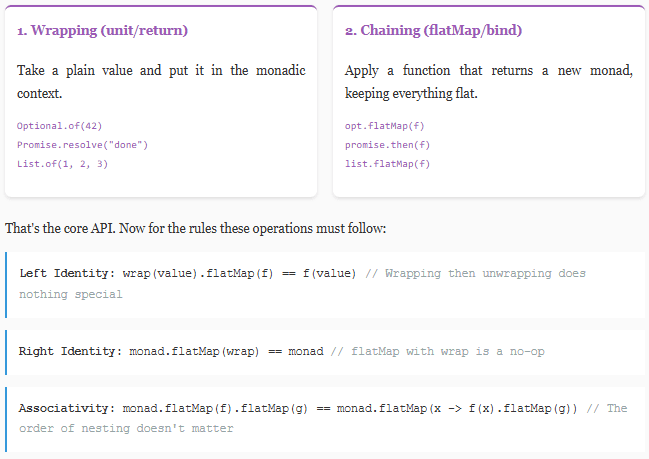
These laws ensure that your monad behaves predictably. They guarantee that composing operations works the way you’d intuitively expect. The monad laws aren’t arbitrary mathematics—they’re the requirements for safe, predictable composition.
3. Monads You Use Every Day
Now that you know what to look for, let’s spot monads in the wild. You’ll be surprised how many familiar patterns fit the definition.
| Language/Library | Monad Type | What It Handles | Wrapping | Chaining |
|---|---|---|---|---|
| Java 8+ | Optional<T> | Potential absence | Optional.of() | flatMap() |
| Java 8+ | Stream<T> | Multiple values | Stream.of() | flatMap() |
| JavaScript | Promise<T> | Async computation | Promise.resolve() | then() |
| Kotlin | Sequence<T> | Lazy evaluation | sequenceOf() | flatMap() |
| C# | IEnumerable<T> | Collection operations | Enumerable.Repeat() | SelectMany() |
| Rust | Option<T> | Potential absence | Some() | and_then() |
| Rust | Result<T,E> | Potential errors | Ok() | and_then() |
4. Why JavaScript Promises Are Monads
Let’s look at one more familiar example to cement the pattern. JavaScript Promises handle asynchronous operations. Every Promise represents a value that will exist in the future (or an error).
// Wrapping a value in a Promise const promise = Promise.resolve(42); // Chaining operations with then() promise .then(x => fetch(`/api/user/${x}`)) // returns Promise .then(response => response.json()) // returns Promise .then(user => user.name) // returns Promise .then(name => console.log(name));
Notice how then() is just flatMap by another name. Each function returns a new Promise, but you don’t get Promise<Promise<Promise<…>>>. The Promise implementation automatically flattens nested Promises. That’s the monadic behavior at work.
The Aha Moment: Monads solve the problem of nested contexts. Without flatMap, Optional<Optional<String>> would be a nightmare. Promises without then() would create callback hell. Monads keep your code flat while maintaining the context you need.
5. The Mathematical Foundation (Made Friendly)
Okay, let’s briefly touch on where this came from, because understanding the roots actually helps. Monads come from category theory, a branch of mathematics that studies abstract structure and composition.
In category theory, mathematicians noticed that many mathematical structures share a common pattern: you have objects, ways to transform between objects (morphisms), and ways to compose those transformations. Monads are a specific pattern that emerged from studying how to compose transformations that add context or effects.
The mathematician Eugenio Moggi realized in a 1991 paper that this abstract mathematical pattern perfectly describes computational effects in programming: exceptions, state, I/O, non-determinism. Philip Wadler then popularized monads in functional programming, particularly in Haskell.
5.1 Why This Matters to Practitioners
You might think “okay, interesting history, but why should I care?” Here’s why: the mathematical foundation gives us guarantees. Those three laws ensure that when you compose monadic operations, they’ll behave consistently and predictably.
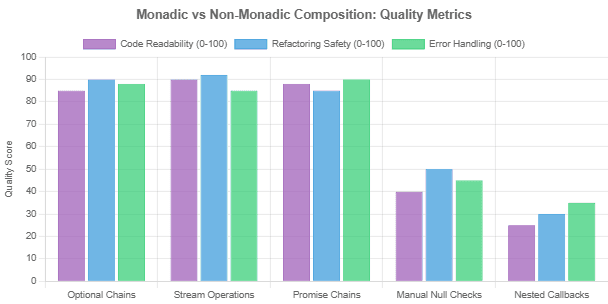
This reliability is powerful. It means library authors can build complex abstractions confident that composition will work. It means you can refactor chains of operations knowing they’ll behave equivalently. The mathematics isn’t academic decoration—it’s practical engineering guidance.
6. The Power of Composition
The real value of monads isn’t the fancy name or the mathematical pedigree. It’s composition—the ability to chain operations while handling context automatically.
// Stream monad: handling multiple values List<String> results = users.stream() .flatMap(user -> user.getOrders().stream()) .flatMap(order -> order.getItems().stream()) .map(item -> item.getName()) .filter(name -> name.startsWith("Premium")) .collect(Collectors.toList());
Each flatMap operation could produce multiple results. Without the monadic structure, you’d have nested loops and temporary collections. The Stream monad handles the “multiple values” context, letting you focus on the transformations.
This composability extends beyond simple chains. You can build complex error handling pipelines, asynchronous workflows, or data transformations by combining monadic operations. Each piece remains simple and testable, but together they handle sophisticated logic.
7. When Not to Think About Monads
Here’s a practical perspective: you don’t need to know something is a monad to use it effectively. Millions of Java developers use Optional without ever hearing the word “monad.” That’s fine. The abstraction works whether you name it or not.
However, understanding the pattern helps in three situations:
| Situation | How Monad Knowledge Helps |
|---|---|
| Learning new libraries | Recognize the pattern instantly: “Ah, this is monadic. I know how this works.” |
| Designing APIs | Build composable interfaces that follow proven patterns for predictable behavior. |
| Debugging composition | Understand why certain chains work and others don’t based on the monad laws. |
| Learning functional programming | Bridge from familiar OOP patterns to functional concepts like Haskell’s do-notation. |
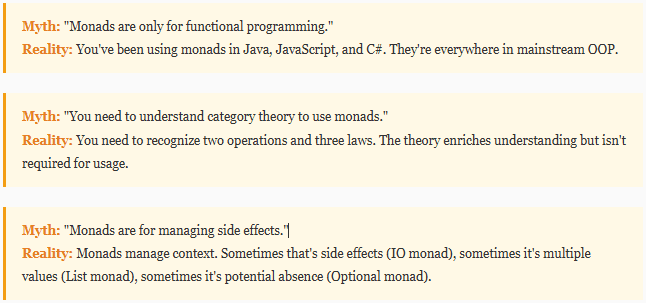
8. Common Misconceptions Cleared Up
9. The Pattern Recognition Game
Now that you know what to look for, you’ll start seeing the monadic pattern everywhere. Here’s a mental model that helps:
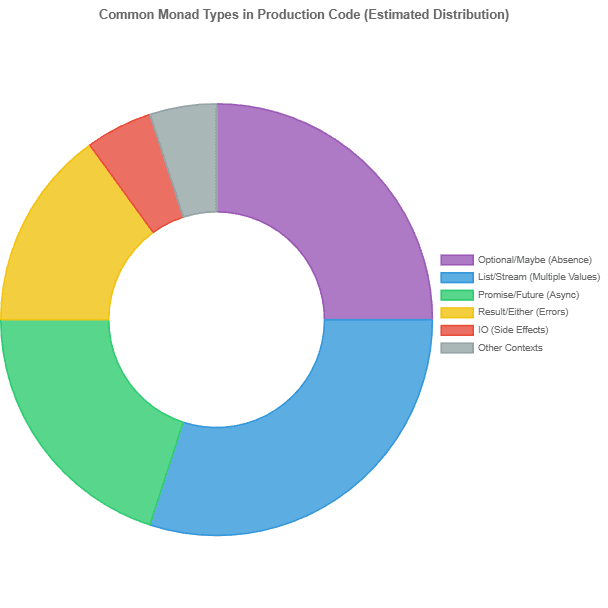
Whenever you see a type that wraps values and provides a way to chain operations while maintaining that wrapping, suspect a monad. Check if there’s a flatMap equivalent. Verify the operations feel composable. Chances are, you’ve found another monad in the wild.
9.1 Building Your Own Monad
Understanding monads also means you can build your own when the situation calls for it. Need to track logging through a chain of operations? That’s the Writer monad pattern. Need to thread configuration through multiple functions? That’s the Reader monad pattern. The pattern repeats across different contexts.
10. What We’ve Learned
Monads aren’t mystical or exclusively functional. They’re a design pattern you already use: Optional, Stream, Promise, and many other familiar types are monads. The pattern solves a specific problem—composing operations that have context—by providing two operations (wrapping and chaining) that follow three laws guaranteeing predictable behavior.
The mathematical foundation from category theory isn’t academic decoration. It provides guarantees that make composition safe and predictable. When you chain Optional.flatMap or Promise.then operations, those monad laws ensure your code behaves consistently, enabling confident refactoring and abstraction building.
You don’t need to know category theory to use monads effectively. But recognizing the pattern helps you learn new libraries faster, understand why certain APIs feel natural, and design your own composable abstractions. The term “monad” is just a name for something you’ve been doing all along—chaining operations while handling context automatically.
The real insight is about composition: monads let you write code that reads linearly while handling complexity behind the scenes. Whether that complexity is potential absence, multiple values, asynchronous execution, or error handling, the monadic pattern provides a consistent, proven approach. Once you see it, you realize that good API design often converges on these same principles, whether the designers knew about category theory or not.