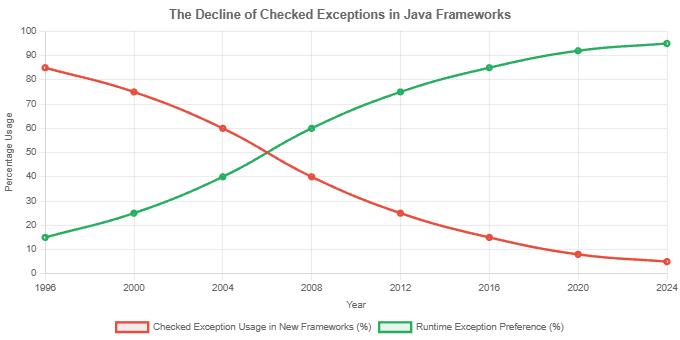
In 1996, Java introduced a bold experiment: checked exceptions. The compiler would force developers to handle errors, making software more reliable. Twenty years later, every major framework has abandoned them, every new JVM language rejected them, and even Java 8’s Stream API quietly ignores them. This is the story of a good idea that didn’t work.
Java is the only mainstream programming language with checked exceptions. C# explicitly rejected them. Kotlin pretends they don’t exist. Scala treats them as an implementation detail. Even within Java’s ecosystem, the trend is unmistakable: Spring wraps any checked exception to make it unchecked, Hibernate changed from checked to unchecked with a key committer saying they “threw their hands up and said sorry”, and modern frameworks universally avoid them.
The question isn’t whether checked exceptions failed—it’s why, and what we learned.
1. The Original Vision
To understand why checked exceptions seemed like a good idea, we need to go back to the problems James Gosling was trying to solve. In C and C++, error handling was a mess. Functions returned error codes that developers routinely ignored. Gosling described the traditional C problem: failing to check if a file exists before reading it, receiving a -1 error code stored in a file descriptor variable, then happily calling read operations that silently fail because the file was never opened.
This wasn’t just sloppy programming—it was the path of least resistance. Checking every return value added clutter. Error codes weren’t standardized between libraries. The compiler couldn’t help because error codes were just integers.
Java’s solution seemed elegant: Any exception that can be thrown by a method is part of the method’s public programming interface, and those who call a method must know about the exceptions it can throw so they can decide what to do about them. The compiler would enforce this contract. No more ignored errors. No more silent failures.
1.1 The Theory Behind the Design
Early recommendations urged using checked exceptions wherever possible to maximize compiler assistance in producing error-free software, with Java library designers subscribing heavily to this philosophy. The distinction was clear: if a client can reasonably recover from an exception, make it checked. If not, make it a runtime exception.
In theory, this forced developers to think about error handling during design rather than as an afterthought. Method signatures would document exceptional conditions. The type system would prevent errors from being silently swallowed.
In practice, it created a different set of problems.
2. Why It Didn’t Work
2.1 The Recoverability Myth
The fundamental assumption behind checked exceptions—that many exceptions are recoverable—turned out to be false for most real-world applications. The biggest argument against checked exceptions is that most exceptions can’t be fixed because we don’t own the code or subsystem that broke, can’t see the implementation, aren’t responsible for it, and can’t fix it.
Consider SQLException. What can you do when the database goes down? Retry a few times? Log and alert? Eventually, you’re going to fail the user’s request. The same applies to RemoteException in RMI, IOException after a connection is established, and dozens of other checked exceptions in the standard library.
An I/O failure is serious but extremely rare, yet Java programmers found themselves forced to provide for IOException and similar unrecoverable events in simple library method calls, adding clutter to code with little that could be done in catch blocks to help.
| Exception Type | When Recoverable | Typical Reality |
|---|---|---|
| IOException | File not found at startup | Network/disk failure mid-operation (unrecoverable) |
| SQLException | Duplicate key, handle gracefully | Connection lost, transaction failed (fatal) |
| RemoteException | Temporary network glitch | Service down, can’t complete request (fatal) |
| ParseException | User input validation | Malformed data from external system (fatal) |
2.2 The Exception Wrapping Anti-Pattern
When you can’t handle an exception but the compiler forces you to, you have two bad choices. You can catch and rethrow it as a runtime exception, or you can add it to your method’s throws clause.
The wrapping approach became ubiquitous. Exception chaining is a common approach with many popular frameworks like Spring or Hibernate, where both frameworks moved from checked to unchecked exceptions and wrap checked exceptions that are not part of the framework in their own runtime exceptions. This pattern is so common it has a name: exception translation.
But wrapping solves nothing. You’ve just converted a checked exception to an unchecked one, negating the entire point of checked exceptions. The exception is still fatal. You still can’t recover. You’ve just added boilerplate.
The Wrapping Paradox: Many developers were told to catch low-level exceptions and rethrow them as higher application-level checked exceptions, requiring vast numbers—2000 per project upwards—of non-functional catch-throw blocks. If your solution to checked exceptions is to systematically convert them to unchecked exceptions, the feature has failed.
2.3 The Propagation Problem
The alternative—adding throws IOException to your method signature—has its own issues. Now every method in the call chain must either handle or declare the exception. This exposes implementation details.
If your service layer calls a repository that uses JDBC, suddenly your service methods throw SQLException. Change the repository to use a REST API, and now they throw IOException. Your method signatures leak details about layers below them, violating encapsulation.
Worse, this forces binary compatibility problems. Add a new checked exception to a public method, and you’ve broken every caller. Libraries become locked into their exception contracts, unable to evolve without breaking changes.
3. How Frameworks Responded
3.1 Spring’s Unchecked Revolution
Spring catches SQLException and RemoteException—exceptions so serious you usually can’t recover—then rethrows them as subclasses of RuntimeException, letting you catch them if you want or ignore them, providing freedom to write code without worrying about exceptions you can’t gracefully deal with.
Spring’s DataAccessException hierarchy translates all database-specific checked exceptions into a consistent set of unchecked exceptions. This abstracts away the underlying database implementation while acknowledging that most database errors are fatal to the current operation.
3.2 Hibernate’s Apology
Until Hibernate 3.x, all exceptions were checked, forcing developers to catch and handle exceptions, but it soon became clear this didn’t make sense because all exceptions thrown by Hibernate are fatal—in many cases the best a developer can do is clean up, display an error message, and exit.
The Hibernate team’s change from checked to unchecked exceptions wasn’t just a technical decision—it was an admission that the checked exception model didn’t match reality. Fatal errors shouldn’t require handling at every layer.
| Framework | Early Approach | Current Approach | Rationale |
|---|---|---|---|
| Spring Framework | N/A (launched with unchecked) | DataAccessException (unchecked) | Database errors are rarely recoverable |
| Hibernate | Checked exceptions (pre-3.0) | HibernateException (unchecked) | “All exceptions are fatal” |
| Java EE/Jakarta EE | Heavy use of checked exceptions | Moving away from checked | Industry consensus shift |
| Java 8 Streams | N/A | No checked exception support | Incompatible with functional style |
4. The Lambda Problem
Java 8’s functional programming features exposed a fatal flaw in checked exceptions: they don’t compose. Java 8 no longer embraces checked exceptions in the new Streams API because they are incompatible with the functional style of coding.
Functional interfaces can’t throw checked exceptions. Function<T, R> can’t throw anything. This means you can’t use method references or lambdas that throw checked exceptions without wrapping them. The ergonomics are terrible, forcing developers into contortions with try-catch blocks inside lambdas.
The Java team faced a choice: retrofit checked exceptions into the functional interfaces or abandon them. They chose abandonment, tacitly admitting that checked exceptions and modern Java don’t mix.
5. What Other Languages Did
5.1 C#: Explicit Rejection
Anders Hejlsberg, creator of C#, explicitly rejected checked exceptions despite learning from Java. His reasoning: the versionability problem is unsolvable. You can’t add new checked exceptions to existing methods without breaking callers, and you can’t know at design time which exceptions might be added later.
5.2 Kotlin, Scala, Groovy: JVM Without the Pain
JVM languages such as Groovy, Scala, and Kotlin have all rejected the idea of checked exceptions, with modern Java frameworks following suit. These languages run on the JVM, they interoperate with Java libraries, but they treat all exceptions as unchecked.
Interestingly, this works fine. Kotlin code calls Java code that throws IOException, and Kotlin simply doesn’t enforce handling. The JVM doesn’t care—checked exceptions are purely a compiler fiction.
6. Modern Alternatives
6.1 Sealed Types and Result Types
Java 17’s sealed classes combined with pattern matching offer a better solution for errors that truly need handling. A method returning a sealed Result type explicitly documents that it might fail and forces callers to handle failure, with pattern matching ensuring exhaustive handling through the type system rather than compiler warnings.
Instead of throwing ParseException, return Result<Data, Error> where Result is a sealed interface with Success and Failure implementations. Pattern matching ensures you handle both cases. The compiler catches missing cases at compile time, but through exhaustiveness checking rather than checked exception mechanics.
6.2 The Result Pattern in Practice
Error handling patterns improve significantly with sealed Result types that explicitly model success and failure—rather than relying on exceptions for control flow or returning null, Result types make both cases explicit in the type system with exhaustive pattern matching enforcement.
This approach has advantages checked exceptions never achieved: it’s compositional (Result types can be mapped and flatMapped), it’s explicit (the return type shows failure is possible), and it doesn’t suffer from binary compatibility problems (changing error types doesn’t break callers who pattern match on Result).
7. Lessons Learned
7.1 Type Systems Aren’t Magic
Checked exceptions attempted to use the type system to enforce error handling. But type systems can’t enforce good judgment. They can’t know which exceptions are recoverable. They can’t predict which errors matter to your application.
The result was mechanical compliance without understanding. Developers added throws Exception or wrapped everything in RuntimeException, satisfying the compiler while defeating the feature’s purpose.
7.2 Language Features Need Evolution Paths
Checked exceptions created a compatibility trap. Once a public API declares checked exceptions, it can never remove them without breaking callers. This locked libraries into exception contracts that turned out to be wrong.
Modern language features like sealed types learned this lesson. They’re designed to be compositional and evolvable, allowing refinement without breaking existing code.
7.3 Theory Meets Practice
Checked exceptions looked great in academic papers and small examples. The theory was sound: making errors explicit should improve reliability. But theory didn’t account for the reality that most exceptions are fatal, that deep call stacks make exception propagation painful, or that functional programming would become mainstream.
Leading Java frameworks and influences have definitively moved away from checked exceptions, with Spring, Hibernate and modern frameworks using only runtime exceptions, acknowledging this convenience as a major factor in their popularity.
8. What We’ve Learned
Java’s checked exceptions represent one of the most significant failed experiments in programming language design. The intention was noble: use the type system to prevent ignored errors and improve software reliability. The execution revealed fundamental mismatches between theory and practice.
The core problem was the recoverability assumption. Most checked exceptions in the Java standard library—IOException, SQLException, RemoteException—represent fatal errors where recovery is impossible. Forcing developers to acknowledge these exceptions at every layer created massive boilerplate without improving reliability. The result was systematic exception wrapping and the proliferation of catch blocks that couldn’t meaningfully handle errors.
The industry response was decisive. Every major Java framework—Spring, Hibernate, and others—moved away from checked exceptions. Every new JVM language—Kotlin, Scala, Groovy—rejected them entirely. Even Java itself abandoned them in Java 8’s Streams API, acknowledging their incompatibility with functional programming.
Modern alternatives exist. Sealed types with pattern matching provide compile-time exhaustiveness checking without the composition and evolution problems that plague checked exceptions. Result types make success and failure explicit in return types rather than forcing error handling through compiler warnings. These approaches preserve the good parts—making errors visible and handling mandatory—while avoiding the bad parts—binary compatibility traps and false recoverability assumptions.
The lesson extends beyond Java. Type systems are powerful tools, but they can’t encode every important property of a program. Features that look elegant in small examples may not scale to real codebases. And sometimes, the best approach is to admit a feature didn’t work and learn from the failure rather than doubling down on a mistake.