
This post provides a simple example of a HTML form validation. It is based on the Spring MVC With Annotations example. The code is available on GitHub in the Spring-MVC-Form-Validation directory.
Data
For this example we will use a bean and JSR303 validation annotations:
public class MyUser {

    @NotNull
    @Size(min=1,max=20)
    private String name;

    @Min(0)
    @Max(120)
    private int age;

    public MyUser(String name, int age) {
        this.name = name;
        this.age = age;
    }

    public MyUser() {
        name = '';
        age = 0;
    }

    // Setters & Getters

}
Pages
Our form will contain input elements, but also the possibility to display error messages:
<%@page contentType='text/html' pageEncoding='UTF-8'%>
<%@ taglib prefix='form' uri='http://www.springframework.org/tags/form' %>
<!doctype html>
<html>
<head>
  <meta http-equiv='Content-Type' content='text/html; charset=UTF-8'>
  <title>My User Form!</title>
</head>
<body>
  <form:form method='post' action='myForm' commandName='myUser'>
    <table>
      <tr>
        <td>Name: <font color='red'><form:errors path='name' /></font></td>
      </tr>
      <tr>
        <td><form:input path='name' /></td>
      </tr>
      <tr>
        <td>Age: <font color='red'><form:errors path='age' /></font></td>
      </tr>
      <tr>
        <td><form:input path='age' /></td>
      </tr>
      <tr>
        <td><input type='submit' value='Submit' /></td>
      </tr>
    </table>
  </form:form>
</body>
</html>
Our success page is:
<%@page contentType='text/html' pageEncoding='UTF-8'%>
<%@taglib prefix='form' uri='http://www.springframework.org/tags/form'%>
<%@ taglib prefix='c' uri='http://java.sun.com/jsp/jstl/core' %>
<!doctype html>
<html>
<head>
  <meta http-equiv='Content-Type' content='text/html; charset=UTF-8'>
  <title>Form Processed Successfully!</title>
</head>
<body>
    Form processed for <c:out value='${myUser.name}' /> ! <br />
    <a href='<c:url value='/'/>'>Home</a>
</body>
</html>
Our home page:
<%@page contentType='text/html' pageEncoding='UTF-8'%>
<%@ taglib prefix='c' uri='http://java.sun.com/jsp/jstl/core' %>
<!doctype html>
<html lang='en'>
<head>
  <meta charset='utf-8'>
  <title>Welcome !!!</title>
</head>
<body>
  <h1>
    Spring Form Validation !!!
  </h1>
<a href='<c:url value='/myForm'/>'>Go to the form!</a>
</body>
</html>
Controller
Notice that we need to use
@ModelAttribute to make sure an instance of
MyUser is always available in the model. In the
validateForm(), we need to use
@ModelAttribute to move the content of the form to the
MyUser project.
@Controller
public class MyController {

    @RequestMapping(value = '/')
    public String home() {
        return 'index';
    }

    @ModelAttribute('myUser')
    public MyUser getLoginForm() {
        return new MyUser();
    }

    @RequestMapping(value = '/myForm', method = RequestMethod.GET)
    public String showForm(Map model) {
        return 'myForm';
    }

    @RequestMapping(value = '/myForm', method = RequestMethod.POST)
    public String validateForm(
        @ModelAttribute('myUser') @Valid MyUser myUser,
        BindingResult result, Map model) {

        if (result.hasErrors()) {
            return 'myForm';
        }

        model.put('myUser', myUser);

        return 'success';

    }

}
Maven Dependencies
We need the following dependencies. The Hibernate validator dependency is necessary to process JSR303 annotations:
<dependency>
  <groupId>javax.validation</groupId>
  <artifactId>validation-api</artifactId>
  <version>1.0.0.GA</version>
  <type>jar</type>
</dependency>

<dependency>
  <groupId>org.hibernate</groupId>
  <artifactId>hibernate-validator</artifactId>
  <version>4.3.0.Final</version>
</dependency>
Running The Example
Once compiled, the example can be run with
mvn tomcat:run. Then, browse:
http://localhost:8383//spring-mvc-form-validation/.
If the end user enters invalid values, error messages will be displayed:
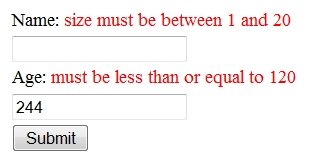
Reference: Spring MVC Form Validation (With Annotations) from our JCG partner Jerome Versrynge at the Technical Notes blog.







It really helped me. I was stuck with a problem and your code helped me to resolve it. Main thing is that your code is lucid and very helpful for biginners like me.
Thanks!